

On this page
Every hypermetropia numerical uses one idea. Once you see it, the working fits in a few lines.
What does a lens for hypermetropia actually do?
NCERT's Class 10 chapter on the human eye defines the near point as the minimum distance at which objects can be seen most distinctly without strain. It puts this at about 25 cm for a young adult with normal vision. In hypermetropia, the same chapter says, the near point is farther away than 25 cm, because the focal length of the eye lens is too long or the eyeball has become too small. The fix is a convex lens of appropriate power.
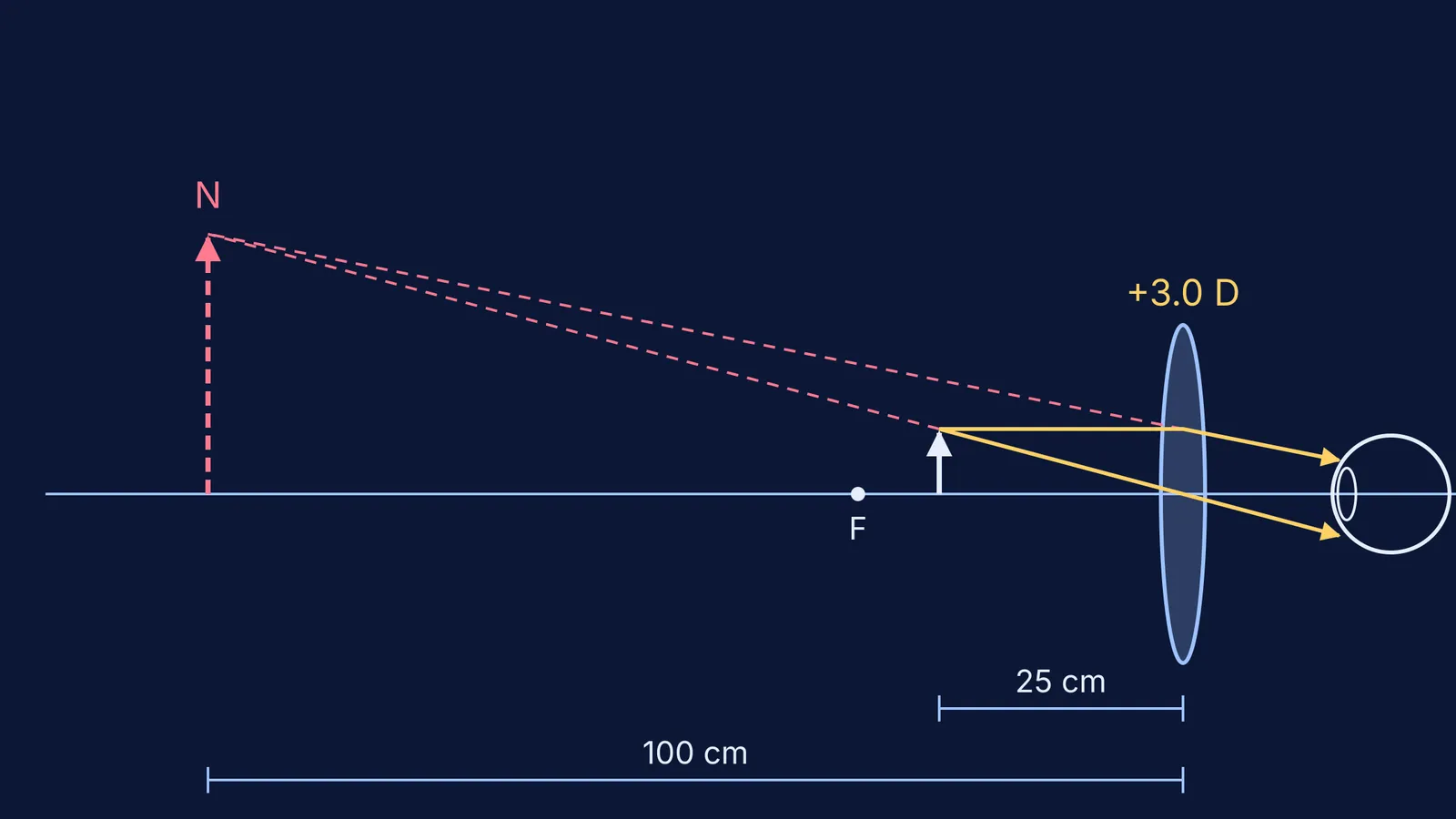
So the spectacle lens must take a book at 25 cm and form an image of it at the person's own near point, N, on the same side as the book. That image is virtual and upright, and the eye focuses on it instead of the book.
How do you find the power of the lens, step by step?
Use the lens formula 1/v − 1/u = 1/f with the New Cartesian sign convention from NCERT's light chapter, where distances measured from the lens towards the incoming light are negative. The same chapter defines the power of a lens as P = 1/f, measured in dioptres (D) when f is in metres. A convex lens has positive power.
Exercise 7 in the human eye chapter gives a hypermetropic near point of 1 m and asks for the lens power, taking the normal near point as 25 cm. Here is the full working:
Write the data with signs: u = −25 cm (the book) and v = −100 cm (the virtual image at the near point).
Substitute: 1/f = 1/v − 1/u = 1/(−100) − 1/(−25) = −1/100 + 4/100 = 3/100.
So f = +100/3 cm = +33.3 cm = +0.333 m.
Power: P = 1/f = 1/(0.333 m) = +3.0 D.
Check the sign: positive means converging, which matches NCERT's rule that hypermetropia needs a convex lens.
If the sign convention is where your answers usually go wrong, the Fermi Problem Library has worked problems with a step-by-step solver that explains the reasoning rather than printing an answer.
Is there a shortcut formula for the near point?
Put u = −0.25 m and v = −N (in metres) into the lens formula and it shrinks to P = 4 − 1/N dioptres. The same relation, written as P ≈ 1/D − 1/NP, appears in Wikipedia's article on the near point. Some values to check against your own working:
N = 50 cm: P = 4 − 2 = +2.0 D
N = 75 cm: P = 4 − 1.33 = +2.67 D
N = 1 m: P = 4 − 1 = +3.0 D
N = 2 m: P = 4 − 0.5 = +3.5 D
As the near point moves farther away, the power climbs towards +4 D but never passes it, because +4 D sends an object at 25 cm all the way to infinity.
The shortcut also runs backwards. Suppose a hypermetropic eye is corrected by a +1.5 D lens. Assuming a 25 cm reading distance, 1.5 = 4 − 1/N gives N = 0.4 m, a near point of 40 cm. Use the shortcut to check answers; in the exam, write out the signs and substitution.
Where do students lose marks on this question?
The 25 cm value and lens choices below follow NCERT's human eye chapter; the eye-test note at the end draws on Wikipedia's near point article.
Swapping u and v. The book at 25 cm is the object; the near point is where the image goes.
Making v positive. The image is virtual and on the object's side, so v is negative.
Leaving f in centimetres. P = 1/f gives dioptres only when f is in metres.
Getting a negative power and writing "convex" anyway. A negative answer means a sign slipped.
Mixing it up with myopia, which needs a concave lens and uses the far point, with the object at infinity.
For both defects side by side, read our guide to the human eye and its defects. If you check homework with a chatbot, see making AI check signs in mirror and lens numericals and asking AI which lens corrects which defect. If the ray picture itself is the gap, the Fermi Concept Library gives every physics concept its own lesson and its place in the map.
Try Exercise 7 again with a near point of 80 cm before you check: you should get +2.75 D.


