

On this page
Mirror and lens numericals often go wrong at the first substitution, when one minus sign goes missing. An AI chatbot can make the same slip, and its neat layout hides it. The fix: make the AI state its signs before it solves, then check its image against a ray sketch you draw yourself.
What sign convention should the AI state before solving?
Class 10 uses the New Cartesian Sign Convention (NCERT Science Class 10, Chapter 9). Its rules for spherical mirrors:
The object is always placed to the left of the mirror, so light falls on the mirror from the left.
All distances parallel to the principal axis are measured from the pole of the mirror.
Distances to the right of the pole are positive; distances to the left are negative.
Heights above the principal axis are positive; heights below it are negative.
For lenses, distances are measured from the optical centre; a convex lens has positive f and a concave lens negative f. The mirror formula is 1/v + 1/u = 1/f, with magnification m = −v/u. The lens formula is 1/v − 1/u = 1/f, with magnification m = v/u. A negative magnification means a real image; a positive one means a virtual image. For the reasoning behind each sign, see our explainer on the mirror formula and New Cartesian signs.
How do you ask AI to check the sign convention in a numerical?
Paste the question, then send this before the AI solves:
"Before solving, state the sign convention you will use and where the origin is."
"List u, f (or R) and any heights with their signs, with a one-line reason for each sign."
"Name the formula you will use, mirror or lens, and the magnification formula that goes with it."
"Stop there. I will check your signs before you substitute."
Check its list against the rules. Then say: "Now solve, and say whether the image is real or virtual, erect or inverted."
Worked example: where does a flipped sign hide?
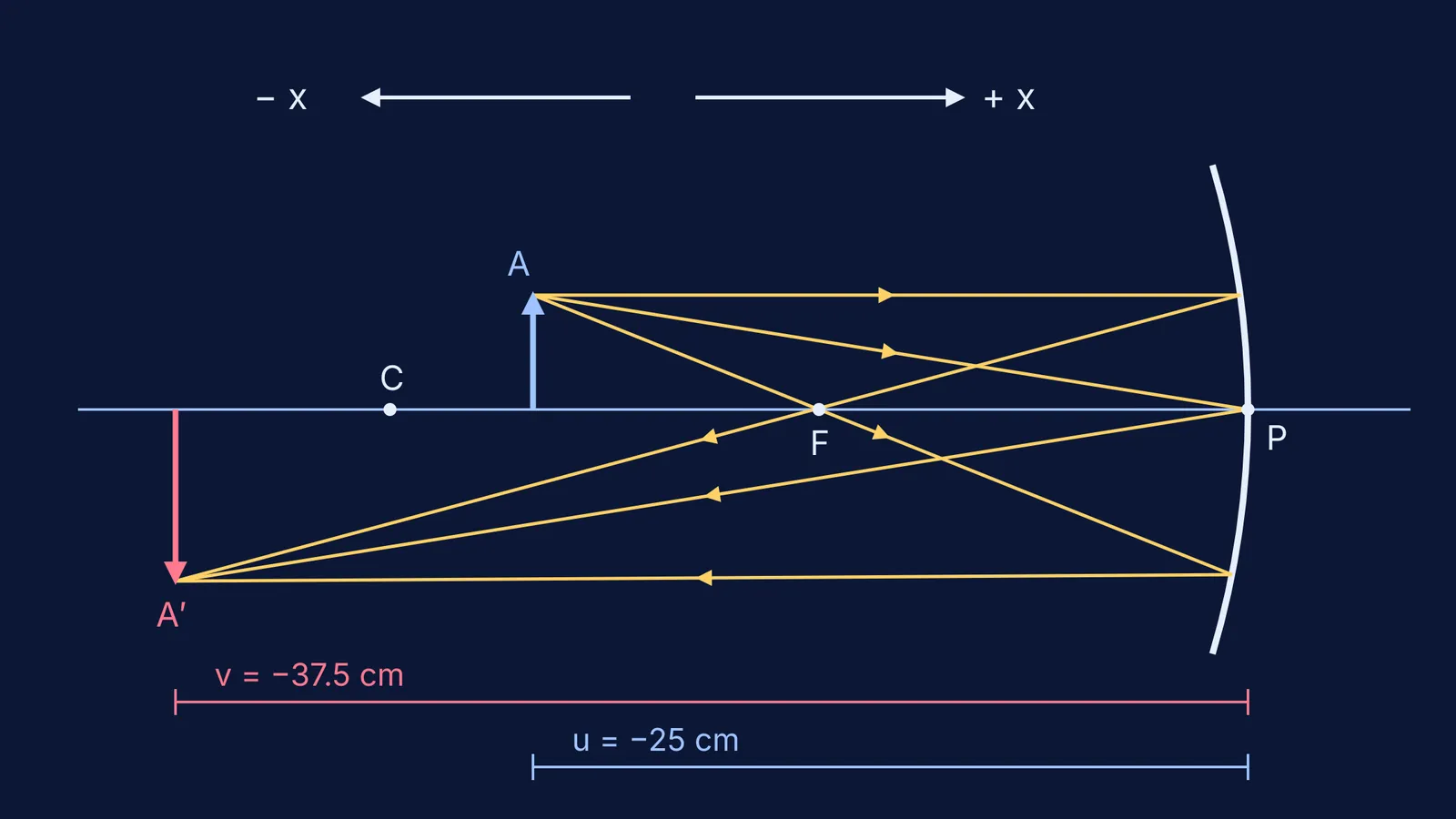
NCERT's Example 9.2 places a 4.0 cm object 25.0 cm in front of a concave mirror of focal length 15.0 cm and asks where the screen should go (NCERT Chapter 9). The signs are u = −25.0 cm and f = −15.0 cm, because a concave mirror's focus is in front of it, on the left. Then 1/v = −1/15 + 1/25 = −2/75, so v = −37.5 cm, and m = −v/u = −1.5: a real, inverted, enlarged image 37.5 cm in front of the mirror, as NCERT finds.
Now suppose the AI writes f = +15 cm. Then 1/v = 1/15 + 1/25 = 8/75, so v = +9.4 cm and m = +0.375: a small, erect, virtual image behind the mirror. Every line after the first is correct arithmetic, which is why the slip is easy to miss.
What should your ray sketch show before you trust v?
Mark P, then F at 15 cm and C at 30 cm (R = 2f). The object at 25 cm sits between F and C. Draw one ray parallel to the axis that reflects through F, and one through F that reflects parallel. They cross below the axis, beyond C. NCERT's Figure 9.7(d) draws this case: the image forms beyond C, inverted and larger than the object (NCERT Chapter 9).
So v must be negative and beyond 30 cm, with m below −1. v = −37.5 cm passes; v = +9.4 cm fails. Use this checklist on any answer:
Does the sign of v match the side where your rays cross?
Is the size of v roughly where your sketch puts the image?
Is m negative for a real, inverted image and positive for a virtual, erect one?
Is the size of m above 1 for enlarged, below 1 for diminished?
If they disagree, say so: "Your v puts the image behind the mirror, but my sketch puts it in front, beyond C. Recheck the sign of f." When the sketch itself is the problem, see our guide to AI feedback on ray diagram errors. Fermi's AI tutor draws the figure and checks understanding as it goes, so you can ask for the rays and the numbers side by side.
Does the same check work for lenses?
Yes, with one change: light passes through a lens, so a real image lands on the right and its v is positive. Do not carry the mirror habit of "real means negative v" into lens questions. NCERT's Example 9.3 has a concave lens with f = −15 cm forming an image at v = −10 cm; the lens formula gives u = −30 cm and m = +1/3, an erect, virtual image one-third the size (NCERT Chapter 9), which matches a sketch on the object's side. To watch the image move with the object, try our walk-through of lens image formation with a simulation, or the interactive simulations in the Fermi Simulation Lab.
Tonight, pick one NCERT mirror question, send the four-line prompt, and sketch before you read the answer.


