

On this page
When calculating the position of an image using the mirror formula, a single misplaced minus sign will give you an impossible answer. In the CBSE Class 10 Science curriculum, the Natural Phenomena unit carries 12 marks, making optics numericals a high-stakes section where strict adherence to sign rules is vital.
To solve these problems reliably, physicists use the New Cartesian Sign Convention. It applies a standard coordinate geometry framework to spherical mirrors, ensuring that formulas work universally for both concave and convex surfaces.
What is the new Cartesian sign convention for spherical mirrors?
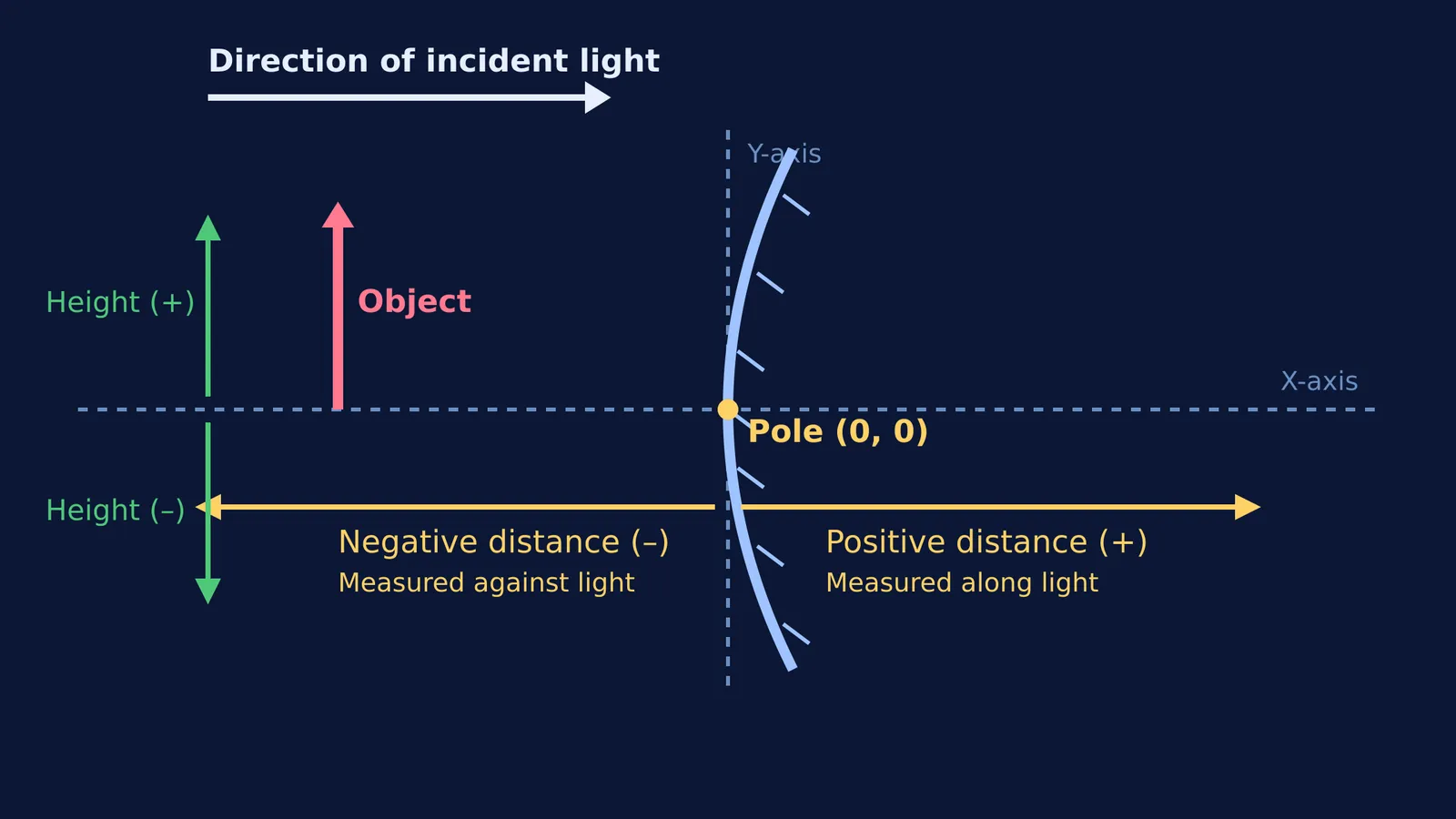
The convention maps the physical setup of a mirror onto an X-Y graph. The mirror's pole (the centre of the reflecting surface) acts as the origin (0, 0). The principal axis acts as the X-axis.
From there, the rules are straightforward:
Light travels from left to right: The object is always placed on the left side of the mirror, meaning incident light travels in the positive X direction.
Distances are measured from the pole: The origin is the starting point for every horizontal measurement.
Along the light is positive, against the light is negative: If you measure from the pole to the right (along the direction of incident light), the distance is positive (+). If you measure to the left (against the incident light), the distance is negative (–).
Upwards is positive, downwards is negative: Heights measured above the principal axis are positive (+), while those below are negative (–).
This systematic approach prevents the confusion of memorising different formulas for different mirrors. This framework assumes the use of paraxial rays; rays striking too far from the pole cause spherical aberration, complicating the simple geometry.
Why is the object distance (u) always negative?
In standard optics problems, the object is placed in front of the mirror to reflect light into it. By convention, we always draw the object on the left.
Since incident light travels from the object to the mirror (left to right), and all distances must be measured starting from the pole, you have to move to the left to measure the object's position. Because you are measuring against the direction of the incident light, the object distance (u) is always negative for a real object.
The only exception is when dealing with a virtual object in lens problems, where the incoming rays are converging toward a point behind the optic, making u positive.
If you are struggling to visualise how this works across different mirror types, the Fermi Concept Library contains a lesson for every concept in physics, helping you see why the signs flip.
How to apply the sign convention to the mirror formula?
The mirror formula is written as 1/f = 1/v + 1/u.
Before plugging any numbers into this equation, you must assign the correct signs based on the New Cartesian rules.
Object distance (u): Always negative (–).
Focal length (f): Negative (–) for a concave mirror because the focus is in front. Positive (+) for a convex mirror because the focus is behind.
Radius of curvature (R): Follows the same sign as the focal length.
Image distance (v): Negative (–) if the image is real (formed in front of the mirror). Positive (+) if the image is virtual (formed behind the mirror).
Heights (h and h'): Object height is positive (+). Real images are inverted and thus have a negative (–) height. Virtual images are erect and have a positive (+) height.
What are common mistakes to avoid in ray optics numericals?
When applying the sign convention in an exam setting, students often make predictable errors.
Memorising signs instead of the rule is a common trap. Do not just memorise that "concave means negative". While the focal length of a concave mirror is negative, a concave mirror can produce a virtual image behind the mirror, which gives a positive image distance (v). Always measure from the pole to find the sign.
Dropping the sign of the unknown variable is another frequent error. When you set up your equation, do not guess the sign of the value you are trying to calculate. Leave the unknown variable (like v) without a sign. The maths will output a positive or negative number, which then tells you whether the image is virtual or real.
Finally, students often misinterpret magnification. Magnification (m) is the ratio of image height to object height (m = h'/h). For mirrors, it is also calculated as m = -v/u. If the magnification is negative, the image is real and inverted. If it is positive, the image is virtual and erect.
If you keep losing a minus sign mid-calculation, Fermi's AI tutor notices where you are stuck and explains the reasoning. You can practice these derivations in the Fermi Problem Library, which features worked problems with a step-by-step solver that explains the reasoning rather than just printing an answer.


