

On this page
When you draw a basic ray diagram for a lens or a mirror, you assume parallel light rays meet at a single focal point. In reality, a standard spherical surface cannot do this. Rays hitting the edge of the glass do not cross the axis at the same place as rays near the middle.
This failure to find a common focus is spherical aberration. It makes cheap lenses produce blurry photographs and why early telescopes struggled to get sharp views.
What are paraxial and marginal rays?
Physicists split incoming light into two categories based on where it strikes the optical element.
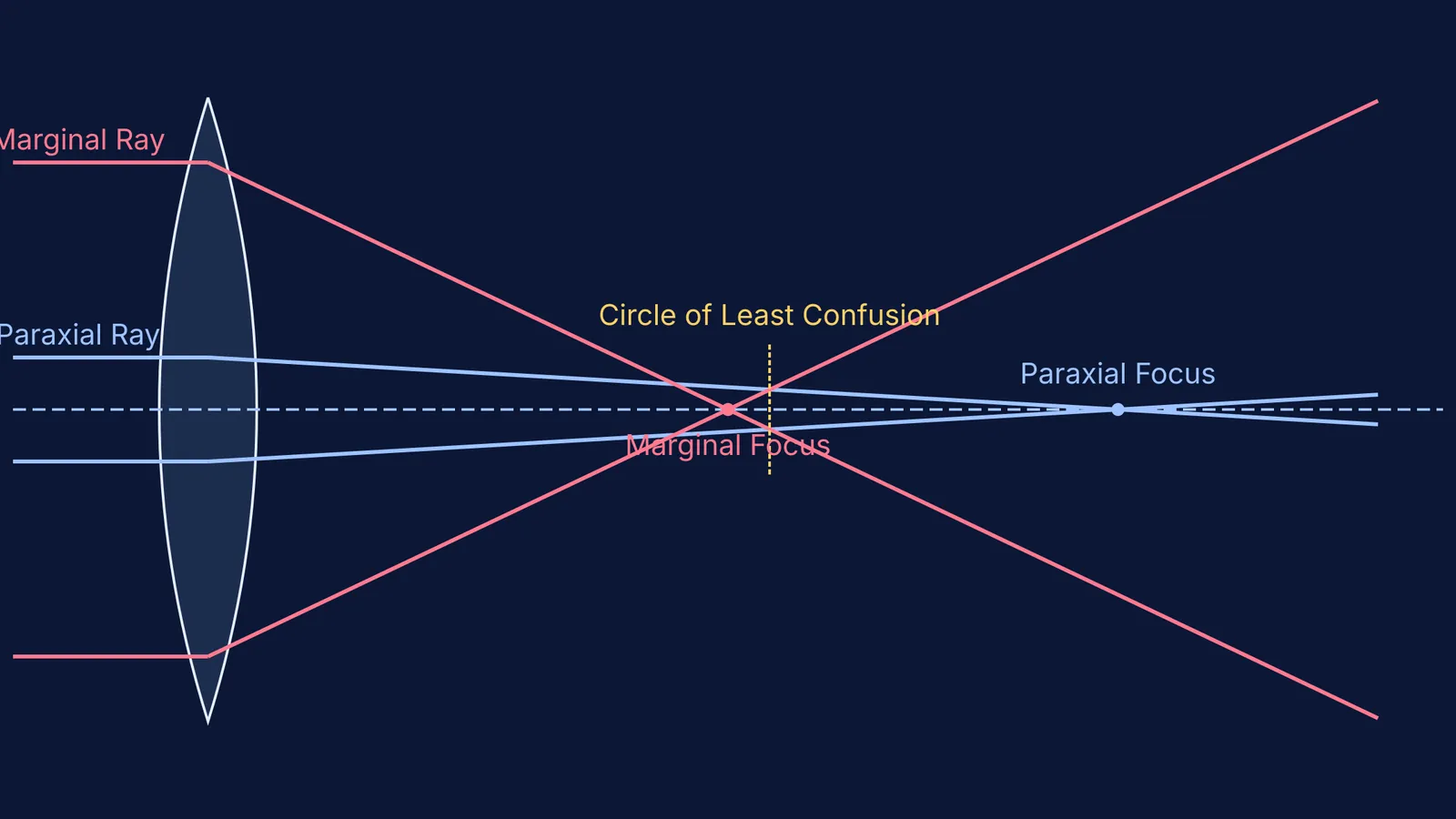
Paraxial rays travel close to the optical axis, the imaginary line through the centre of the lens. They strike the glass at a shallow angle. In an ideal diagram, the focal point is where these paraxial rays meet.
Marginal rays strike the outer edges of the spherical surface. Because the glass curves away from the centre, these rays meet the surface at a steeper angle and undergo severe bending.
This geometry means marginal rays in a standard convex lens are refracted too strongly. They cross the optical axis closer to the lens than paraxial rays do. The gap between the marginal focus and the paraxial focus is the longitudinal spherical aberration.
What is positive and negative spherical aberration?
Lenses and mirrors suffer from the defect in two directions.
Positive spherical aberration: This happens in a standard convex lens or a concave mirror. The glass bends the marginal rays too fiercely, so the marginal focus ends up closer to the lens than the paraxial focus.
Negative spherical aberration: This happens in a concave lens. The marginal rays are not bent outwards strongly enough. Their virtual focus is further away from the lens than the virtual focus of the paraxial rays.
Where is the circle of least confusion?
Because rays cross the axis at different points, the light never forms an infinitely small dot. Instead, overlapping rays form a three-dimensional cone of light with a narrow waist.
This narrowest cross-section is the circle of least confusion. If you hold a screen at the marginal focus, the image is surrounded by a wide halo of paraxial light. At the paraxial focus, you get a halo of marginal light. The circle of least confusion, located between the two foci, is the spot where the blur diameter is at its absolute minimum.
If you are trying to understand how rays shift as curvature changes, the Fermi Concept Library walks through the geometry of optical defects. To see the circle of least confusion form in real time, set up parallel rays and measure the blur dynamically in the Fermi Simulation Lab.
How do you reduce spherical aberration?
When you need a sharper image, you have to make the marginal rays agree with the paraxial ones, or remove them entirely.
Use an aperture stop: The simplest fix blocks the outer rays. A piece of cardboard with a small hole lets only paraxial rays through. According to the Wikipedia page on Spherical Aberration, the transverse spherical aberration (the diameter of the blur at the paraxial focus) is proportional to the cube of the aperture diameter. Reducing the aperture by half shrinks the blur by a factor of 8. The trade-off is a dimmer image.
Use parabolic mirrors: A spherical surface is the wrong mathematical shape for bringing parallel rays to a single point. A parabola is the correct one. Astronomers replace spherical primary mirrors with parabolic mirrors. A parabolic surface reflects all incoming parallel rays to exactly one point, eliminating spherical aberration for distant objects.
Use lens combinations: Pairing a convex lens with a weaker concave lens creates an aplanatic doublet where the errors cancel each other out. When you combine lenses carefully, you get a sharp focus across the whole glass.
Whether designing a telescope or trying to avoid mistakes in ray optics homework, remembering the difference between the margin and the centre is the first step to a clear picture.
How do you calculate the aperture stop effect?
Imagine using a magnifying glass to focus sunlight onto paper. The lens has a diameter of 4 cm. Due to spherical aberration, the light forms a blurred circle, say 8 mm in diameter.
To make the spot sharper and hotter, cover the edges with a paper ring, reducing the open aperture to 2 cm.
Find the scaling factor: You have halved the aperture diameter.
Apply the cube rule: The diameter of the transverse blur scales with the cube of the aperture diameter.
Calculate the new blur: The new blur size will be 1/8 of the original size (1/2 cubed).
Result: The new blur diameter is 8 mm / 8 = 1 mm.
You have reduced the collected sunlight area by a factor of 4, but concentrated it into a spot with 1/64th of the original area. Blocking the marginal rays actually increases the hot spot's intensity.


