On this page
Ray optics questions are short, and the physics is usually simple. The marks go on signs: a minus dropped, a formula swapped, a magnification misread. This guide uses NCERT's Class 12 chapter on ray optics and works through four common mistakes.
What is the Cartesian sign convention?
NCERT states it like this: "all distances are measured from the pole of the mirror or the optical centre of the lens. The distances measured in the same direction as the incident light are taken as positive and those measured in the direction opposite to the direction of incident light are taken as negative." Heights measured upwards from the principal axis are positive; downwards are negative.
If you always draw light travelling left to right, a real object to the left of the mirror or lens has a negative u.
With this convention, NCERT gives:
Mirror formula: 1/v + 1/u = 1/f, with magnification m = −v/u.
Thin lens formula: 1/v − 1/u = 1/f, with magnification m = v/u.
NCERT stresses that, with the sign convention applied properly, these formulas hold for concave and convex mirrors and lenses, and for real and virtual images. That is the point of the convention: one formula, every case.
Mistake 1: Putting the signs in twice
The formulas already have the convention built in. You substitute signed values; you never change the formula to suit the case.
Worked example. An object is 10 cm in front of a concave mirror of focal length 15 cm.
Signs: u = −10 cm, f = −15 cm (the focus is on the incoming-light side).
1/v = 1/f − 1/u = −1/15 + 1/10 = 1/30, so v = +30 cm.
m = −v/u = −(30)/(−10) = +3.
The image is 30 cm behind the mirror, virtual, erect and three times the size. That fits what you expect for an object inside the focus of a concave mirror.
Mistake 2: Using the mirror formula for a lens
The two formulas differ by one sign, which is exactly why they get swapped.
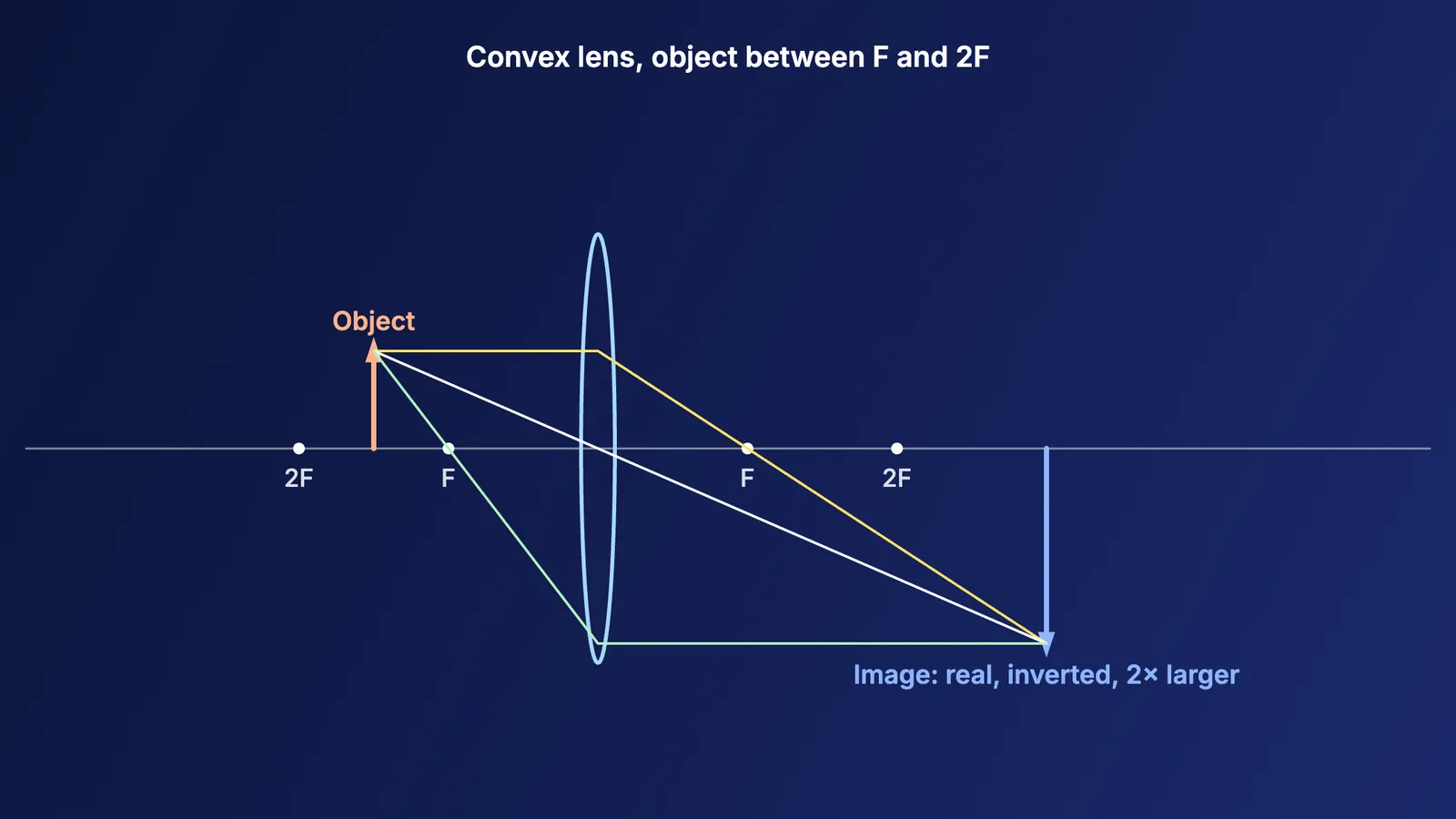
Worked example. An object is 30 cm from a convex lens of focal length 20 cm.
Signs: u = −30 cm, f = +20 cm.
Lens formula: 1/v = 1/f + 1/u = 1/20 − 1/30 = 1/60, so v = +60 cm.
m = v/u = 60/(−30) = −2.
The image is real, inverted, twice the size, on the far side of the lens. If you had used the mirror formula by mistake, you would get 1/v = 1/20 + 1/30, so v = 12 cm, which no ray diagram supports.
Mistake 3: Misreading the sign of the answer
The sign of v and m carries the answer to "real or virtual, erect or inverted".
Worked example. An object is 20 cm from a concave lens of focal length 20 cm.
Signs: u = −20 cm, f = −20 cm.
1/v = 1/f + 1/u = −1/20 − 1/20 = −1/10, so v = −10 cm.
m = v/u = (−10)/(−20) = +0.5.
The image is 10 cm from the lens on the same side as the object: virtual, erect and half the size.
A reading guide, with light travelling left to right:
Mirror, v negative: image in front of the mirror, real. v positive: behind it, virtual.
Lens, v positive: image on the far side, real. v negative: same side as the object, virtual.
For a lens, NCERT notes that m is positive for an erect, virtual image and negative for an inverted, real image.
Mistake 4: Working out power in centimetres
NCERT defines the power of a lens as P = 1/f, with the SI unit dioptre: 1 D = 1 m⁻¹. The focal length must be in metres.
A convex lens with f = +25 cm = +0.25 m has P = +4 D, not +0.04.
A concave lens with f = −50 cm = −0.5 m has P = −2 D.
A checklist for every optics question
Draw the light travelling left to right, and a quick ray sketch.
Write u, f (and v if given) with signs before touching the formula.
Choose the right formula: mirror (plus) or lens (minus).
Read the sign of v and m back into words: real or virtual, erect or inverted.
Convert to metres before finding power.
The habit of drawing first pays off across physics; see why drawing the diagram first helps you solve physics problems. Keeping every sign on its own line also matters; our post on neat working and fewer errors shows a layout.
Where rays are hard to picture, the Fermi Simulation Lab has interactive simulations for the ideas that are easier to see than to read. To check a whole method, the Fermi Problem Library has worked problems with a step-by-step solver that explains the reasoning rather than printing an answer.