

On this page
Most ray optics problems deal with real objects—a candle, a pin, or a person standing in front of a lens. For these, light rays physically diverge from the object, and you measure the object distance against the direction of incident light. That is why the object distance u is almost always negative in basic textbook exercises.
But what happens when the light hitting the lens is already converging?
What is a virtual object in lens problems?
A virtual object is a mathematical concept that describes a beam of light converging towards a point behind the lens, but intercepted by the optical instrument before the rays can physically meet. Because the rays never actually cross at that point before hitting the lens, the point acts as a "virtual" source for the calculations.
You will typically encounter a virtual object when dealing with a combination of lenses, such as in microscopes or telescopes. The real image formed by the first lens acts as the object for the second lens. If the second lens is placed before that image has a chance to form, the converging beam strikes the second lens, making that intended image point a virtual object.
Why is the object distance positive?
To solve these problems without confusion, physicists rely on the New Cartesian Sign Convention. According to the official NCERT Class 12 Physics textbook, this convention states that the optical centre of the lens is the origin, and all distances measured in the direction of incident light are treated as positive along the x-axis.
When a beam of light converges towards a point P behind the lens, the incident light is travelling from left to right. To locate P, you must measure the distance from the optical centre to P moving left to right—in the exact same direction that the incident light is travelling. Therefore, for a virtual object, the object distance u is always given a positive sign.
How do you solve a virtual object problem?
Let us look at a standard application, featured as Exercise 9.8 in the NCERT Class 12 Physics syllabus. This problem demonstrates exactly how the mathematics handles an intercepted beam.
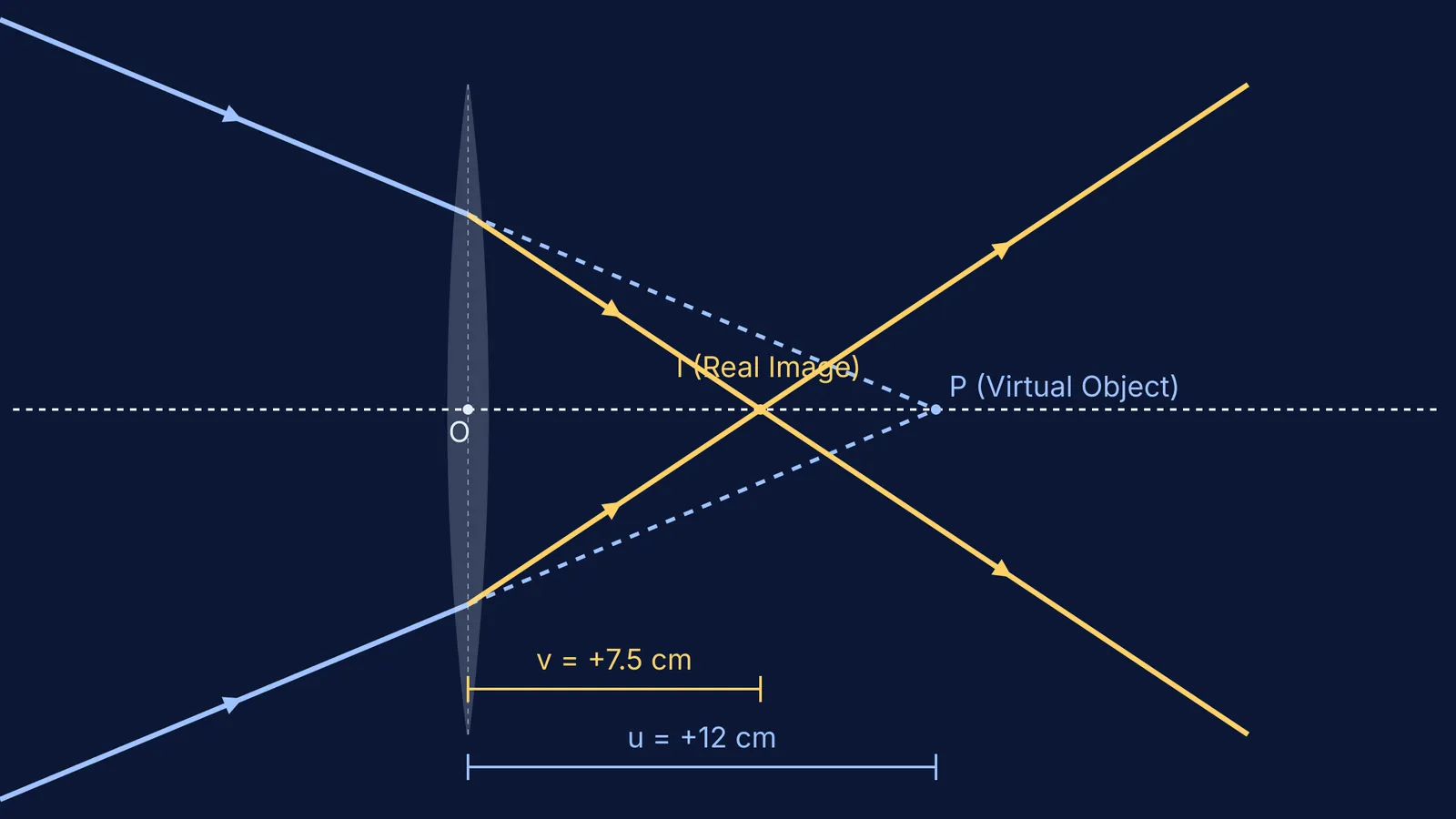
A beam of light converges at a point P. A lens is placed in the path of the convergent beam 12 cm from P. At what point does the beam finally converge if the lens is a convex lens of focal length 20 cm?
Identify the virtual object: The incoming beam is trying to focus at P, which is 12 cm behind the lens. Because the incident rays are converging toward P, this point acts as our virtual object.
Apply the sign convention: We measure the object distance in the direction of the light, giving us u = +12 cm. A convex lens has a positive focal length, so f = +20 cm.
Use the lens formula: The standard lens equation 1/v - 1/u = 1/f applies equally to real and virtual objects.
We can rearrange the formula to solve for the image distance v: 1/v = 1/f + 1/u 1/v = 1/20 + 1/12
To add the fractions, find a common denominator (which is 60): 1/v = 3/60 + 5/60 = 8/60 v = 60 / 8 = 7.5 cm
Because v is positive, the final beam forms a real image 7.5 cm behind the lens. The convex lens adds converging power, pulling the focal point closer to the optical centre than the original 12 cm. If you swapped it for a concave lens with a focal length of -16 cm, the diverging power would push the focus further back, resulting in a real image at v = +48 cm.
How does Fermi's AI tutor help with sign conventions?
Sign conventions are notoriously easy to slip up on, especially when moving between mirrors and lenses, or between real and virtual objects. If you find yourself dropping a minus sign and arriving at an image that forms inside the lens itself, the Fermi Problem Library has worked problems with a step-by-step solver that explains the reasoning rather than printing an answer.
Instead of just checking whether your final v is correct, Fermi's AI tutor looks at the exact step where you set up your variables. If it notices you assigned a negative value to a virtual object, it will pause and prompt you to check the direction of the incident light. For optics concepts that are difficult to picture in your head—like multiple lenses intercepting a light beam—the Fermi Simulation Lab offers interactive simulations for the ideas that are easier to see than to read. You can drag a lens into a converging beam and watch the light rays immediately recalculate, mapping out the math in real time.
*Related reading: Brush up on the images formed by a concave mirror or see how light shifts laterally in our guide to ray tracing through a glass slab.*


