On this page
For each eye defect in Class 10 you need two answers: where does the image land, and which lens moves it onto the retina? An AI chatbot can explain both, but a smooth explanation is easy to nod along to. So let the AI explain, then check with a two-minute ray sketch.
Where does the image form in myopia and hypermetropia?
This section follows NCERT's Class 10 Science chapter, The Human Eye and the Colourful World. For a young adult with normal vision, the near point is about 25 cm and the far point is at infinity.
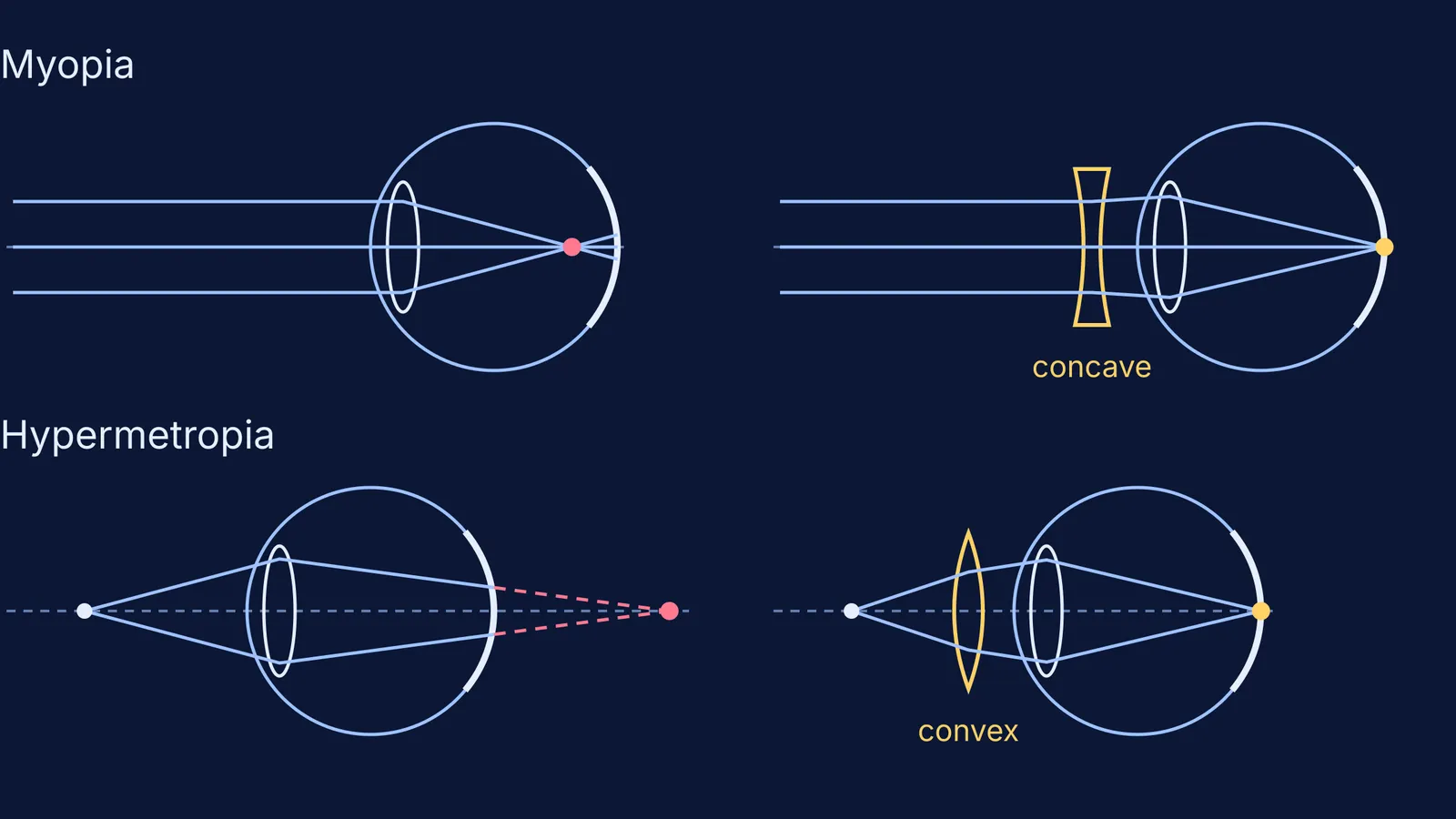
Myopia (near-sightedness): near objects are clear, distant ones are not. The image of a distant object forms in front of the retina, because the eye lens is too curved or the eyeball is elongated.
Hypermetropia (far-sightedness): distant objects are clear, near ones are not. Light from a close object is focused behind the retina, and the near point moves beyond 25 cm, because the eye lens's focal length is too long or the eyeball is too small.
Presbyopia: with age the ciliary muscles weaken and the near point recedes. People with both myopia and hypermetropia often need bifocals: concave on top, convex below.
A 2016 meta-analysis of 145 studies by Brien Holden and colleagues in Ophthalmology estimated that 22.9% of the world's population was myopic in 2000 and projected 49.8% by 2050. The WHO says uncorrected refractive error remains a leading cause of vision impairment in all countries.
Which lens corrects myopia and which corrects hypermetropia?
A spectacle lens moves the image onto the retina.
Image too early (in front of the retina): spread the rays slightly before they enter the eye. A diverging, concave lens does that, so it corrects myopia.
Image too late (behind the retina): bend the rays slightly inward first. A converging, convex lens does that, so it corrects hypermetropia.
Shaky on diverging lenses? Read where a diverging lens forms its image.
How do you ask AI to explain it without copying the answer?
Make the AI explain the image position first and hold back the lens. Send these one at a time:
"Don't name any lens yet. For a myopic eye looking at a distant object, where does the image form, and why?"
"Now the same for a hypermetropic eye reading a book held close."
"Ask me which way each image must move to reach the retina. Wait for my answer."
"Ask me which lens moves it that way. If I'm wrong, give a hint, not the answer."
"Give me one numerical on each defect and check my working step by step."
Step 3 counts most: if you can say "this image must move back" before you hear "concave", you have understood it.
To see the figure drawn as you talk, Fermi's AI tutor writes on a board, draws the figure and checks understanding as it goes.
How do you check the AI's answer with a ray sketch?
AI can sound sure and still swap a sign or mix up near and far point. A rough sketch catches that, the same habit as asking AI to describe a diagram, then drawing it yourself.
Draw the eye as a circle, the eye lens as a thin oval at the front, the retina as the back wall.
Myopia: two parallel rays from far away cross before the back wall.
Add a concave lens in front and tilt the rays slightly outward after it. They now cross on the retina.
Hypermetropia: from a dot close to the eye, draw two rays that would meet beyond the back wall.
Add a convex lens and tilt the rays inward before the eye. They now meet on the retina.
How do you work out the lens power?
The NCERT chapter asks: a myopic person cannot see beyond 1.2 m; which lens do they need? The lens must image a distant object at the far point, so u = infinity and v = −1.2 m. With 1/v − 1/u = 1/f, f = −1.2 m and P = 1/f ≈ −0.83 D. Negative power: a concave lens.
Our own hypermetropia example: the near point is 1 m and you want to read at 25 cm. The lens must image the book at the near point, so u = −25 cm and v = −100 cm. Then 1/f = −1/100 + 1/25 = 3/100, so f ≈ +33.3 cm and P = 100/33.3 ≈ +3.0 D: a convex lens. If dioptres trip you up, see power of a lens when focal length is in centimetres.
Ask the AI to solve both and compare signs. For practice, the Fermi Problem Library has worked problems with a step-by-step solver that explains the reasoning.
Tonight, try the script on one defect and check the AI's words against your sketch.