

On this page
Most students learn diagrams by copying them. The redrawn convex lens figure looks right, and then in the exam, with no figure in front of you, the rays go the wrong way.
Try a different use of an AI chatbot. Ask it to *describe* the diagram in words, with no picture. Draw it from that description. Then open the textbook and compare. The AI gives you the words, you build the picture, and the book checks your work.
Why does drawing from a description work better than copying?
When you copy, your eyes do the work. When you draw from words, you have to decide where each ray starts, bends and ends. That is the skill the exam tests.
In a 2010 study in the Journal of Educational Psychology, 196 ninth-graders read a science text about how soap cleans clothes. Students told to draw while reading beat those who only read on a transfer test, with a large effect size (d = 0.91).
The same study found that drawing also works as a warning sign. Drawing accuracy correlated with transfer scores at r = .57 (Schwamborn and colleagues, 2010). A wrong drawing shows you what you haven't understood yet, before the exam does.
A review by Logan Fiorella and Qian Zhang found that drawing consistently helps comprehension compared with just reading or summarising. One kind of drawing help it looks at is comparing your drawing with an instructor's illustration, which is the "check the book" step here. A study by Peggy Van Meter and colleagues found that fourth- and sixth-graders who drew with support did better on problem solving than students who didn't draw.
How do I ask an AI to describe a diagram so I can draw it?
Use this four-step loop, one diagram at a time.
Ask for words only. Name the diagram and ask for numbered drawing steps, with no image.
Draw from the steps. Use a pencil and ruler and don't look anything up. Mark the places where you weren't sure.
Compare with the textbook. Open the NCERT figure and circle every difference: a missing arrow, a ray through the wrong point, a wrong label.
Explain each difference. Write one line on why the book is right. Ask the AI about anything you still can't explain.
A prompt you can copy:
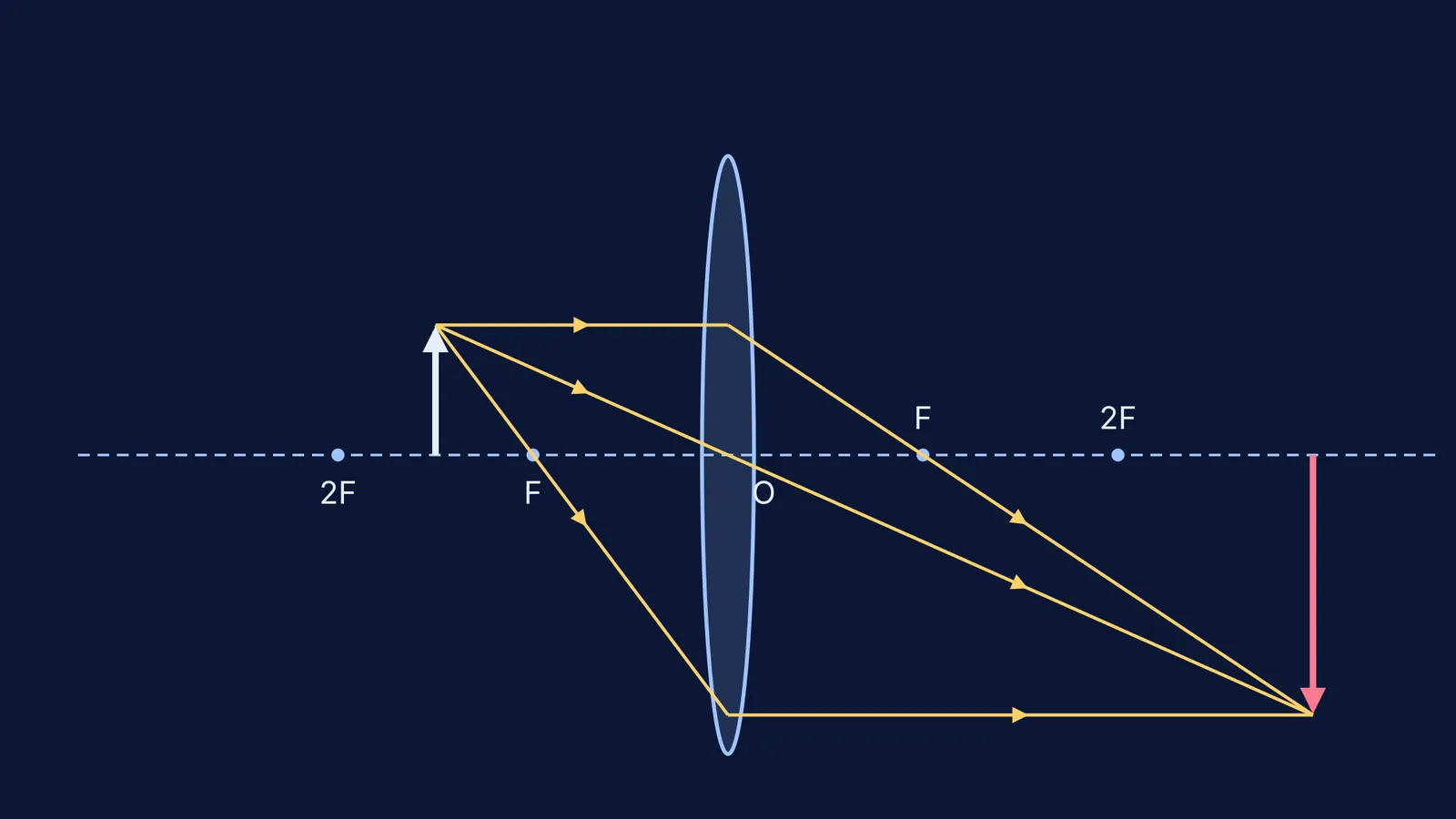
"I'm studying Class 10 light. Describe, in numbered steps, how to draw the ray diagram for a convex lens with the object between F and 2F. Don't give me an image. Tell me where each ray starts, which point it passes through, and where the image forms."
The textbook is the referee, not the chatbot. An AI description can get a detail wrong, such as which focus a ray passes through. Comparing with the book catches its errors as well as yours.
What does this look like for a ray diagram and a circuit?
Ray diagram. A good description gives you three rays from the top of the object. One goes parallel to the axis, then bends through the far focus. One goes straight through the optical centre. One passes through the near focus and leaves the lens parallel to the axis. They meet beyond 2F, below the axis. A common mistake shows up in the comparison: the image drawn upright, when the book shows it real, inverted and enlarged.
Circuit. Try: "Describe in words a circuit with a cell, a switch, two resistors in parallel, an ammeter measuring the total current and a voltmeter across one resistor. No diagram." Students often put the ammeter inside one branch or the voltmeter in series. Checking against the textbook makes that obvious.
You can also flip the roles. Describe your drawing to the AI in words and ask what doesn't match the physics. This is the self-explanation effect applied to a figure.
Where does a tutor help more than a chatbot?
A chatbot answers the question you typed. If you keep drawing the image upright, you need someone to notice the pattern. Fermi's AI tutor notices where a student is stuck, decides whether to explain, ask or show, and can draw the figure on a board for you to compare with yours. If the comparison shows a concept gap, such as not knowing why a ray through the focus leaves parallel, the Fermi Concept Library has a lesson on every concept in physics, chemistry, biology, mathematics and computing.
For exam practice, read why drawing the diagram first helps you solve physics problems and our guide to drawing ray diagrams in the CBSE Class 12 physics paper.
Tonight, pick the one diagram you always get wrong and run the loop once.


