

On this page
If a wire touches both ends of a pencil cell, the cell soon feels warm. Here is why, with the numbers.
What is internal resistance in a battery?
Current inside a cell must pass through the electrolyte, which has a finite resistance r that NCERT's Class 12 chapter on current electricity calls the internal resistance (NCERT Physics Part 1, Chapter 3, section 3.10). The emf E is the potential difference between the terminals when no current flows. With a load R connected, the current is I = E/(R + r), and the terminal voltage falls to V = E − Ir.
The cell supplies power EI: I²R goes to the load and I²r becomes heat inside the cell. The share that stays inside is r/(R + r).
If V = E − Ir is new, see our explainer on why a battery's terminal voltage drops under load.
Why does a battery get warm when short circuited?
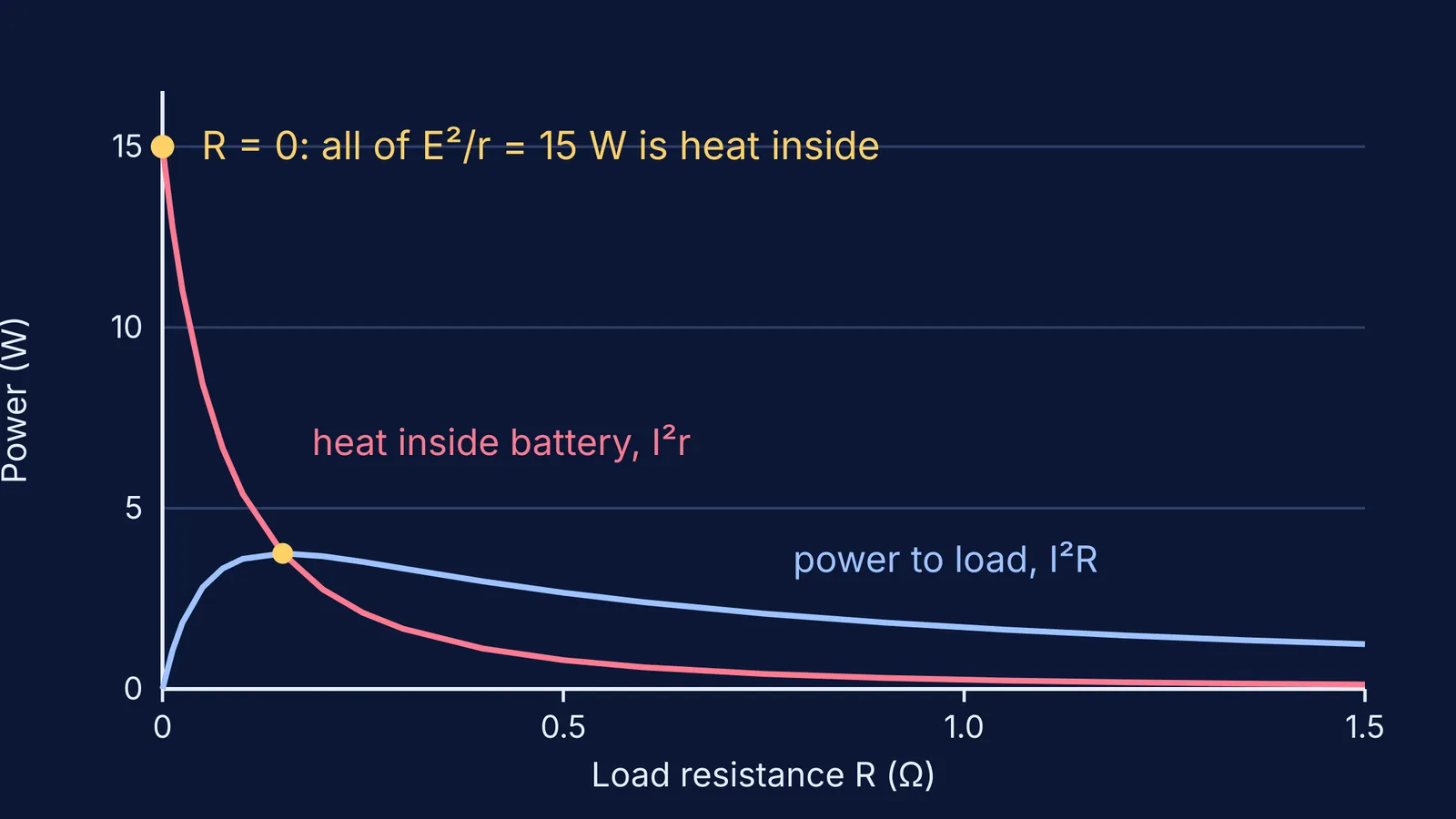
A short circuit makes R close to zero, so the share r/(R + r) becomes 1: the whole emf pushes current through the battery's own insides.
Current: I = E/r, which NCERT gives as the maximum current that can be drawn from a cell (NCERT, section 3.10).
Power: P = EI = E²/r, and in the ideal picture all of it is heat inside the battery.
The terminal voltage collapses to zero, so the outside circuit receives almost nothing. The wire warms a little too, but if its resistance is much smaller than r, most heat appears inside the cell.
How much heat is that for a real AA cell?
Energizer's datasheet for its EN91 AA alkaline cell lists a nominal voltage of 1.5 V, a nominal internal resistance of 150 to 300 milliohms when fresh, and a typical weight of 23.0 grams (Energizer EN91 datasheet). Work it through:
Short circuit, r = 0.15 Ω: I = 1.5/0.15 = 10 A, and P = 1.5²/0.15 = 15 W.
Short circuit, r = 0.30 Ω: I = 5 A, and P = 7.5 W.
Normal use: the same datasheet tests the cell on a 3.9 Ω toy load. With r = 0.15 Ω, I = 1.5/4.05 ≈ 0.37 A. Heat inside is I²r ≈ 0.021 W, while the toy gets I²R ≈ 0.53 W. Under 4% of the power stays in the cell.
So in this simple model, shorting the same cell raises the heat inside from about 0.02 W to as much as 15 W, roughly 700 times more, in a 23 g cylinder. Treat these as upper limits: the formula assumes E and r stay fixed, which a real cell under such a load does not manage for long.
One trap: a fresh cell with lower r heats more on a short, not less, because E²/r grows as r shrinks.
Is a short-circuited battery dangerous?
It can be. The US National Fire Protection Association warns that a metal object touching both posts of a 9-volt battery can cause a short circuit that makes enough heat to start a fire, and that even weak batteries may have enough charge to cause one (NFPA 9-volt battery safety tip sheet). Its advice for 9-volt batteries:
Keep them in the original packaging until you are ready to use them.
If loose, cover the posts with masking, duct or electrical tape.
Do not store them loose in a drawer near paper clips, coins, keys or other batteries.
Do not throw them out with household trash; take them to a collection site for household hazardous waste.
NCERT adds a caution from the physics side: in most cells the maximum allowed current is much lower than E/r, to prevent permanent damage to the cell. So do not short a cell to test this.
How do exam questions test this?
Board and JEE Main questions on cells build on I = E/(R + r) from NCERT's current electricity chapter. Checklist for any cell with internal resistance:
Short circuit: I = E/r, terminal voltage 0, heat inside E²/r.
Open circuit: I = 0, terminal voltage E, no heat inside.
Any load R: heat inside is I²r, and the fraction lost inside is r/(R + r).
Maximum power to the load comes at R = r, when exactly half the cell's power is lost inside.
Try one: a cell of emf 2 V and internal resistance 0.5 Ω is shorted. The current is 4 A and the heat inside is 8 W. With a 1.5 Ω load instead: 1 A flows, the cell heats at 0.5 W, the load gets 1.5 W, so 25% stays inside.
The same physics appears in terminal voltage versus current graphs, where the line meets the current axis at E/r, and in our post on short-circuit current and fuses.
If you keep slipping on which R to use in multi-step circuits, the Fermi Problem Library has worked problems with a step-by-step solver that explains the reasoning rather than printing an answer. If emf and internal resistance themselves feel shaky, each has its own lesson in the Fermi Concept Library.


