

On this page
If you connect a 1.5-volt AA battery to a single lamp, what does a voltmeter placed across the battery's terminals read? Many students would say 1.5 volts. Now, if you add a second identical lamp in parallel, what does the voltmeter read?
A 1983 study by researchers at the Weizmann Institute of Science, which tested 145 high school students, found a common misconception: students often regard a battery as a source of constant current, and struggle to understand electromotive force (EMF) and internal resistance. In reality, a battery does not supply a perfectly constant current or a constant voltage. Its terminal voltage drops as you draw more current.
What happens inside the battery?
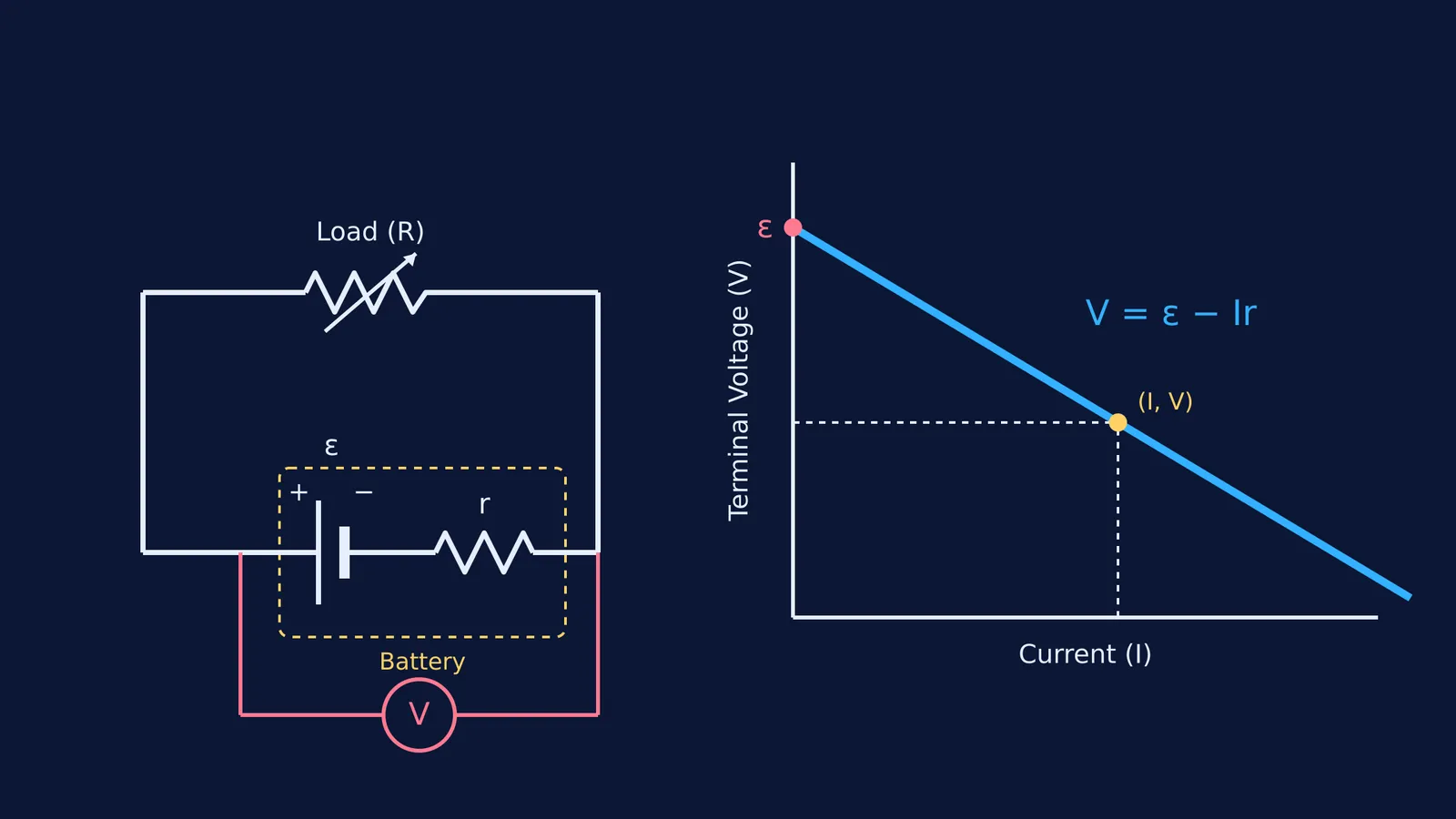
A battery is not a perfect well of energy. The chemical reactions and the materials inside it resist the flow of electrons. We model this as an internal resistance (r) placed in series with a perfect, constant voltage source called the electromotive force (ε).
A fresh AA alkaline battery has an internal resistance of about 0.15 Ω at room temperature. This might seem tiny, but it has a real impact.
When current (I) flows out of the battery, it must pass through this internal resistance. This creates a voltage drop inside the battery itself, equal to I × r. The voltage you actually get out of the battery—the terminal voltage (V)—is the EMF minus this lost voltage:
V = ε − Ir
Will battery terminal voltage drop with load?
Yes. When we talk about adding "load" to a circuit, we usually mean adding more components in parallel, like turning on more lamps in a room.
Adding lamps in parallel decreases the total resistance of the circuit. A lower circuit resistance means the battery has to supply a higher total current. Look at the equation V = ε − Ir. As the current I increases, the term Ir gets larger. This means more voltage is lost inside the battery, and the terminal voltage V drops.
A worked example: Adding lamps in parallel
Let's test this with some numbers. Imagine a simplified battery with an EMF of 1.5 V and a rather high internal resistance of 0.5 Ω, typical of a heavily used AA battery. You connect it to a lamp with a resistance of 1.0 Ω.
One lamp: The total resistance is the lamp plus the battery (1.0 + 0.5 = 1.5 Ω).
The current is I = 1.5 V / 1.5 Ω = 1.0 A. The terminal voltage is V = 1.5 − (1.0 × 0.5) = 1.0 V.
Two lamps in parallel: Adding a second 1.0 Ω lamp in parallel drops the load resistance to 0.5 Ω.
The total resistance is now 0.5 + 0.5 = 1.0 Ω. The new current is I = 1.5 V / 1.0 Ω = 1.5 A. The new terminal voltage is V = 1.5 − (1.5 × 0.5) = 0.75 V.
The terminal voltage has dropped from 1.0 V to 0.75 V just by adding a second lamp. This is why a car's headlights dim slightly when you start the engine: the starter motor draws a massive current, creating a large voltage drop across the car battery's internal resistance.
If you are struggling to picture how voltage and current change as you alter a circuit, the Fermi Simulation Lab has interactive simulations for the ideas that are easier to see than to read.
How to solve internal resistance problems
When you face exam problems on internal resistance, follow this simple framework:
Draw the battery properly: Always draw a dashed box around the EMF symbol and the internal resistor. Treat them as two separate components that happen to be trapped in the same plastic shell.
Find the total resistance: Add the external load resistance to the internal resistance (R + r).
Calculate the main current: Use Ohm's law for the whole circuit: I = ε / (R + r).
Find the terminal voltage: Use V = ε − Ir, or simply calculate the voltage across the external load V = IR. They will give the exact same answer.
This approach will help you track the voltage drops step by step, whether you are solving complex networks using the node potential method: solving circuits by assigning voltages or learning about Gaston Planté and the lead battery that could be recharged.


