

On this page
Most electrical devices are designed to provide resistance. A light bulb or a motor slows down the flow of electrons, keeping the current steady and safe. But what happens if that resistance disappears?
If a frayed cord or a dropped spanner connects the positive and negative terminals directly, the electricity takes a shortcut.
What happens in a short circuit current?
In a normal circuit, the current (I) is controlled by the voltage (V) and the resistance (R) of the load, according to Ohm's law: I = V / R.
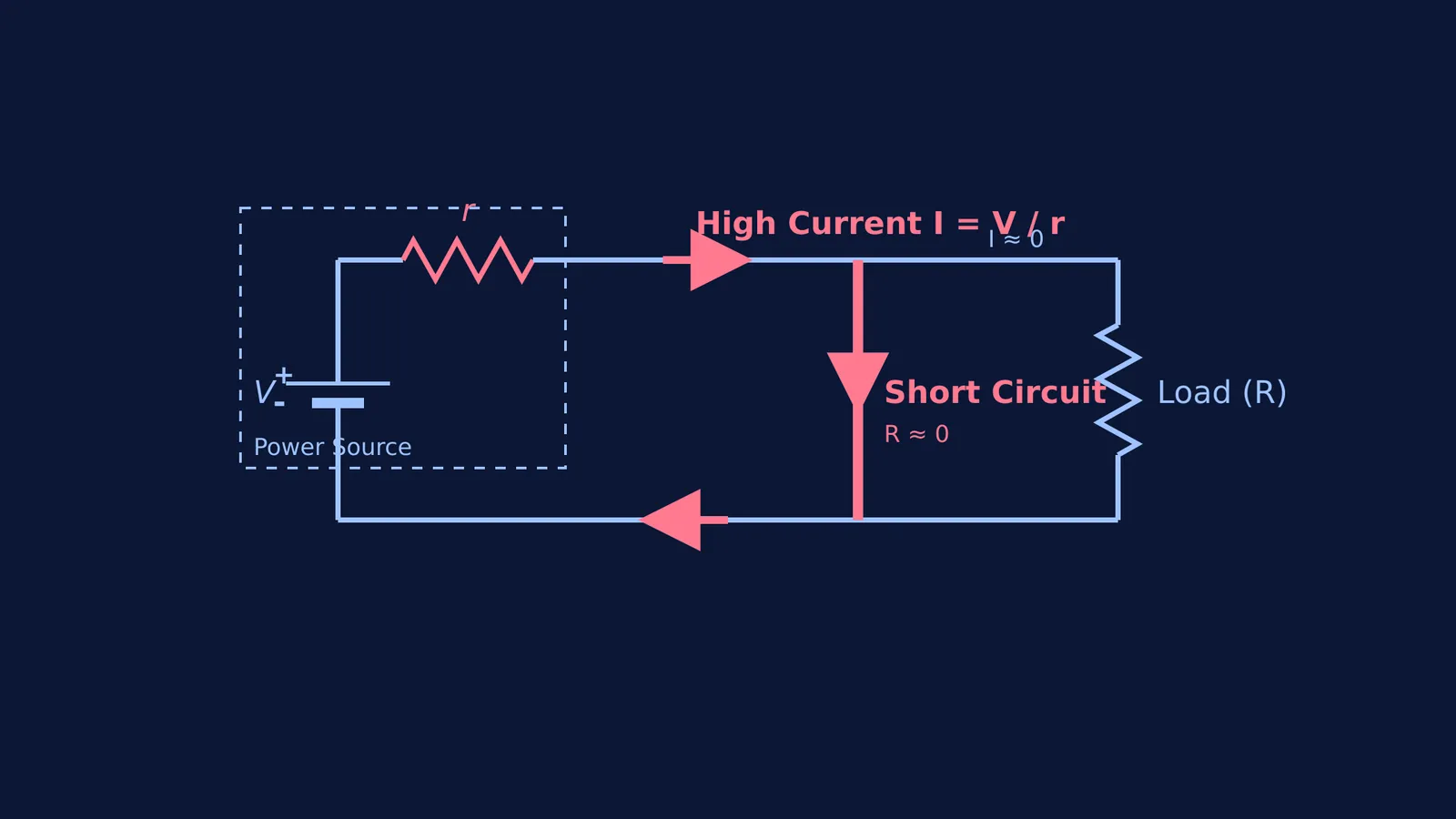
When a short circuit occurs, the load is bypassed. The resistance of the new path drops to almost zero. Because dividing by a number close to zero gives a huge result, the current spikes dramatically.
The sudden surge of electricity generates immense heat, which can melt plastic insulation, vaporise copper, and ignite surrounding materials. According to the 2024 Accidental Deaths & Suicides in India (ADSI) report by the National Crime Records Bureau (ncrb.gov.in), electrical short circuits caused 1,012 deaths, accounting for about 17.2% of all 5,888 fire-accident fatalities in the country that year.
You can safely test this concept in the Fermi Simulation Lab. Build a circuit with a battery and a bulb, add a bypass wire across the bulb, and watch the ammeter spike as the current takes the easier path.
Why does the current not go to infinity?
If the resistance of a short wire is practically zero, Ohm's law suggests the current should become infinite. In reality, it is limited by the power source itself.
Every real battery or generator has its own internal resistance, usually written as a lowercase r. This is caused by the chemicals and materials inside the battery. Even during a perfect short circuit, the electricity still has to push through this internal barrier (hyperphysics.phy-astr.gsu.edu).
The maximum possible short circuit current is therefore the open-circuit voltage divided by the internal resistance.
For example, a car battery has a very low internal resistance. If you accidentally short-circuit it with a thick spanner, the resulting massive current converts all the battery's stored energy into intense heat internally and in the shorting object. This rapid heating often causes the battery to boil, melt its casing, or even explode. This is why you must never place tools across battery terminals.
How do fuses prevent electrical fires?
To stop a short circuit from burning down a house, engineers use fuses or circuit breakers. A fuse contains a thin wire designed to be the weakest link in the circuit.
When the current spikes during a short circuit, the thin fuse wire heats up much faster than the thick copper wires in the walls. It melts and physically breaks the circuit before the dangerous current can do any damage. If you want to know how the thickness of that wire is chosen, you can read Why Does a Fuse Wire's Rating Depend on Radius, Not Length?.
If you have ever struggled to picture how a blown fuse stops the flow or where the current goes, drawing it out with Fermi's AI tutor can help you trace the broken path step by step.
How to predict the maximum fault current?
Before designing a safety system, engineers must calculate the worst-case scenario. You can use this three-step framework to find the maximum short circuit current of any source:
Identify the source voltage (V). Read the open-circuit voltage of the battery or supply.
Find the internal resistance (r). For a battery, this is usually very small. For a household supply, it depends on the grid transformer and the wires leading to the house. (See Why Are Household Appliances Connected in Parallel? for more on household grids).
Divide the voltage by the internal resistance. The result is the absolute limit of the current. You must choose a fuse or breaker that can safely interrupt this exact amount of current without exploding.


