

On this page
We plug appliances into wall sockets and flick a switch, expecting them to work immediately. Whether you are boiling water in a kettle or running a ceiling fan, the physics happening inside your walls is a direct application of parallel circuits. Let's look at how domestic wiring is set up and why switching on too many things at once trips the power.
In short
Household appliances run in parallel to receive the full 230 V independently. But total current adds up, which is why turning on too many devices trips a fuse.
Why do we wire homes in parallel?
If you wire components in series, the electrical current has only one path to flow through. This creates two major problems for a house. First, if you turn off a lamp, you break the entire circuit, and all the other appliances go out. Second, components in series share the voltage; if you turn on another appliance, they all receive less voltage and run weakly.
Instead, domestic wiring uses parallel circuits. Components connected in parallel are connected along multiple paths, and each component has the same voltage across it, equal to the voltage across the network. In much of the world, homes receive mains electricity at a nominal voltage of 230 V and a frequency of 50 Hz.
Because they are wired in parallel, your toaster and microwave each receive the full 230 V supply. They also operate independently: turning one off does not interrupt the electrical path for the other.
What happens when you turn on more appliances?
While the voltage stays constant at 230 V, the current behaves differently. In a parallel circuit, the current through the network is equal to the sum of the currents through each component.
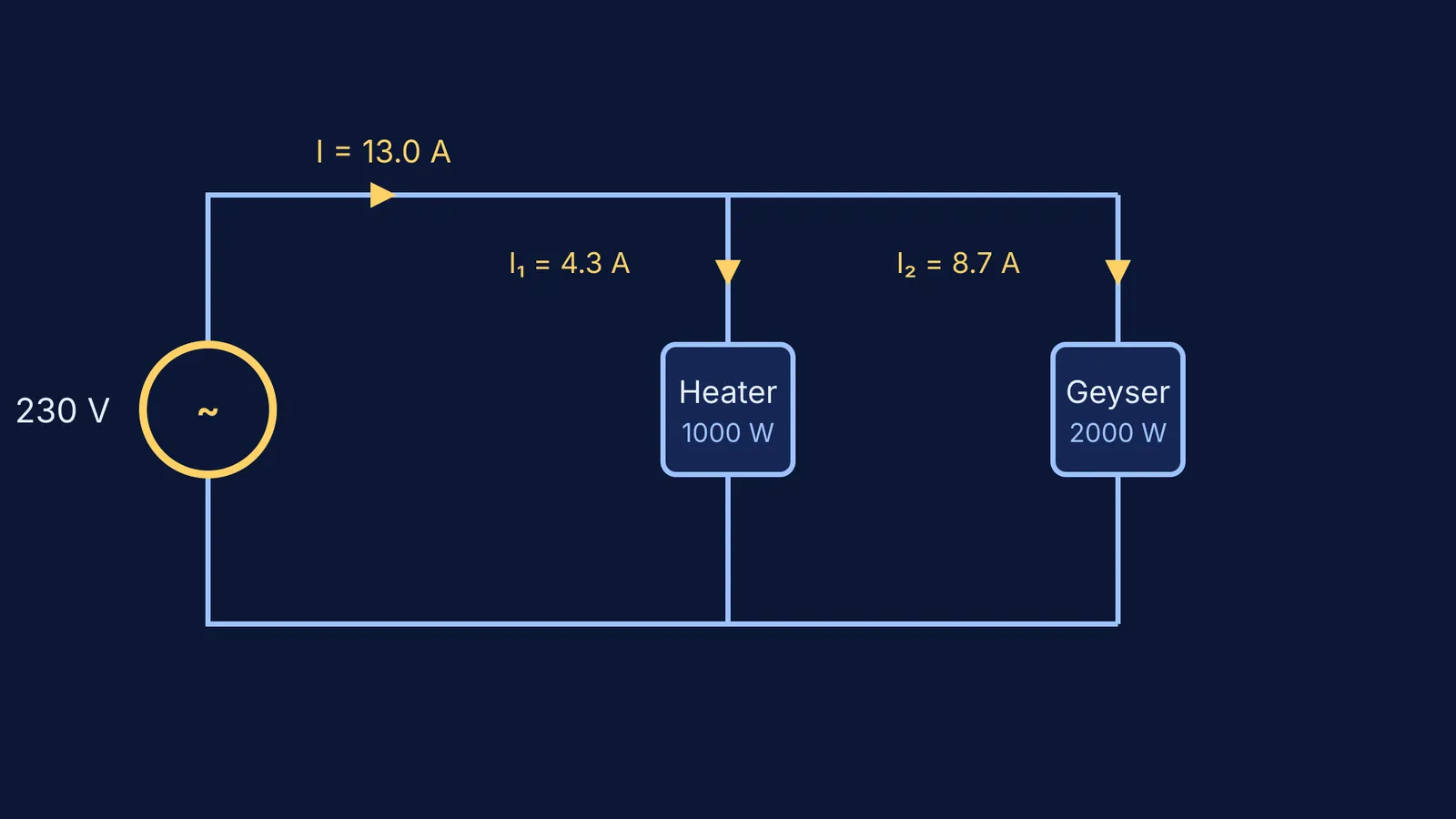
Every time you switch on an appliance, you provide a new parallel path for electricity to flow. We can use the electrical power formula (P = V × I) to calculate the impact. If you plug in a 1000 W room heater to your 230 V socket, it draws about 4.3 A of current (1000 ÷ 230). If you then turn on a 2000 W geyser on the same circuit, it draws about 8.7 A. The total current flowing from the mains is now 4.3 + 8.7 = 13.0 A.
This additive effect is exactly what causes an electrical overload. As you plug in more high-power devices, the overall resistance of the house circuit drops, and the total current being pulled through your home's wiring increases.
Why do fuses trip during an overload?
Wires are designed to safely carry only a specific amount of current before they overheat and become a fire risk. To prevent this, circuits are protected by a fuse) or a miniature circuit breaker (MCB). A fuse's essential component is a metal wire or strip that melts when too much current flows through it, thereby stopping the current.
If your room's circuit is protected by a 10 A fuse, and you turn on both the 4.3 A heater and the 8.7 A geyser, the combined 13.0 A current exceeds the fuse's rating. The fuse strip heats up, melts, and breaks the circuit safely to mitigate the overloading before the wires in the wall can catch fire.
If you ever wonder why you understand physics theory but still fail numericals, it is often because textbook formulas are taught separately from what they physically mean. Reading about overload is one thing, but research shows a clear benefit when choosing between simulations or static diagrams. In the Fermi Simulation Lab, you can build this exact parallel circuit safely, change the appliances' power ratings, and watch the total current add up in real time before the virtual fuse trips.
Here is a practical checklist for solving parallel circuit problems in your exams:
Identify the constant: In a parallel circuit, voltage (V) is the same across all branches.
Find the current per branch: Use Ohm's Law (I = V ÷ R) or Power (I = P ÷ V) for each appliance.
Add them up: Total current is the sum of the branch currents (I = I₁ + I₂ + …).
Check the limit: Compare the total current to the maximum rating of the fuse or main breaker.


