

On this page
When you study current electricity, you learn early on that the resistance of a wire depends on its length. The longer the wire, the higher the resistance. So, it feels entirely logical to assume that a longer fuse wire) would get hotter and melt faster than a shorter one.
But it does not. According to a principle known as Preece's Law, the current required to blow a fuse depends on the wire's radius and its material, not its length.
Why does the length suddenly stop mattering when we talk about a wire melting? The answer lies in how heat is produced and lost, and why those two processes balance each other out perfectly.
Why Does Length Cancel Out?
To understand why a fuse melts, we have to look at thermal equilibrium. A wire carries a steady current without melting as long as the heat it generates is equal to the heat it loses to the surrounding air. The moment the heat generated exceeds the heat lost, the wire's temperature climbs until it reaches its melting point.
Let us look at both sides of this balance.
1. Heat Generated
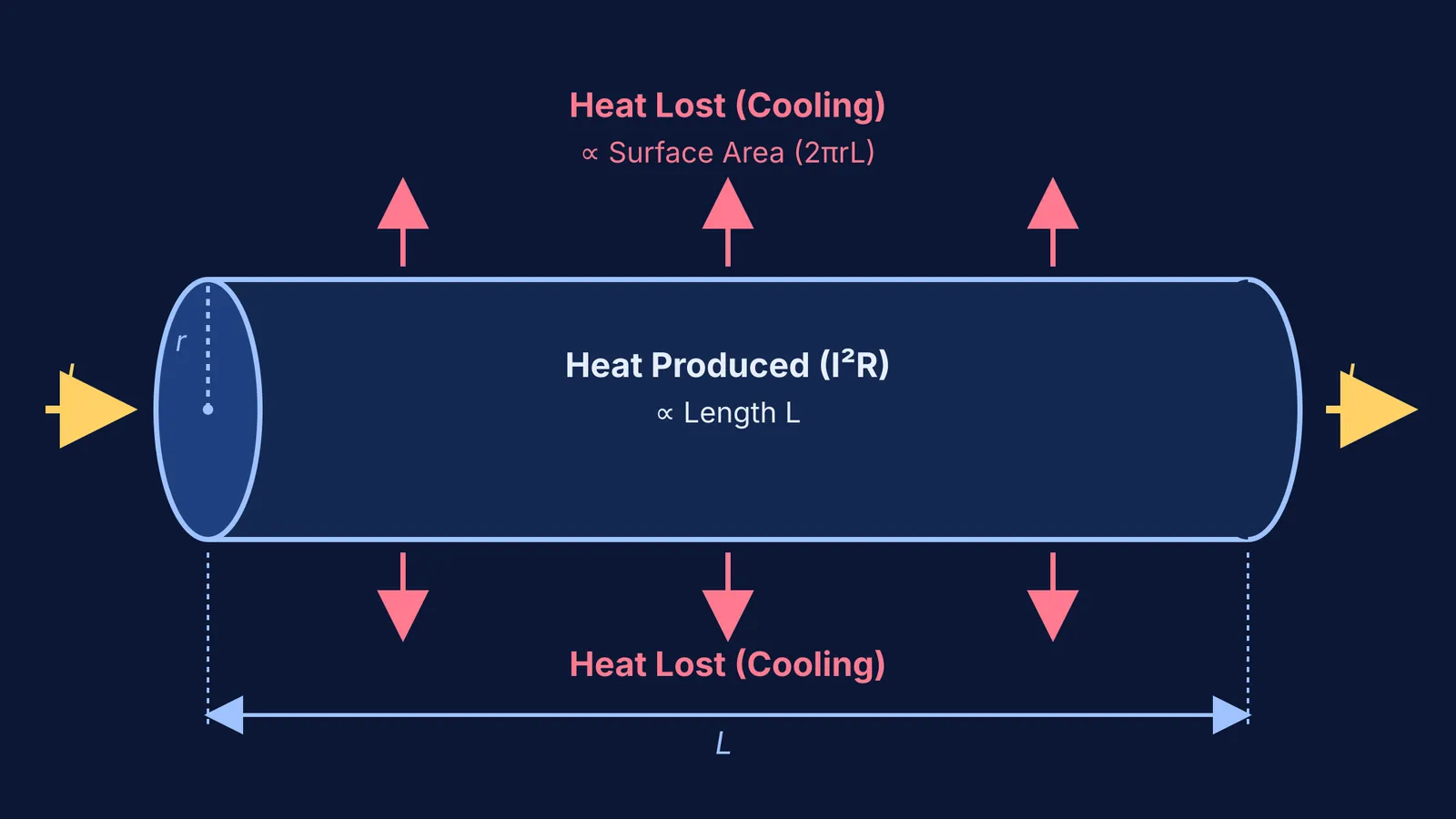
When a current I flows through a wire of resistance R, the heat produced per second is I²R. We know that resistance is given by R = ρL/A, where ρ is the resistivity, L is the length, and A is the cross-sectional area (πr²).
So, the heat generated is: Heat produced = I²(ρL / πr²)
Notice that the heat generated is directly proportional to the length, L. A longer wire does indeed produce more heat because its resistance is higher.
2. Heat Lost
The wire does not just sit there; it loses heat to the air through its surface. The rate of heat loss depends on the surface area of the wire, the temperature difference between the wire and the air (ΔT), and a heat transfer coefficient (h).
For a cylindrical wire, the curved surface area is 2πrL.
So, the heat lost is: Heat lost = (2πrL) × h × ΔT
Here again, the heat lost is directly proportional to the length, L. A longer wire has more surface area to radiate heat away.
3. The Balance
At the steady-state melting point, the heat generated equals the heat lost: I²(ρL / πr²) = (2πrL) × h × ΔT
Because L is a multiplier on both sides of the equation, it cancels out entirely. I²(ρ / πr²) = (2πr) × h × ΔT
Rearranging this to solve for I², we get: I² = (2π²hΔT / ρ) r³
This is the mathematical basis of Preece's Law. It shows that the fusing current I is proportional to r^(3/2). The length of the wire has vanished from the equation.
When Does Length Actually Matter?
In a theoretical "infinitely long" wire, the length cancels perfectly. However, in the real world, wires have ends.
If a fuse wire is extremely short, the heavy metal terminals holding it act as heat sinks. They draw heat away from the ends of the wire through conduction. In this case, the simple surface-area formula does not capture all the heat loss, and a short fuse might require a slightly higher current to melt than Preece's Law predicts. But for a standard fuse wire of reasonable length, the terminals' effect is negligible, and the radius alone determines the rating.
Beyond the terminals, length becomes crucial when we consider the voltage rating of a fuse. While the radius dictates the current at which the wire melts, the length determines what happens immediately after the wire breaks. When the fuse blows, the air gap can ionize, creating a sustained electrical arc if the voltage is high enough. A higher voltage circuit requires a physically longer fuse to ensure that the gap is wide enough to safely extinguish the arc and fully break the circuit. This is why a high-voltage fuse is noticeably longer than a low-voltage fuse, even if both are rated for the exact same melting current.
Spotting Patterns in Physics
This cancellation of a dimension is a common trick in physics problems. Whenever a property depends on volume (like mass or heat generated) and is balanced against a property that depends on surface area (like heat lost or air resistance), the shared dimension often drops out.
If you want to practice finding these relationships in circuits, the Fermi Concept Library maps out how variables connect across electricity and thermodynamics. You can also explore how geometry affects resistance by setting up the integral for the Resistance of a tapered conductor or calculating what happens when Stretching a wire. When a result seems counterintuitive, Fermi's AI tutor can draw the figure on a board and teach you through the reasoning, checking your understanding as it goes.


