

On this page
When you draw current from a real battery, the voltage across its terminals drops. This is why a car's headlights might dim slightly when the starter motor runs, or why lab readings for voltage don't perfectly match the label on a cell. The difference comes down to the cell's internal resistance.
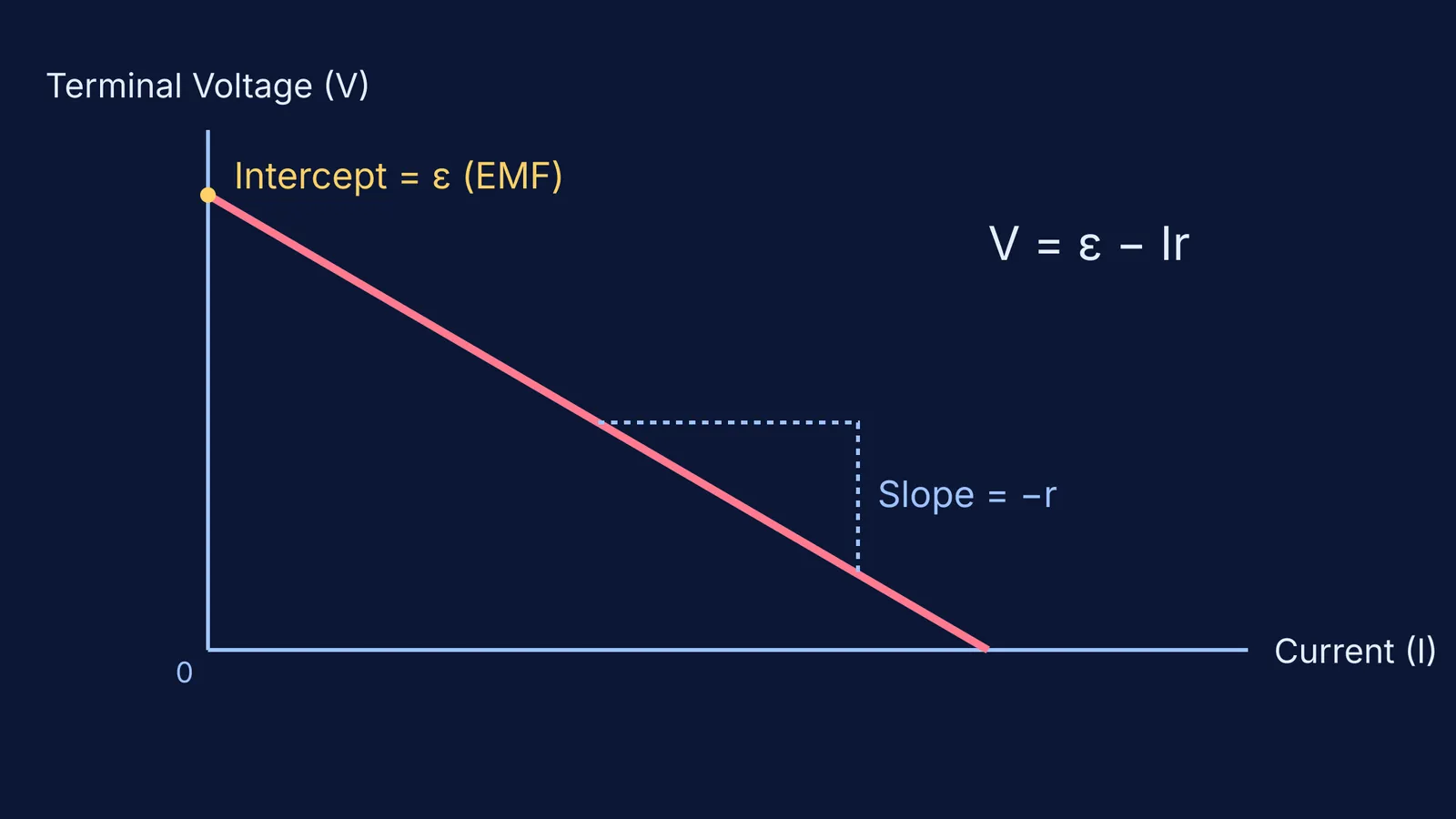
Plotting a terminal voltage vs current graph is the standard way to measure both the electromotive force (EMF) and the internal resistance of a power source.
What is the V = ε − Ir equation?
An ideal battery provides a constant voltage regardless of the current. But a real cell is made of chemicals and electrodes that naturally resist the flow of charge. We model this as an ideal voltage source in series with a small internal resistor (r).
When a current (I) flows, some voltage is "lost" pushing the charge through the cell's own internal resistance. This lost voltage is Ir. The terminal voltage (V) of a real cell is its electromotive force (ε) minus the voltage drop across its internal resistance (r), given by the equation V = ε − Ir (OpenStax).
This equation has the form of a straight line, y = mx + c, where:
y is the terminal voltage V
x is the current I
c is the intercept ε
m is the slope −r
How do you find EMF from a terminal voltage vs current graph?
If you plot experimental data with terminal voltage V on the y-axis and current I on the x-axis, you will get a straight line that slopes downwards.
The EMF is the value of the voltage when the current is zero. To find it on the graph, simply look at where the line crosses the y-axis. The y-intercept is the electromotive force (EMF) of the cell. For example, if the line crosses the y-axis at 1.5 V, the cell's EMF is 1.5 V.
How do you find internal resistance from a V-I graph?
As you draw more current, the terminal voltage drops. The rate of this drop depends on the internal resistance.
To find the internal resistance, you calculate the slope (gradient) of the line:
Pick two points on the line that are far apart.
Find the change in voltage (ΔV) and the change in current (ΔI) between them.
Divide the change in voltage by the change in current: Slope = ΔV / ΔI.
Because the line goes down, the slope will be a negative number. The internal resistance r is the negative of the slope (r = −Slope). If your slope is −0.5 V/A, your internal resistance is 0.5 Ω.
Dealing with circuit calculations
Reading graphs and solving for internal resistance often involves setting up equations for the whole circuit, including the external load resistor. If you get stuck on questions involving combinations of cells or mixed series and parallel loads, the Fermi Concept Library has a full breakdown of the physics behind direct current circuits.
When working through textbook numericals, wrong answers usually stem from a single missed step, like forgetting to add the internal resistance to the total circuit resistance. The Fermi Problem Library has worked problems with a step-by-step solver that explains the reasoning rather than printing an answer. If you upload a question, the AI tutor holds a line of reasoning across the session, notices where you are stuck, and decides whether to explain, ask, or show; it works out what you already know and builds a plan for the session so you find the right path yourself.
For a practical application of these ideas, you can review the standard Ohm's law practical or explore how to combine cells for maximum power. If you need help with the broader skill of interpreting slopes and areas, our guide on reading physics graphs breaks down common misreadings.
A worked example: finding the values
Imagine an experiment where a student measures the following data for a cell:
At I = 1.0 A, V = 5.5 V
At I = 3.0 A, V = 4.5 V
Find the internal resistance: The change in voltage is 4.5 − 5.5 = −1.0 V. The change in current is 3.0 − 1.0 = 2.0 A. Slope = −1.0 / 2.0 = −0.5 V/A. So, internal resistance r = 0.5 Ω.
Find the EMF: Use the equation V = ε − Ir with one of the points. 5.5 = ε − (1.0 × 0.5), which simplifies to 5.5 = ε − 0.5. Therefore, EMF ε = 6.0 V.
By plotting the points and drawing the line back to the y-axis, you would see the intercept perfectly matching this calculated EMF of 6.0 V.


