

On this page
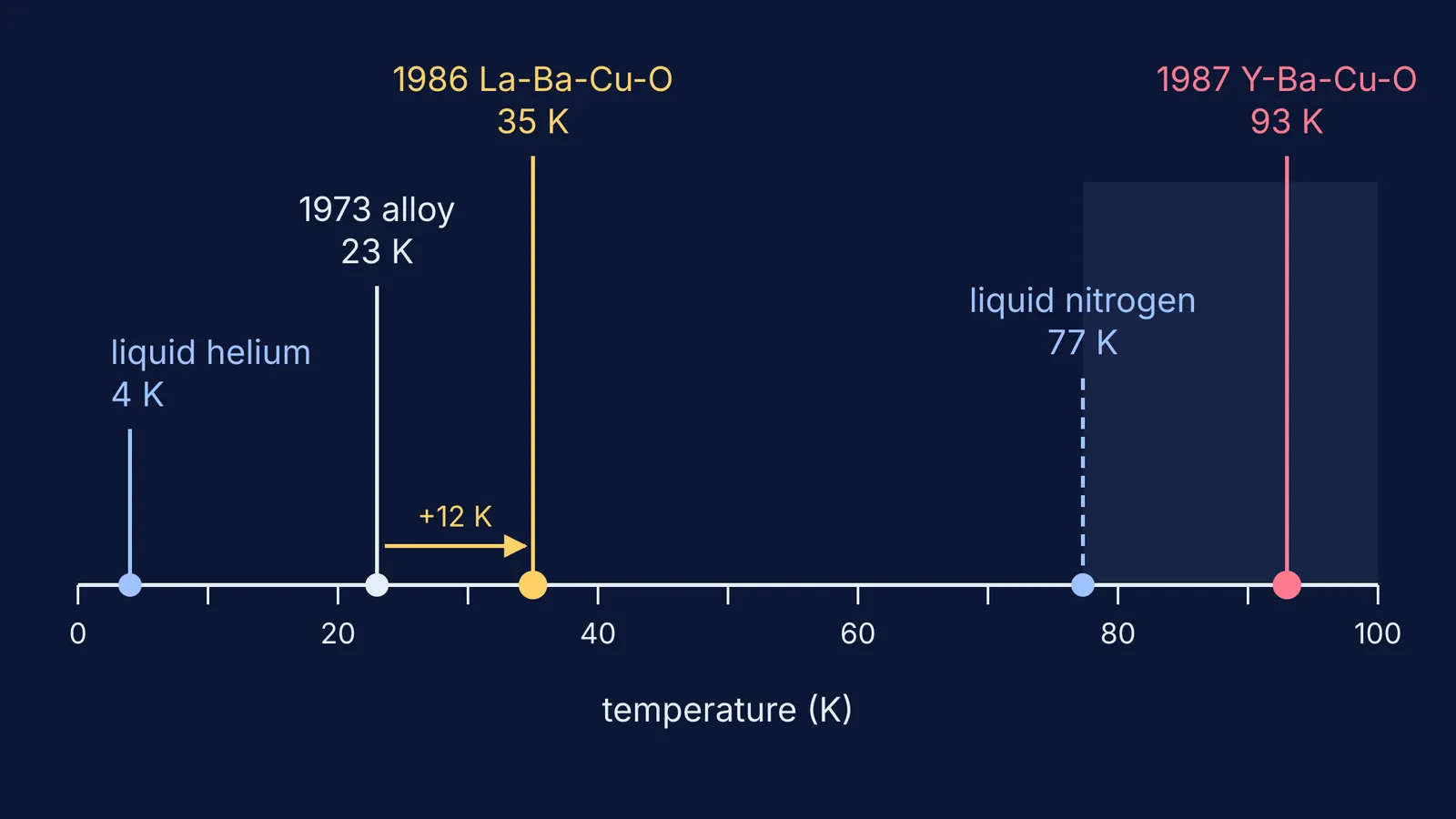
In January 1986, at IBM's Zurich Research Laboratory, Georg Bednorz and Alex Müller found that a ceramic sample became superconducting at about 35 K (IBM history of Georg Bednorz). That is −238 °C, which sounds frozen. But every superconductor known before then needed to be colder still, and the record had not moved since 1973.
What did Bednorz and Müller discover in 1986?
The material was lanthanum copper oxide with barium added, with an approximate composition of La1.85Ba0.15CuO4, according to the 1987 Nobel Prize press release. It is a ceramic from a family of oxides called perovskites (IBM history). The Nobel release says the transition to superconductivity set in 12 degrees above the highest temperature then known, and that later in 1986 the pair purified the material and demonstrated the magnetic properties of a genuine superconductor.
They published carefully. Their paper in Zeitschrift für Physik B, in the issue dated June 1986, was titled "Possible high Tc superconductivity in the Ba-La-Cu-O system" (the paper on doi.org). The word "possible" mattered: one measurement was not yet proof.
Why was 35 K such a big deal?
Superconductivity means that below a critical temperature a current flows with no resistance at all, and the material pushes magnetic fields out, which is called the Meissner effect (Nobel press release). Heike Kamerlingh Onnes discovered it in 1911. The catch was the cold: until 1986, every known superconductor needed liquid helium, which boils at −269 °C and is complicated and expensive to handle, the same release explains.
The best material, an alloy, reached 23 K in 1973, and that record stood for 13 years (IEEE Milestone proposal on high-temperature superconductivity). Bednorz and Müller jumped 12 K in one step.
The material itself was the second surprise. Ceramics were generally considered insulators, so the result was first greeted with skepticism (IBM history). The Nobel release describes their reasoning: in copper oxides, electrons interact strongly with the vibrating crystal, and that strong interaction was linked to the electron pairing that superconductivity needs.
What happened after the 1986 discovery?
Other labs moved fast. In March 1987, M. K. Wu, C. W. Chu and colleagues reported superconductivity at 93 K in a yttrium-barium-copper oxide in Physical Review Letters (the 1987 paper on doi.org). That is above the boiling point of liquid nitrogen, 77.3 K (NIST Chemistry WebBook). The Nobel press release notes that liquid nitrogen is a considerably cheaper, more efficient and more easily handled coolant than liquid helium.
The 1987 Nobel Prize in Physics went to Bednorz and Müller "for their important breakthrough in the discovery of superconductivity in ceramic materials" (Nobel press release). IBM calls it the shortest time ever between a discovery and a science Nobel (IBM history). Even then, the Nobel committee wrote that how superconductivity arises in the new materials was still unknown.
Worked example: how do you compare these temperatures?
News stories and exam questions mix kelvin and Celsius. Use T(K) = T(°C) + 273, and only take ratios in kelvin.
Liquid helium: −269 + 273 = 4 K.
The 1986 material: 35 − 273 = −238 °C.
How much warmer is 35 K than 23 K? In kelvin, 35 ÷ 23 ≈ 1.5, so about 50% further from absolute zero. In Celsius, −238 and −250 give a meaningless ratio, because 0 °C is not zero thermal energy.
The Nobel press release said new materials worked at more than four times the old temperatures, counted from absolute zero. Check: 93 ÷ 23 ≈ 4.0.
Can liquid nitrogen cool the 1986 ceramic into its superconducting state? No: 77 K is warmer than 35 K. It can cool the 93 K material, with 16 K to spare.
What can students take from Bednorz and Müller?
Look where others are not looking. They left the usual alloys and searched among metal oxides from 1983, the Nobel release says.
Name your uncertainty. "Possible" in a title is honest, not weak.
Check a result two independent ways, as they did with resistance and magnetism.
If the Meissner effect feels abstract, our explainer on why a superconductor is a perfect diamagnet works through it. For the contrast with everyday materials, read why a semiconductor's resistance falls as it warms and the derivation of drift velocity and Ohm's law.
For ideas that are easier to see than to read, the Fermi Simulation Lab has interactive simulations, and the Fermi Concept Library gives every concept in physics and chemistry its own lesson, so you can fill a gap like the kelvin scale before you attempt the numericals.


