

On this page
When you heat a metal wire, its resistance goes up. The atoms in the metal vibrate more violently with the added heat, acting as obstacles that slow down the flowing electrons. But if you heat an intrinsic (pure) semiconductor like silicon or germanium, its resistance behaves entirely differently: it drops as it gets hotter.
This negative temperature coefficient of resistance is driven by a tug-of-war between two physical processes: the number of available charge carriers and how freely those carriers can move through the crystal.
Why does carrier concentration rise so fast?
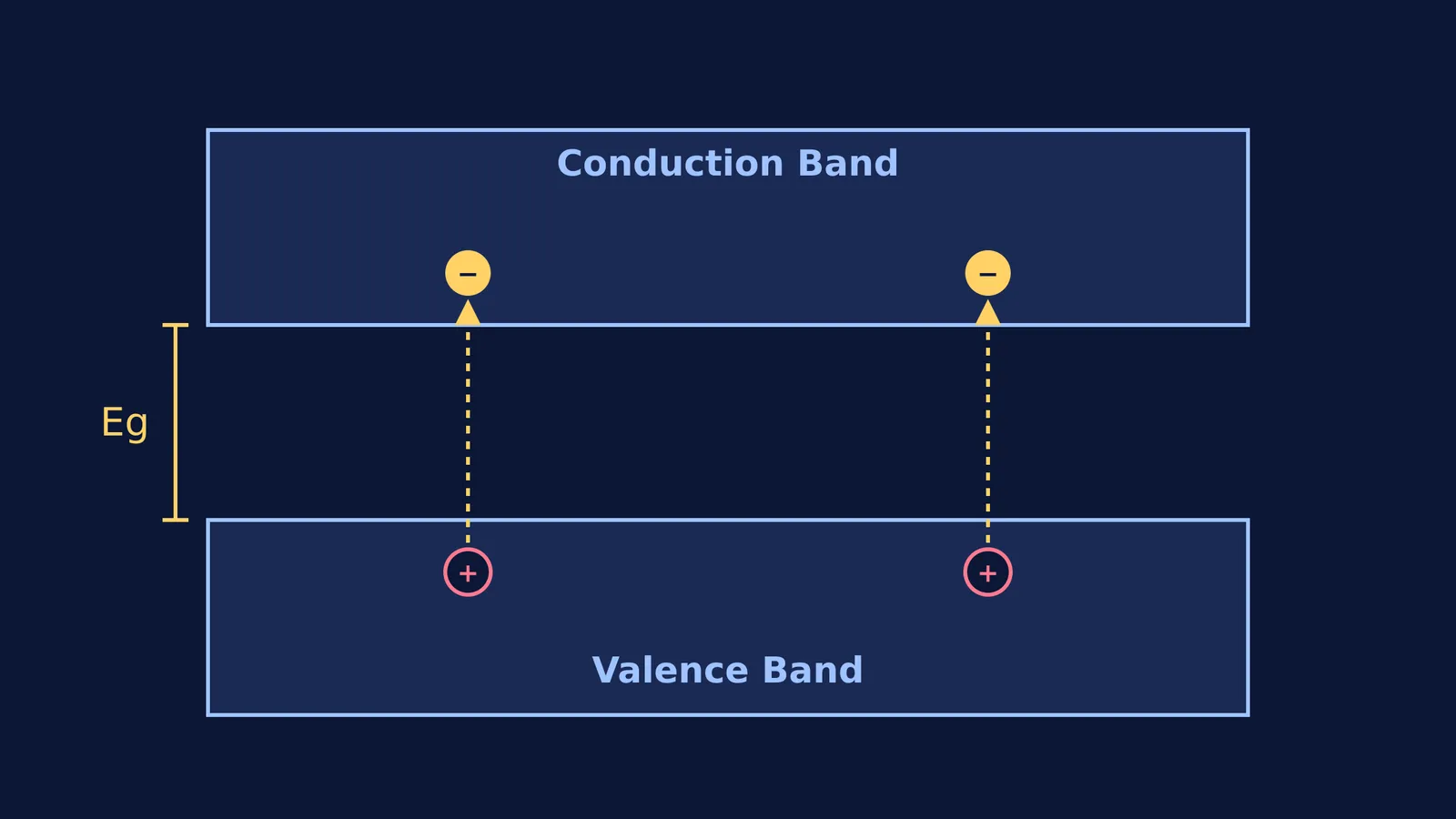
At absolute zero (0 K), an intrinsic semiconductor acts as a perfect insulator. Its valence band is completely full of electrons locked into covalent bonds, and its conduction band is completely empty. There are no free charges available to carry an electrical current.
As the temperature rises above zero, thermal energy (kT) begins to vibrate the crystal lattice, occasionally breaking covalent bonds. This energy knocks electrons loose, exciting them across the energy gap (Eg) and into the conduction band. Each electron that makes the jump leaves behind an electron deficiency in the valence band, known as a hole. In a semiconductor, both the free electron and the hole act as charge carriers.
The intrinsic carrier concentration (ni) represents the number of these electron-hole pairs in a given volume. It is highly sensitive to temperature and grows exponentially:
ni ∝ T^(3/2) exp(−Eg / 2kT)
Because of this exponential relationship, even a small increase in temperature produces a massive surge in charge carriers. For example, at room temperature (300 K), the intrinsic carrier concentration of silicon is approximately 9.65 × 10⁹ cm⁻³. If you heat the silicon further, this concentration multiplies rapidly. The hotter the material gets, the more covalent bonds break, flooding the material with free electrons and holes.
What about lattice scattering?
While the number of carriers is skyrocketing, their ability to move is actually being hindered by the very same heat.
Just as in metals, the atoms in a semiconductor's crystal lattice vibrate more energetically at higher temperatures. These thermal vibrations propagate as pressure waves through the crystal, known as phonons. As electrons and holes try to drift through the material under an electric field, they collide with and scatter off these vibrating atoms. This phenomenon is called lattice scattering, and it acts as friction, reducing the carrier mobility (μ).
For non-polar semiconductors like silicon, theoretical physics models show that mobility due to acoustic phonon scattering drops proportionally to T^(−3/2). As the semiconductor gets hotter, the carriers bump into vibrating atoms more often and more violently, which limits their drift velocity.
Which effect wins the tug-of-war?
The overall electrical conductivity (σ) of the semiconductor depends directly on both the concentration of carriers and their mobility. The formula is:
σ = ni e (μe + μh)
Here, the two temperature effects are fighting against each other. The mobility (μ) is dropping algebraically as T^(−3/2), which tends to push the resistance up. However, the intrinsic carrier concentration (ni) is rising exponentially, which pushes the resistance down.
In an intrinsic semiconductor, the exponential generation of new electron-hole pairs completely overpowers the relatively sluggish drop in mobility. The net result is a massive increase in overall conductivity, meaning the resistance drops sharply as the material heats up. This is why intrinsic semiconductors are often used in thermistors (temperature sensors) — their resistance provides a highly sensitive, predictable measure of temperature.
How should you structure your exam answer?
If you are a student, "why resistance of semiconductor decreases with temperature" is a classic conceptual question that frequently appears in multiple-choice and short-answer sections. To score full marks and avoid confusing semiconductors with metals, structure your reasoning around the two competing factors.
The Generators: State clearly that thermal energy breaks covalent bonds, generating electron-hole pairs. Write down the proportionality ni ∝ T^(3/2) exp(−Eg / 2kT) to prove that the carrier concentration rises exponentially with heat.
The Blockers: Acknowledge that lattice vibrations (phonons) increase with temperature, leading to increased lattice scattering. Note that this causes the carrier mobility to drop (μ ∝ T^(−3/2)).
The Victor: Conclude your answer by stating that the exponential increase in carrier concentration vastly overwhelms the algebraic decrease in mobility, leading to a net increase in conductivity and a net decrease in resistance.
If you find yourself memorising these equations instead of truly understanding them, the Fermi Concept Library holds a lesson for every concept in physics and chemistry, showing exactly where it fits in the wider map of the subject. A clear grasp of the underlying band theory makes these temperature trends feel intuitive and logical, rather than just another fact you have to cram before test day.


