

On this page
When you cool certain materials below their critical temperature (Tc), they lose all electrical resistance. But superconductivity is much more than just perfect conductivity. If you place a magnet above a cooled superconductor, the magnet floats effortlessly in mid-air. This levitation happens because a superconductor acts as a perfect diamagnet.
What happens inside a perfect diamagnet?
To understand this magnetic levitation, we first need to look at magnetic susceptibility (χ), a property that measures how a material responds to an applied magnetic field. Many everyday materials are slightly diamagnetic, meaning they very weakly repel external magnetic fields. For example, the volume magnetic susceptibility of water is roughly −9 × 10⁻⁶ (Source).
When any material is exposed to an external magnetic field intensity (H), it develops its own internal magnetization (M). The total internal magnetic field, or magnetic induction (B), is the sum of both the external field and the material's response:
B = μ₀(H + M)
For a standard diamagnetic material like water, M is a tiny negative fraction of H. Because this opposing magnetization is so small, the resulting internal field B is only slightly less than the external field.
Why is a superconductor's susceptibility exactly −1?
In 1933, physicists Walther Meissner and Robert Ochsenfeld discovered that when a material becomes superconducting, it actively expels all magnetic flux from its interior (Source). You can read more about this historic experiment in our profile on Walther Meissner and superconductors expelling fields.
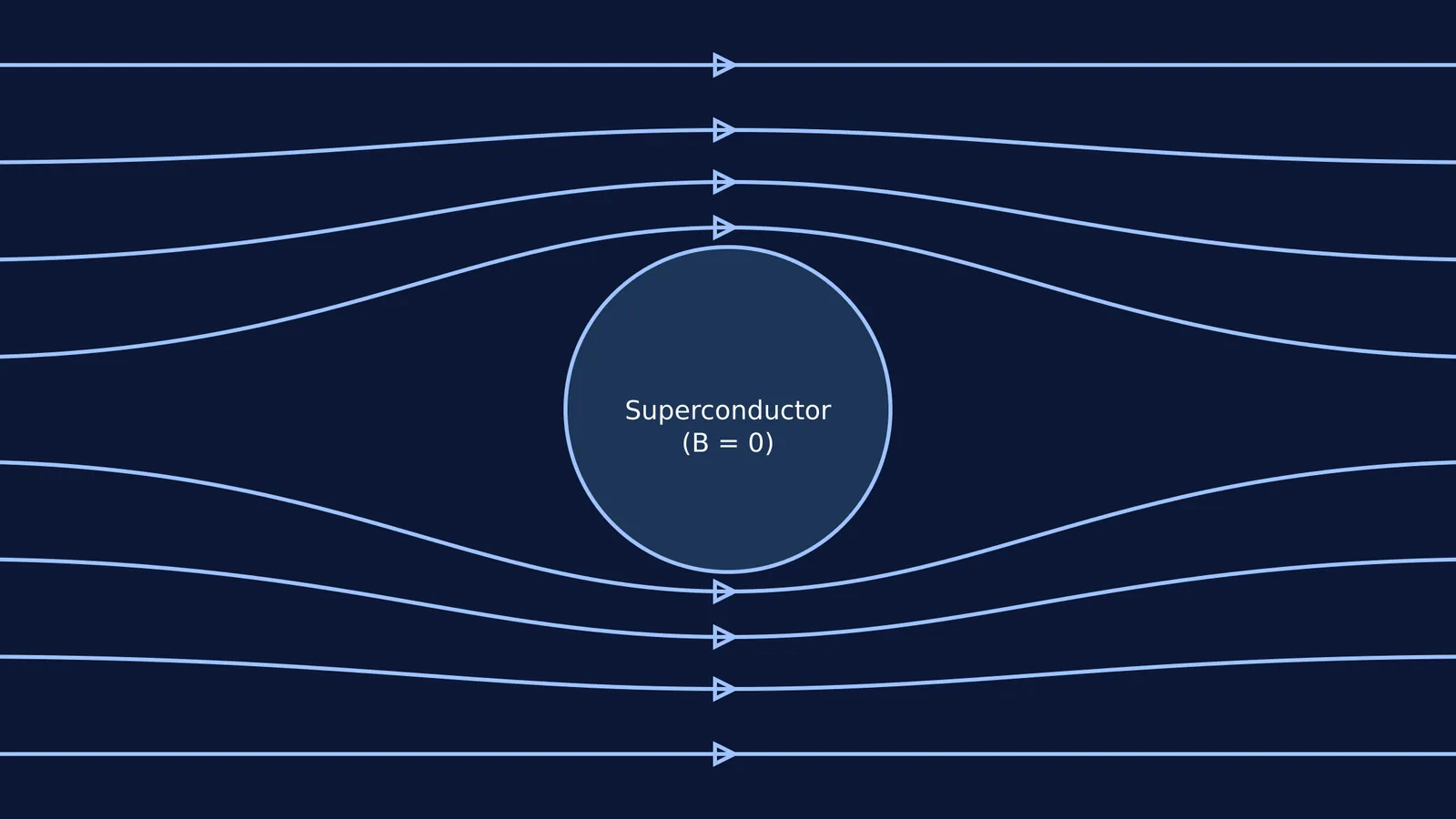
Because of this Meissner effect, the magnetic field (B) inside the bulk of a superconductor drops to exactly zero (Source). The material achieves this by running lossless screening currents along its surface. These persistent surface currents generate a magnetic field that perfectly cancels out the applied external field.
Returning to our magnetic induction equation with an internal field of zero:
0 = μ₀(H + M)
This means the material must generate a magnetization perfectly equal and opposite to the applied field:
M = −H
Magnetic susceptibility is defined as the ratio of magnetization to the applied field (χ = M/H). Substituting −H for M, we find that a superconductor's susceptibility is exactly −1. This value represents the theoretical maximum for diamagnetism.
Perfect conductors vs. perfect diamagnets
It is tempting to think that having zero electrical resistance alone explains this field expulsion, but that is a misconception. If you apply a magnetic field to a hypothetical "perfect conductor," Lenz's law dictates that it will generate surface currents to oppose the change in flux, keeping the internal field frozen at whatever value it had before (to see how normal materials handle charge transport, compare energy bands: conductors, semiconductors and insulators).
Superconductors, however, behave entirely differently. Even if a magnetic field is already present before the material is cooled, the moment it crosses the critical temperature, it forcibly kicks the field out. This history-independent state proves superconductivity is a distinct thermodynamic phase of matter, not just a metal with zero resistance. Unlike the helical path of a charge in a magnetic field, where the field dictates a particle's motion, the superconductor strictly forbids the field from entering the bulk at all.
Exam Checklist: Spotting the difference
When solving physics problems, examiners often test whether you know the difference between a normal perfect conductor and a true superconductor. Use this quick checklist to avoid common traps:
Internal Field (B): For a perfect conductor, B is constant (it stays at whatever value it had before the change). For a superconductor, B = 0 always.
Magnetic Susceptibility (χ): For a perfect conductor, it is undefined or depends on the material's history. For a superconductor, χ = −1.
Cooling in a static field: A perfect conductor simply traps the field inside as it cools. A superconductor actively expels it.
If you are exploring magnetism for JEE or university physics, the Fermi Concept Library maps out every concept in physics, chemistry, biology, mathematics and computing, each with its own lesson and its place in the map.
Instead of just printing a final numerical answer to a problem, Fermi's AI tutor teaches. It holds a line of reasoning across a whole session, notices where you are stuck, and decides whether to explain, ask, or show—even drawing the figure on a board so you can clearly see the Meissner effect in action.


