

On this page
The microscopic model of conduction explains how a current flows through a wire at the atomic level. When you learn physics from first principles, connecting the macroscopic formulas you use in lab experiments—like Ohm's law—with the tiny, invisible motions of electrons makes the formulas much easier to remember and understand.
What is drift velocity?
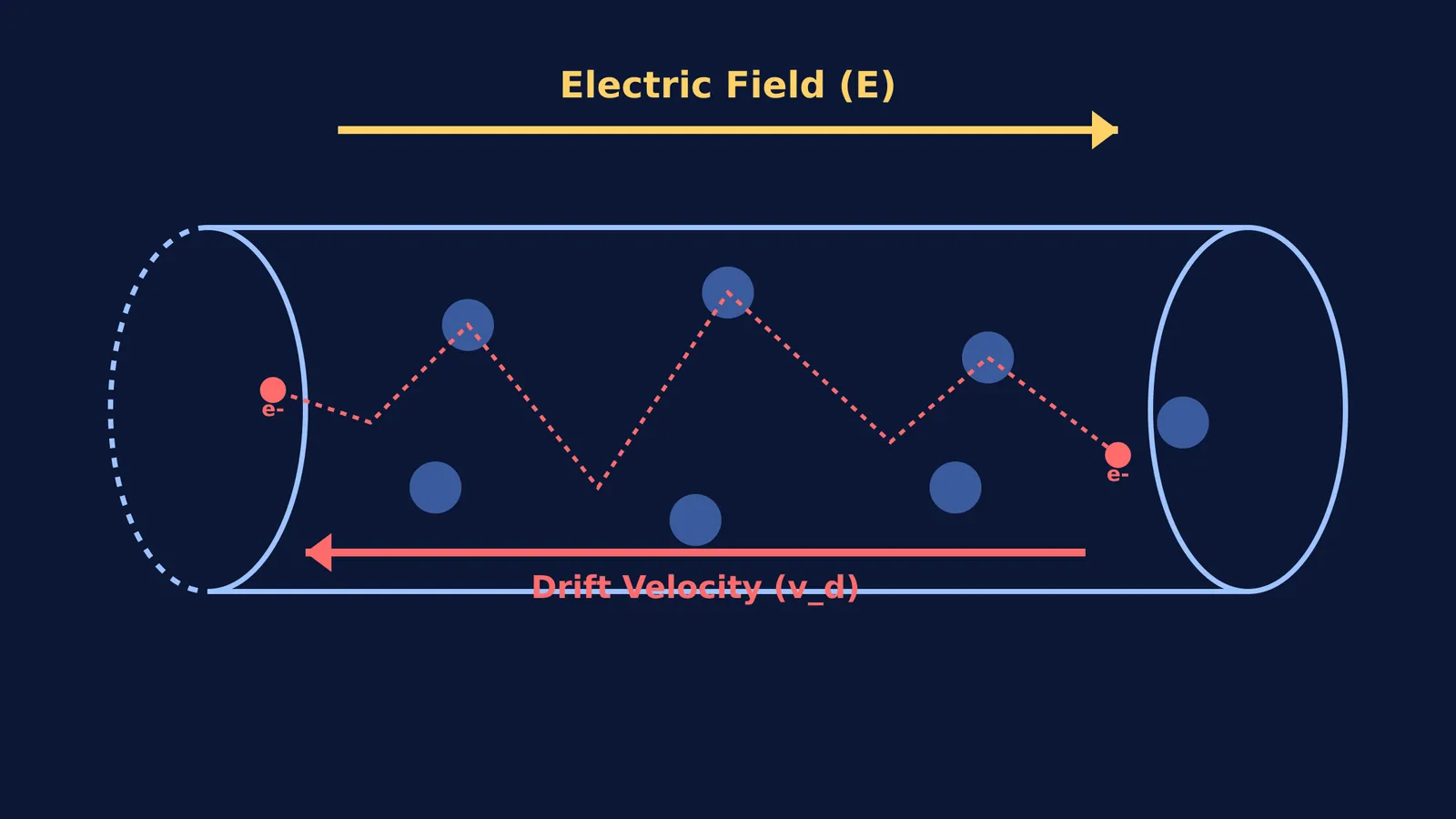
Drift velocity is the average velocity of free charges as they move through a conductor under the influence of an electric field. In a standard piece of metal with no applied voltage, free electrons zip around at incredibly high speeds in random paths, bouncing off the fixed atoms in the metal lattice. Because this motion is entirely random, there is no net flow of charge in any single direction.
When you apply a voltage from a battery, it creates an electric field inside the wire. This field constantly pushes the electrons, giving them a slow, net movement in one direction on top of their fast, random zig-zags. This net forward speed is the drift velocity. Even though an individual electron carries a tiny charge of roughly −1.60 × 10⁻¹⁹ C, the sheer number of them shifting together creates a steady current. (You can read more about why a bulb glows instantly if drift velocity is so small to understand how the electric field propagates through the circuit.)
How do you derive drift velocity from relaxation time?
To find the derivation of drift velocity, we use Newton's laws of motion and a property called relaxation time (τ). Relaxation time is defined as the average time an electron travels freely between collisions with the metal lattice.
When an electric field (E) is applied across the conductor, it exerts a force on an electron of charge (e). The magnitude of this force is F = eE.
Using Newton's second law (F = ma), the acceleration (a) of an electron with mass (m) is a = eE / m.
The average velocity that the electron gains in the direction of the field between collisions is the drift velocity (v_d). Multiplying the steady acceleration by the relaxation time gives the final formula: v_d = (eE / m) τ.
If you are stuck picturing these derivations, the Fermi Concept Library has every concept in physics, chemistry, biology, mathematics and computing, each with its own lesson and its place in the map.
How is Ohm's law derived from drift velocity?
With the drift velocity formula ready, we can derive the macroscopic Ohm's law (V = IR) step by step. This proves that macroscopic resistance fundamentally comes from electrons colliding with atoms.
First, we write the current (I) in terms of drift velocity: I = n e A v_d, where n is the free charge density (number of electrons per unit volume) and A is the cross-sectional area of the wire.
Substitute the drift velocity formula into the current equation: I = n e A (eEτ / m)
Simplify this to find the current density (J = I / A): J = (n e² τ / m) E. This equation is known as the microscopic form of Ohm's law, which states that current density is directly proportional to the electric field.
To reach the familiar V = IR, replace the electric field (E) with the voltage divided by the length of the wire (V / L): I = (n e² A τ / m) (V / L)
Rearrange the equation to isolate V: V = [m L / (n e² A τ)] I
The bracketed term represents the electrical resistance (R) of the wire. Therefore, V = I R, and the specific resistivity of the material is ρ = m / (n e² τ). If you want to dive deeper into these properties, see the difference between resistance and resistivity.
How is drift velocity calculated for copper?
Let's calculate how slow this drift really is using a standard 20.0 A current flowing through a 12-gauge copper wire, which has a diameter of 2.053 mm.
The density of free electrons in copper is 8.34 × 10²⁸ electrons/m³.
The cross-sectional area (A) for a radius of 1.0265 × 10⁻³ m is 3.30 × 10⁻⁶ m².
Using the rearranged formula v_d = I / (n e A), we divide 20.0 A by the product of the charge density, the electron charge, and the area.
The resulting drift velocity is −4.54 × 10⁻⁴ m/s.
This result shows that electrons drift at less than half a millimetre per second. However, the signal moves on the order of 10¹² times faster than the charges that carry it, so the current flows everywhere in the circuit almost immediately. (For related problems, see drift velocity in a varying wire: why thinner means faster.)


