

On this page
What is the difference between resistance and resistivity?
When you connect a wire across a circuit, two distinct properties govern how current flows: resistance and resistivity. The fundamental difference is between a specific object and the substance it is made from. Resistance, denoted by R, is an extrinsic property of a particular component. It measures the total opposition that a given object offers to electric current. Electrical resistivity, denoted by the Greek letter ρ (rho), is an intrinsic property of the material itself. It quantifies how strongly a substance opposes charge transport regardless of its dimensions.
According to the BIPM SI Brochure (9th edition), the SI derived unit of resistance is the ohm (Ω), defined as 1 volt per ampere (1 V/A) or 1 kg·m²·s⁻³·A⁻² in base units. The coherent SI derived unit of resistivity is the ohm metre (Ω·m), equivalent to 1 kg·m³·s⁻³·A⁻². A common exam mistake is writing "ohm per metre" (Ω/m), which measures linear resistance along a transmission line, rather than ohm metre (Ω·m).
Think of water flowing through a corridor: resistance is the total difficulty of moving through a specific hallway, where length and width matter, while resistivity is the roughness of the floor material itself. If you are organizing these foundational concepts, the Fermi Concept Library maps every concept in physics, chemistry, biology, mathematics and computing, each with its own lesson and its place in the map.
Why does resistance depend on geometry while resistivity does not?
For a uniform conductor of length L and cross-sectional area A, resistance follows the relation R = ρL / A, as outlined in OpenStax University Physics Volume 2. Geometry affects resistance directly:
Length: Doubling length doubles resistance (R ∝ L) because drifting electrons encounter twice as many atomic collisions along their path.
Area: Doubling cross-sectional area halves resistance (R ∝ 1/A) because a wider conductor offers more parallel channels for current.
Material: Resistivity ρ = R × A / L remains constant for a given substance at fixed temperature. If length doubles, resistance doubles in lockstep, keeping the ratio R × A / L unchanged.
At the microscopic level, NCERT Class 12 Physics shows that resistivity depends only on atomic structure: ρ = m / (n × e² × τ), where m is electron mass, e is elementary charge, n is free electron density, and τ is mean relaxation time between collisions. Because n and τ are characteristic of the material at a given temperature, cutting or reshaping a wire cannot change ρ. To see how electron drift relates to macroscopic current, read our explainer on drift velocity and current density in conductors.
How does stretching a wire change resistance and resistivity?
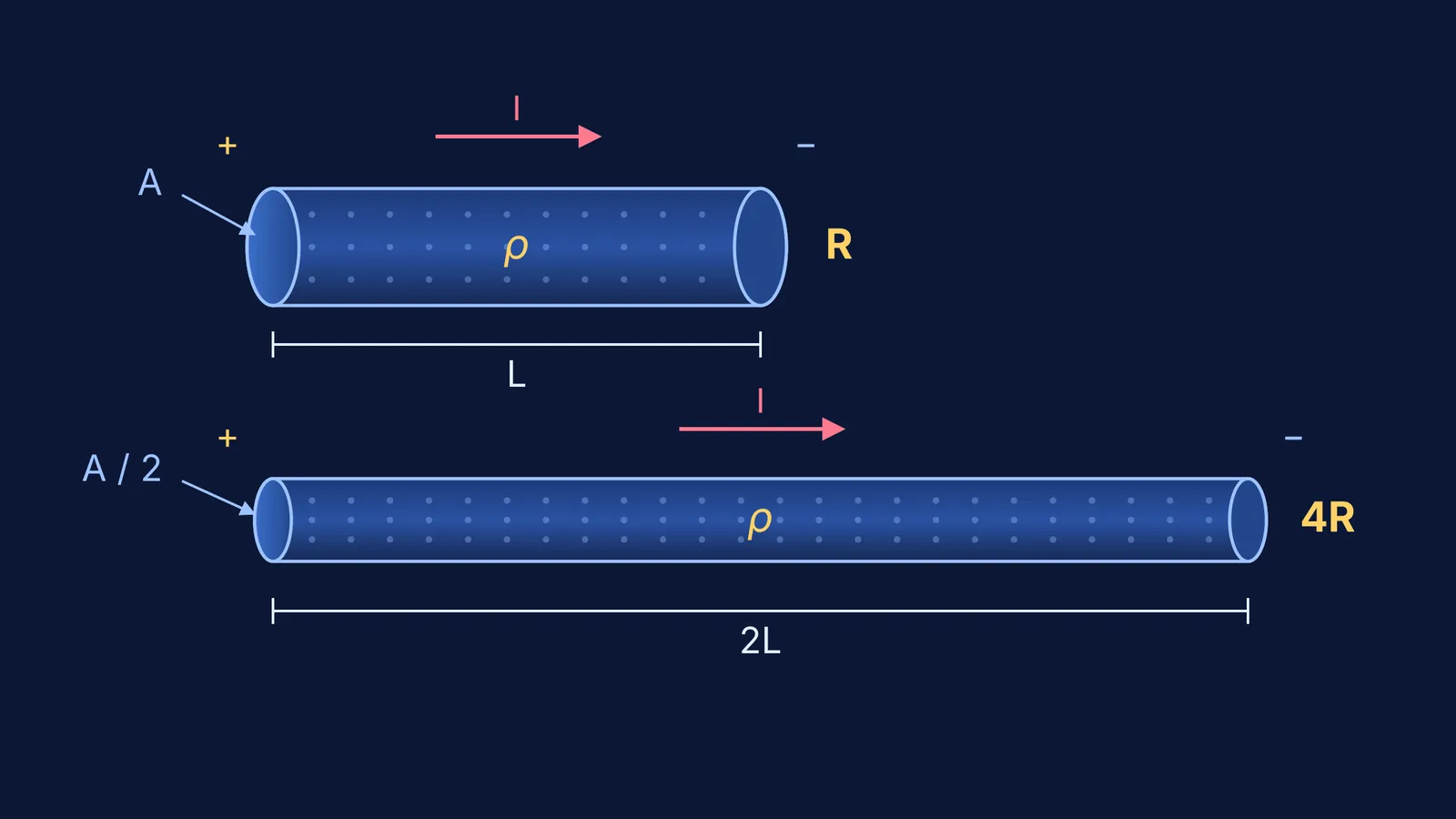
A standard question discussed in NCERT Class 10 Science and board exams asks what happens when a wire of resistance R = 5.0 Ω is stretched uniformly to double its original length (2L).
Volume conservation: Because density and mass do not change, the volume V = A × L is constant. When length doubles to 2L, the cross-sectional area must halve to A / 2.
New resistance: The new resistance becomes R' = ρ × (2L) / (A / 2) = 4 × (ρL / A) = 4R. For an initial 5.0 Ω wire, the final resistance is 4 × 5.0 Ω = 20.0 Ω, an increase by a factor of 4.
New resistivity: Because the wire is still made of copper at constant temperature, its resistivity ρ' = ρ, changing by 0%.
Many students incorrectly assume resistance only doubles, overlooking that stretching also thins the wire. You can check the complete derivation in our guide on how stretching a wire changes its resistance. When solving multi-step circuit numericals, the Fermi Problem Library provides worked problems with a step-by-step solver that explains the reasoning rather than printing an answer.
How do temperature and material affect resistance and resistivity?
Temperature alters both quantities. In metals, heating increases lattice vibrations, causing more frequent collisions that shorten relaxation time τ and raise resistivity. OpenStax University Physics Volume 2 models this as ρ = ρ₀[1 + α(T - T₀)], where α is the temperature coefficient. For worked calculations, see our guide on the temperature coefficient of resistance formula and worked examples.
Resistivity varies drastically across materials at 20 °C, as listed in NCERT Class 10 Science:
Conductors: Silver (1.60 × 10⁻⁸ Ω·m) and copper (1.62 × 10⁻⁸ Ω·m) offer very low resistivity, making copper the standard for home wiring.
Alloys: Nichrome has a resistivity of 100 × 10⁻⁶ Ω·m in the NCERT table, roughly 6,000 times that of copper, making it ideal for heating elements that must produce heat without oxidizing.
Insulators: Glass and rubber reach resistivities above 10¹² Ω·m, stopping current almost entirely.
For ideas that are clearer to watch than read, the Fermi Simulation Lab provides interactive simulations for the ideas that are easier to see than to read.


