

On this page
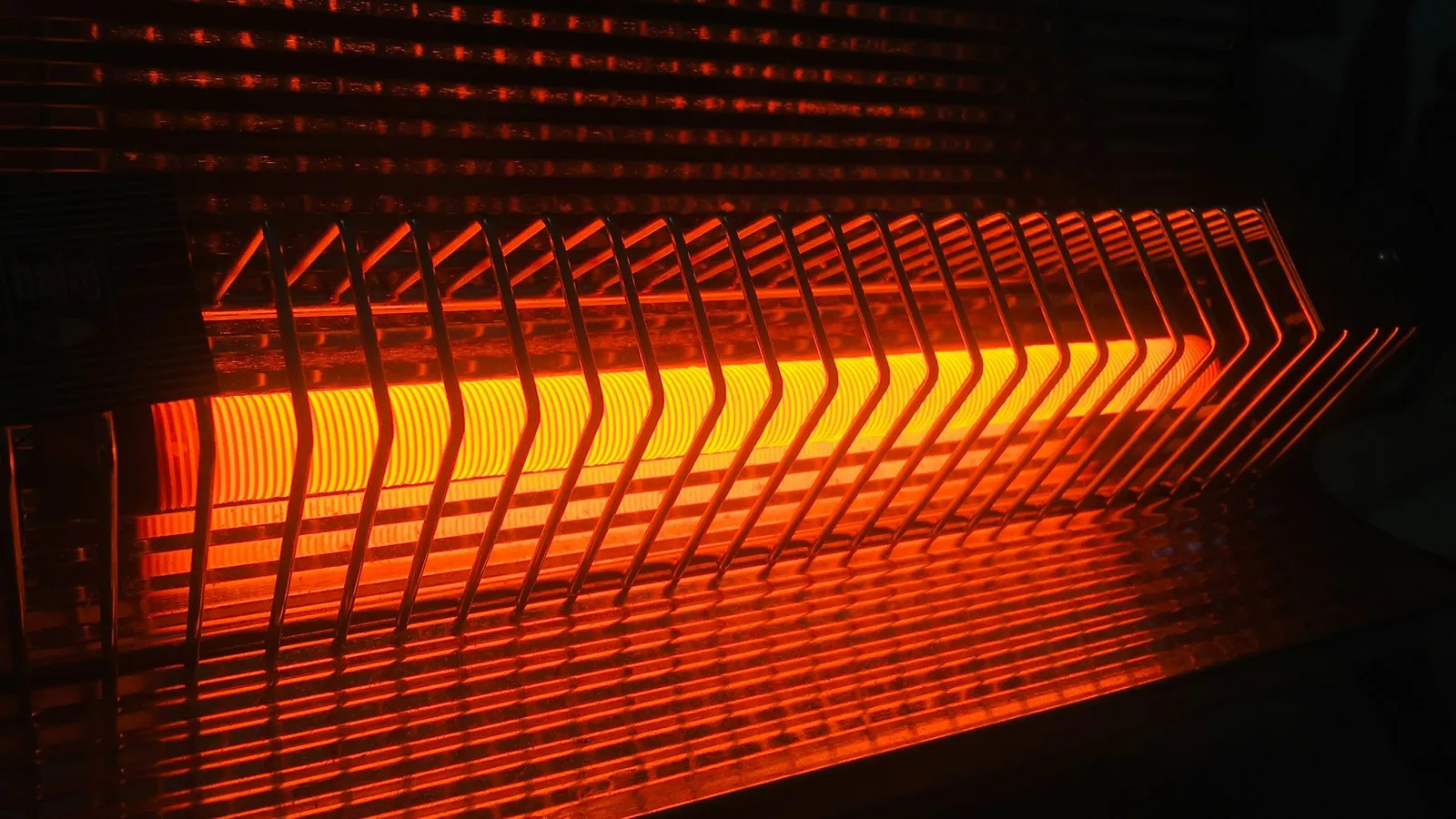
Switch on a toaster and its current settles a little below its first value within a few seconds. The element has heated up, and its resistance has gone up with it. This post explains why that happens, how to use the temperature coefficient formula, and three worked problems, with the sign and unit slips that cost marks.
Where is this in the syllabus?
The CBSE Physics curriculum for 2026-27 lists "temperature dependence of resistance" in the Current Electricity chapter of Class 12. The JEE Main 2026 syllabus has the same phrase in its Current Electricity unit. The textbook treatment is section 3.8 of the NCERT Class 12 Physics chapter on Current Electricity.
What is the temperature coefficient of resistivity?
NCERT gives, for a metallic conductor over a range of temperatures that is not too large:
ρT = ρ0[1 + α(T − T0)]
Here ρ0 is the resistivity at a reference temperature T0, and α is the temperature coefficient of resistivity, with units of per degree (°C⁻¹ or K⁻¹). NCERT's summary defines α as the fractional increase in resistivity per unit rise in temperature. For metals α is positive. If the wire's size hardly changes, resistance follows the same rule: R = R0[1 + α(T − T0)].
The relation predicts a straight line on a ρ against T graph. NCERT points out that for copper the graph bends well away from a straight line at temperatures far below 0 °C. Use the formula only over a limited range around T0.
Why does a metal's resistance rise when it gets hotter?
NCERT writes resistivity as ρ = m/(ne²τ), where n is the number of free electrons per unit volume and τ is the average time between collisions. In a metal, n hardly changes with temperature. But hotter electrons move faster and collide more often, so τ falls and ρ rises.
In semiconductors and insulators, n increases with temperature. That increase more than makes up for the fall in τ, so their resistivity decreases as temperature rises. Alloys such as nichrome, manganin and constantan change very little with temperature. NCERT notes that this is why they are used in wire-wound standard resistors.
At the extreme low end, something stranger happens. The Nobel Prize facts page for Heike Kamerlingh Onnes records that in 1911 he found the electrical resistance of mercury completely disappeared a few degrees above absolute zero. This is superconductivity, which is far outside the linear rule.
Worked example 1: finding α from two readings
NCERT Exercise 3.5: a silver wire has a resistance of 2.1 Ω at 27.5 °C and 2.7 Ω at 100 °C. Find α.
Using R = R1[1 + α(T − T1)] with the 27.5 °C reading as reference:
α = (R − R1)/[R1(T − T1)] = (2.7 − 2.1)/[2.1 × (100 − 27.5)] = 0.6/(2.1 × 72.5) = 0.6/152.25 = 3.9 × 10⁻³ °C⁻¹
Worked example 2: the toaster
NCERT Example 3.3: a nichrome toaster element measures 75.3 Ω at room temperature (27.0 °C) with a tiny current. On a 230 V supply the current settles at 2.68 A. Take α = 1.70 × 10⁻⁴ °C⁻¹.
Hot resistance: R2 = 230/2.68 = 85.8 Ω.
Rise in temperature: T2 − T1 = (R2 − R1)/(R1α) = (85.8 − 75.3)/(75.3 × 1.70 × 10⁻⁴) = 10.5/0.0128 = 820 °C.
Steady temperature: T2 = 820 + 27.0 = 847 °C.
Notice how small α is for nichrome. A rise of about 820 °C increases resistance by only about 14 per cent (10.5/75.3 = 0.139).
Worked example 3: finding temperature from resistance
NCERT Exercise 3.3: a heating element is 100 Ω at 27.0 °C and 117 Ω when hot, with α = 1.70 × 10⁻⁴ °C⁻¹.
T − 27.0 = (117 − 100)/(100 × 1.70 × 10⁻⁴) = 17/0.017 = 1000 °C, so T = 1027 °C.
Common mistakes and how to avoid them
Using the hot current to find the cold resistance. In problems like the toaster, the room-temperature resistance comes from the small-current or initial reading, and the hot resistance from the steady current.
Mixing up °C and K. A temperature difference is the same in both units, so α has the same value per °C and per K. Do not add 273 to a difference.
Forgetting the reference temperature. R0 in the formula is the resistance at T0, which is not necessarily 0 °C. Use the temperature the problem gives.
Applying a positive α to a semiconductor. Its resistance falls as it heats.
Using the formula over huge ranges. It is a linear approximation, which is why problems quote α "averaged over the temperature range involved".
A practice routine
Redo the three worked examples without looking, then try NCERT Exercise 3.6. A nichrome element on 230 V draws 3.2 A at first and settles at 2.8 A, starting at 27.0 °C. You should get about 867 °C.
Write one line explaining each sign: why α is positive for copper and why resistivity falls with temperature for silicon.
Mix these problems with drift velocity questions from our post on drift velocity and resistivity, so you practise choosing the right formula.
When you get the wrong temperature and cannot see why, the Fermi Problem Library has worked problems with a step-by-step solver that explains the reasoning rather than printing an answer.
Tonight, solve Exercise 3.6 and check your answer against 867 °C.


