

On this page
When you connect a wire of varying thickness to a battery, you might intuitively think that more current flows through the thicker parts and less through the thinner parts. This is a common trap in JEE and NEET physics.
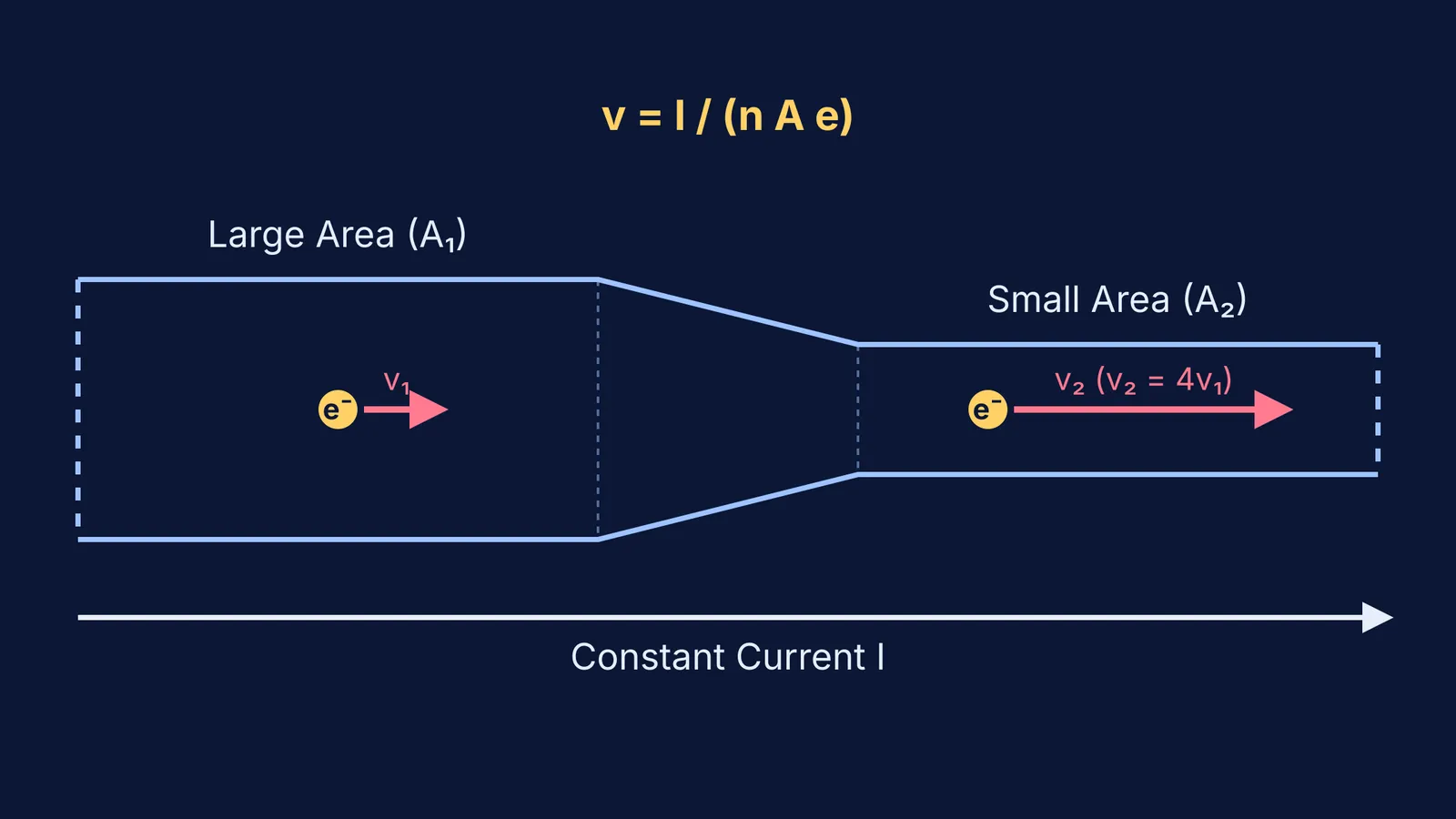
In reality, the current is exactly the same everywhere. What changes is the drift velocity of the electrons.
Why is the current constant everywhere?
Think of a wire as a pipe full of water. If you push one litre of water into the left end, one litre must come out the right end, no matter how the pipe narrows or widens in between. This is the principle of conservation of charge, formalised as Kirchhoff's current law, which states that the sum of currents flowing into any node must equal the sum flowing out (Source).
Since charge cannot build up or disappear inside the wire, the rate of flow of charge (the current, I) must be identical across every cross-section of the conductor.
How does cross-sectional area affect drift velocity?
Current is the macroscopic result of microscopic charge carriers moving. For a wire, the relationship between current (I) and the drift velocity (v) of its free electrons is:
I = n × A × e × v
Where:
n is the number density of free electrons (which is constant for a given material like copper).
A is the cross-sectional area.
e is the elementary charge of an electron.
v is the drift velocity.
Since the current I, the material property n, and the charge e are all constant, we can rewrite the formula to see how v depends on A:
v = I / (n × A × e)
This shows that drift velocity v is inversely proportional to the cross-sectional area A (v ∝ 1/A).
When the wire gets thinner, the cross-sectional area A decreases. To maintain the same constant flow of charge (current), the electrons must move faster through the narrow section, much like a river speeding up when it flows through a narrow gorge. Conversely, in a thicker section, they can move more slowly because there is a larger area for the charge to pass through.
Translating a physical rule like v ∝ 1/A into a mental model can be difficult. If you find it hard to picture how velocity changes with area, plotting it out or using interactive tools can bridge the gap. The Fermi Concept Library covers every concept in physics, chemistry, biology, mathematics and computing, each with its own lesson and its place in the map, so you can see exactly how the variables constrain each other.
How does drift velocity compare to thermal velocity?
If you look inside a conductor, electrons are not standing still waiting for a battery to push them. They are constantly zipping around in random directions due to thermal energy, colliding with the stationary atoms of the metal lattice. The thermal speed of electrons at room temperature is in the order of 10⁶ m/s (Source).
However, because this motion is completely random, the net flow in any one direction is zero. When an electric field is applied across a wire, it imposes a very small, directional push—the drift velocity—on top of this chaotic thermal motion. This is why drift velocity is so slow compared to the rapid thermal speeds.
Even though the individual electrons drift slowly, a bulb lights up the instant you flip a switch. This is because the electric field itself propagates through the entire wire at nearly the speed of light, causing electrons in all sections to start drifting simultaneously.
How can I remember this for the exam?
If you are faced with a question comparing two sections of a tapered wire, remember this checklist:
Current (I) is the same in both sections.
Current density (J = I/A) is higher in the thinner section.
Drift velocity (v ∝ 1/A) is higher in the thinner section.
Electric field (E = ρJ) is stronger in the thinner section.
Understanding these rules prevents you from relying purely on rote memory. Once you know that the flow of charge must be continuous, the inverse relationship between area and speed becomes intuitive. Visualising these relationships saves time and prevents calculation errors in competitive exams where every second counts. If you want to practise problems on variable resistance and cross-sections, try Resistance of a tapered conductor: setting up the integral or explore Stretching a wire: how its resistance changes with length.


