

On this page
When you walk into a dark room and flip the switch, the light bulb glows instantly. This feels perfectly natural, until you learn in physics class that the electrons powering the bulb are moving at a snail's pace.
In a typical copper wire, according to OpenStax University Physics/Book%3A_University_Physics_II_-_Thermodynamics_Electricity_and_Magnetism_(OpenStax)/09%3A_Current_and_Resistance/9.03%3A_Model_of_Conduction_in_Metals), the average speed of an electron—its drift velocity—is only about 10⁻⁴ m/s. At that speed, it would take a single electron roughly 37 minutes to travel just one meter along the wire. So why do we not have to wait for the light to turn on?
Why does a bulb glow instantly if drift velocity is so small?
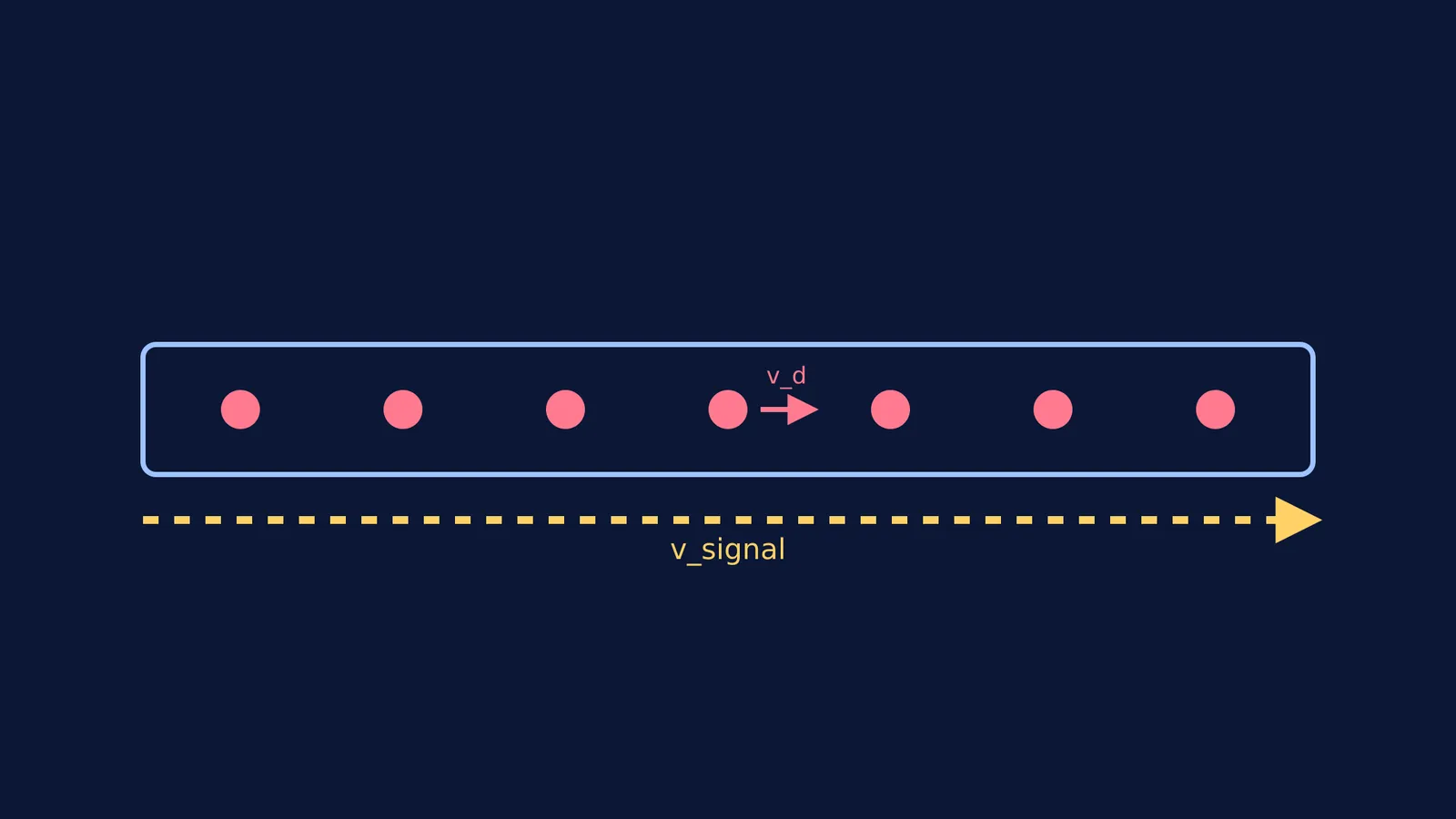
The secret lies in the difference between the speed of the physical electrons and the speed of the electrical signal.
According to OpenStax University Physics/Book%3A_University_Physics_II_-_Thermodynamics_Electricity_and_Magnetism_(OpenStax)/09%3A_Current_and_Resistance/9.03%3A_Model_of_Conduction_in_Metals), the electrical signal travels at approximately 10⁸ m/s, which is a significant fraction of the speed of light in a vacuum. This signal is a rapidly propagating change in the electric field, caused by the repulsive force between like charges. When you close the switch, the electric field is established throughout the entire circuit almost instantaneously, creating a rapid wave of energy.
The wire and the bulb's filament are already packed with free electrons. The moment the switch is closed, the electric field racing through the wire exerts a force on all these free electrons at once.
Think of it like a long garden hose that is already entirely full of water. When you turn on the tap, water immediately flows out of the nozzle. You do not have to wait for the specific water molecules from the tap to travel the entire length of the hose; the pressure pushes the water that is already sitting at the end. Similarly, the electric field pushes the electrons already resting inside the bulb, causing them to collide with atoms and generate heat and light instantly.
What is drift velocity?
In a conductor, free electrons do not move in a straight line. They zip around randomly at very high thermal speeds, constantly colliding with atoms in the metal lattice. Because this motion is entirely random, there is no net movement of charge in any one direction.
When a battery or power source sets up an electric field, it applies a steady force that slightly biases this chaotic motion. The electrons continue to bounce around wildly, but they slowly "drift" collectively in the direction opposite to the electric field. This slow, average forward progression is what we measure as the drift velocity.
How do you calculate the drift velocity of an electron?
To see just how slow drift velocity is, we can calculate it for a real-world scenario from OpenStax University Physics/Book%3A_University_Physics_II_-_Thermodynamics_Electricity_and_Magnetism_(OpenStax)/09%3A_Current_and_Resistance/9.03%3A_Model_of_Conduction_in_Metals). The mathematical relationship between current (I) and drift velocity (v_d) is given by the formula:
I = n × q × A × v_d
Where:
n is the density of free charge carriers.
q is the charge of a single electron (1.60 × 10⁻¹⁹ C).
A is the cross-sectional area of the wire.
Imagine a standard 12-gauge copper wire carrying a high current of 20 Amperes. The free charge density for copper is roughly 8.34 × 10²⁸ electrons per cubic meter, and the cross-sectional area of a 12-gauge wire is 3.30 × 10⁻⁶ m².
Rearranging the formula to solve for v_d:
v_d = I / (n × q × A)
v_d = 20 / (8.34 × 10²⁸ × 1.60 × 10⁻¹⁹ × 3.30 × 10⁻⁶)
v_d = 4.54 × 10⁻⁴ m/s
At 4.54 × 10⁻⁴ m/s, an electron travels less than half a millimetre per second. Yet, because the electric field sets up so quickly, the bulb does not have to wait for that specific electron to arrive from the switch.
How can you master current electricity?
Current electricity requires you to think about both the microscopic scale (colliding electrons) and the macroscopic scale (current and voltage).
If you are struggling to connect these ideas, the Fermi Concept Library contains every concept in physics, each with its own lesson and its place in the map, helping you trace how drift velocity leads to Ohm's law. When you need to solve complex circuit problems, such as finding the Resistance of a tapered conductor: setting up the integral or determining Stretching a wire: how its resistance changes with length, practice is key.
Instead of staring at a blank page when a calculation gets tricky, Fermi's AI tutor works out what you already know, builds a plan for the session, and teaches through it, helping you understand the reasoning behind the formulas step by step.


