

On this page
The people behind your phone's lithium-ion battery usually trained in different departments: chemists, materials scientists and electrical engineers each own one part of the job. Here is what each does, which degrees in India lead there, and what to do in Class 11 and 12.
Why is battery technology a growing career field?
Two numbers explain most of it. Lithium-ion battery prices fell from USD 1,400 per kilowatt-hour in 2010 to less than USD 140 per kilowatt-hour in 2023, according to the International Energy Agency's report Batteries and Secure Energy Transitions. The same report says the energy sector, mainly electric vehicles and power-sector storage, now accounts for over 90% of annual lithium-ion battery demand.
The IEA also finds that China has almost 85% of global battery cell production capacity. India is building its own. The Ministry of Heavy Industries runs the National Programme on Advanced Chemistry Cell (ACC) Battery Storage, approved in May 2021 with an outlay of ₹18,100 crore to set up 50 GWh of domestic cell manufacturing capacity, according to a December 2025 PIB release. That release says 40 GWh had been awarded to four firms. Cell factories and test labs need trained people.
What do chemists, materials scientists and electrical engineers do in batteries?
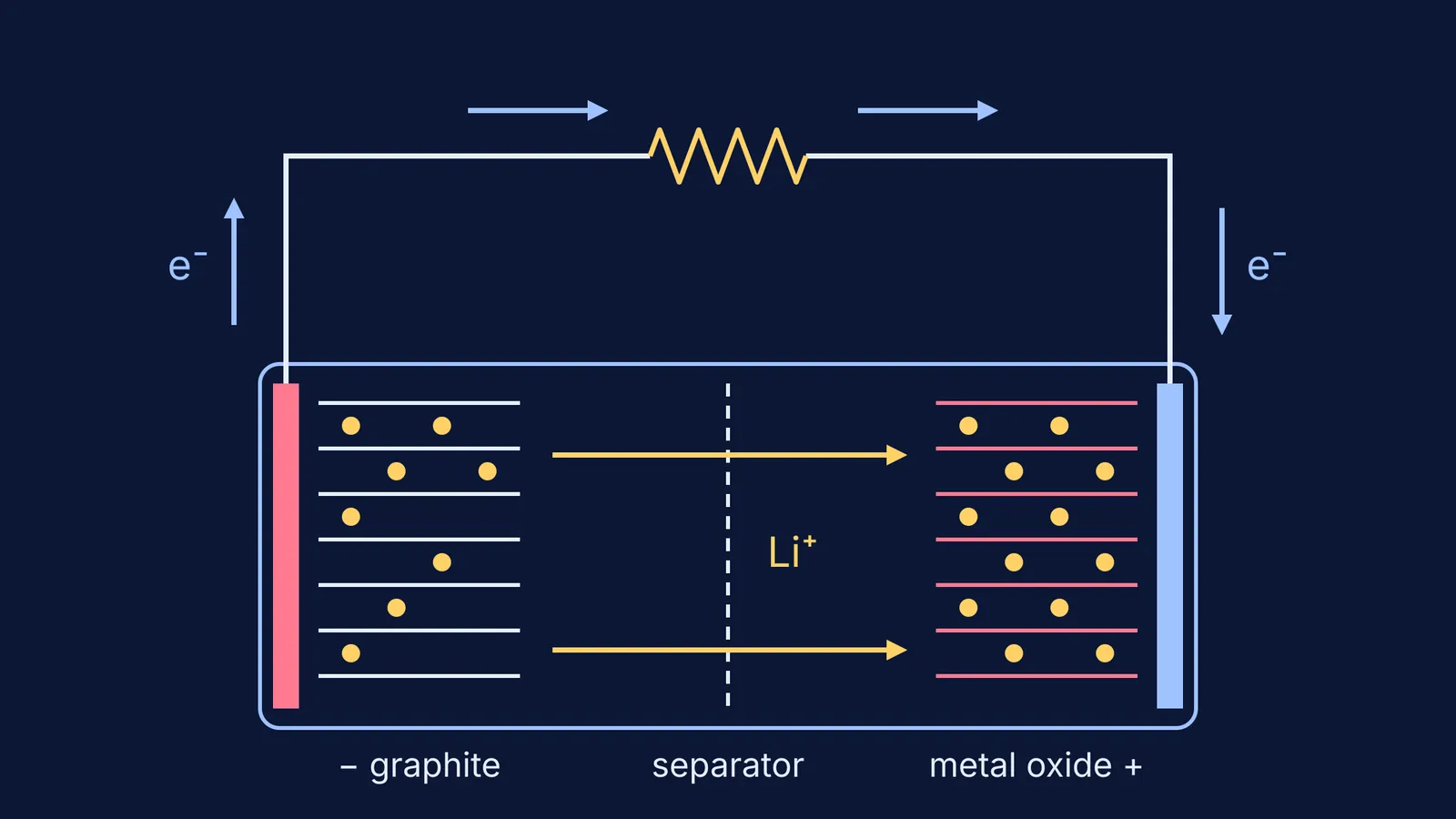
During discharge, lithium ions move through the electrolyte from the negative electrode to the positive one, while electrons take the outside circuit and power your device. Each field owns part of that.
Chemistry owns the reaction: which ions move, at what voltage, and which side reactions wear the cell out. Class 12 electrochemistry is where this starts.
Materials science owns the host: electrodes are solids that let lithium slip in and out. Materials engineers design these structures and separators, and study why they crack and age.
Electrical engineering owns the system: packs carry electronics that track voltage, current and temperature to keep every cell safe, and power engineers connect storage to the grid.
The 2019 Nobel Prize in Chemistry shows how the three meet. The Nobel press release explains that M. Stanley Whittingham made a cathode from titanium disulphide, which has spaces that can house lithium ions. John Goodenough showed in 1980 that cobalt oxide with lithium inside it can produce as much as four volts. Akira Yoshino then built the first commercially viable lithium-ion battery in 1985, using petroleum coke, a carbon material, in place of reactive lithium metal. One story, three fields.
The trade-offs continue. The IEA report notes that lithium iron phosphate (LFP) batteries reached 40% of electric vehicle sales and 80% of new battery storage in 2023: they are less energy-dense but cheaper, use no nickel or cobalt and last longer.
Which degree leads to a career in battery technology?
Few colleges offer an undergraduate "battery" degree; you enter through a core subject and specialise later. Pick your door:
You enjoy reactions and lab work: BSc and MSc in chemistry, or B.Tech in chemical engineering. Our career map for students who love chemistry covers both routes.
You wonder why materials crack, conduct or corrode: B.Tech in metallurgical and materials engineering; see what metallurgy and materials engineering involves.
You like circuits, control and power: B.Tech in electrical or electronics engineering; see electrical engineering careers in the power sector.
You want energy itself as the subject: a few institutes have dedicated departments. IIT Bombay's Department of Energy Science and Engineering lists a four-year B.Tech through JEE Advanced, an M.Tech in Energy Systems Engineering, an MSc-PhD dual degree through JAM, and a PhD.
If you want to invent new cell chemistries, plan for a master's or PhD. If you would rather build, test and manage packs, a bachelor's in a core branch is the usual way in.
A worked example: what does your phone battery hold?
Take a phone cell labelled 3.7 V and 5,000 mAh, which is 5 Ah. Energy is voltage times charge: 3.7 × 5 = 18.5 Wh, or 0.0185 kWh. At the IEA 2023 average of under USD 140 per kWh, that is under 0.0185 × 140 = USD 2.60, a rough estimate rather than a real phone-cell price.
Now split the label between the three fields. The 3.7 V comes from the electrode chemistry. The 5,000 mAh depends on how much lithium the electrode materials hold. Charging fast without overheating is largely an electrical engineering problem.
How can you prepare in Class 11 and 12?
Make electrochemistry your strongest chemistry chapter. If electrode potentials or the Nernst equation feel shaky, the Fermi Concept Library gives every concept in chemistry and physics its own lesson and shows where it sits in the map.
In physics, master current electricity: emf, internal resistance, power and energy.
Ions moving through a cell are hard to picture from a textbook figure. The Fermi Simulation Lab has interactive simulations for ideas that are easier to see than to read.
Before applying, open the department pages of three colleges you are considering and note which faculty work on energy storage.
Pick one step and do it this week.


