

On this page
What does an electrical engineer do in the power sector?
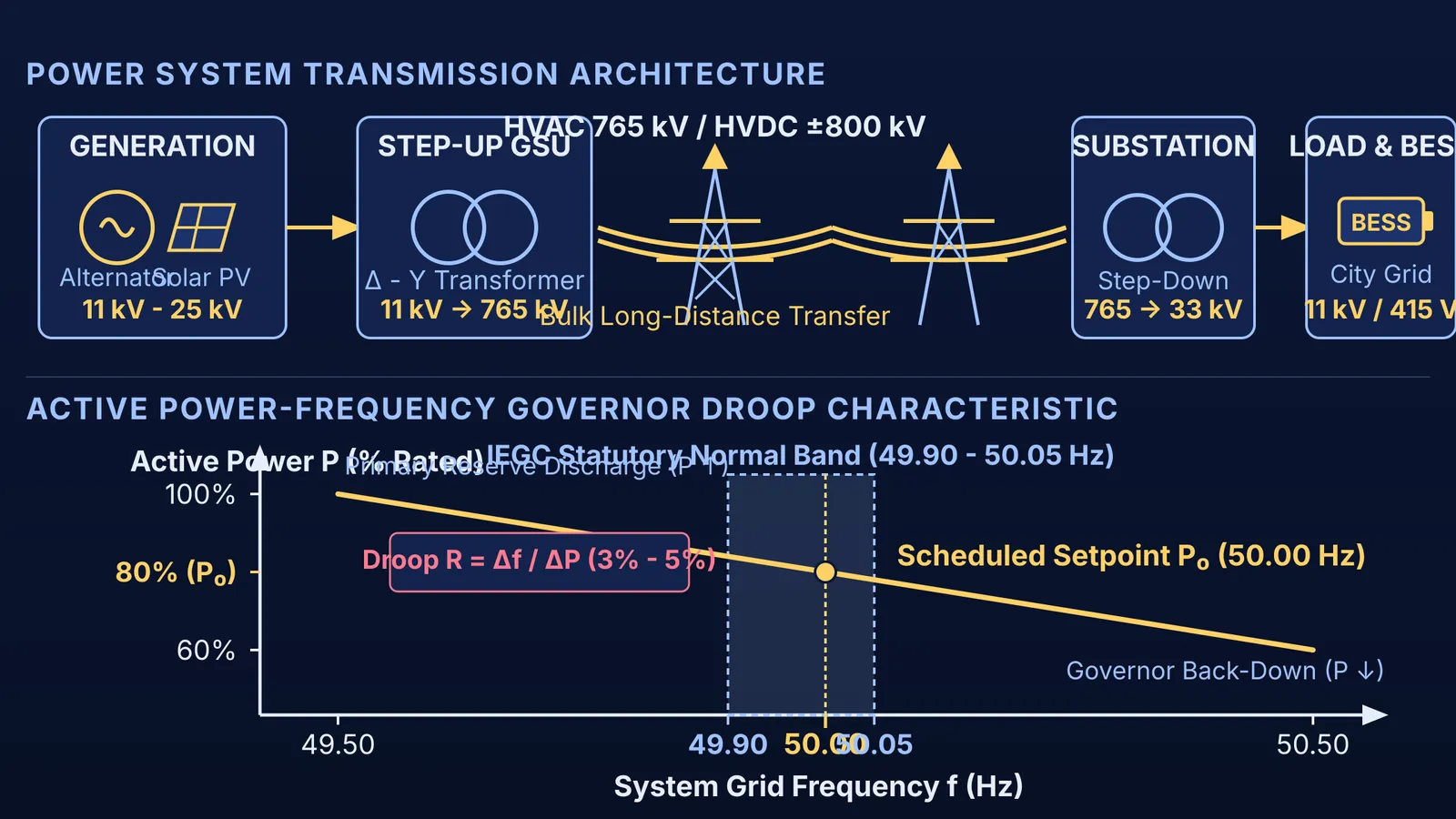
The electric power grid generates, transforms, transmits, and distributes energy in real time. In India, where peak power demand recently reached approximately 256 GW according to the Ministry of Power, electrical engineers keep this massive flow stable, continuous, and safe across four primary domains:
Generation engineering: Engineers manage thermal stations, hydroelectric dams, and utility-scale solar and wind plants. They oversee excitation systems, synchronise transformers and AC generators to the grid, and minimise inverter and generator losses.
Transmission and substation engineering: Lines at 400 kV and 765 kV HVAC, alongside ±800 kV HVDC links, transport bulk power across regions. Under the National Electricity Plan (Transmission) released by the Press Information Bureau, India is adding over 1,91,000 circuit kilometers (ckm) of lines and 1,270 GVA of transformation capacity, requiring engineers to design gas-insulated substations (GIS) and configure distance protection relays.
System operations and load dispatch: Engineers at the National Load Despatch Centre (NLDC) and Regional Load Despatch Centres (RLDCs) monitor real-time flows around the clock. Under regulations from the Central Electricity Regulatory Commission, operators maintain grid frequency within the statutory band of 49.90 Hz to 50.05 Hz around the nominal 50.00 Hz baseline, using automatic generation control (AGC) to balance sudden load fluctuations.
Distribution and smart metering: At the local level, engineers manage medium-voltage 33 kV and 11 kV networks, oversee distribution transformer loading, and integrate automated supervisory control and data acquisition (SCADA) systems.
How do public sector undertakings recruit electrical engineers?
Public sector undertakings (PSUs) form the backbone of India's power infrastructure. Maharatna and Navratna corporations such as NTPC Limited, Power Grid Corporation of India Limited (POWERGRID), and the Grid Controller of India Limited (Grid-India) conduct executive trainee recruitment primarily through the Graduate Aptitude Test in Engineering (GATE).
Candidates sit the Electrical Engineering (EE) paper, which tests electric circuits, electromagnetic fields, electrical machines, and power systems. Selection processes typically allocate an 85% weightage to the normalized GATE score, with the remaining 15% determined by interviews and group discussions. Recruits join executive cadres in the E2 pay scale, with basic pay ranging from ₹50,000 to ₹1,60,000 per month on industrial dearness allowance (IDA) patterns.
Beyond central PSUs, state electricity boards, state transmission utilities (STUs), and distribution companies (DISCOMs) recruit assistant engineers through state public service commissions or dedicated utility entrance exams. The technical syllabus remains centered on core power system analysis, fault calculations, and symmetrical components—principles pioneered historically by Edith Clarke's pioneer calculations for transmission line stability.
What technical skills are demanded by modern renewable grids?
The power sector is shifting rapidly toward inverter-based clean energy. To meet India's target of 500 GW of non-fossil capacity by 2030, the transmission roadmap from the Press Information Bureau projects an investment exceeding ₹9,15,000 crore by 2032, integrating 47 GW of Battery Energy Storage Systems (BESS) and 31 GW of Pumped Storage Plants (PSP).
This clean energy expansion shifts the technical competencies required from power engineers:
Inverter control and power electronics: Solar photovoltaic parks and wind turbines interface with the AC grid through voltage source converters (VSCs). Engineers must model phase-locked loops (PLLs), pulse-width modulation (PWM), and harmonic filters to prevent grid resonances.
Grid inertia and frequency support: Conventional synchronous alternators provide natural rotational inertia that resists sudden frequency dips. Because solar panels possess zero mechanical inertia, power engineers must program grid-forming inverters with synthetic inertia and fast frequency response algorithms.
Power system simulation: Planning modern grids requires steady-state and dynamic transient simulation tools. Engineers run Newton-Raphson load flows, transient stability studies, and electromagnetic transient programs (EMTP) to ensure lines do not trip under sudden faults.
Energy storage management: Managing grid-scale battery systems involves designing state-of-charge algorithms, cycle life optimisation, and reactive power compensation to stabilise voltages at renewable pooling substations.
How should students prepare during their engineering degree?
Power engineering pairs physical intuition with mathematical calculation. When studying three-phase networks and transients, mastering AC circuit analysis and phasors builds the foundation for every advanced power system course.
A structured roadmap across four years ensures both competitive exam readiness and practical engineering competence:
Semesters 1 and 2 (Foundations): Master differential equations, linear algebra, and circuit laws. When foundational circuit theorems feel abstract, the Fermi Concept Library offers lessons that explain the underlying physics step by step.
Semesters 3 and 4 (Core machines and fields): Focus on single-phase and three-phase transformers, induction motors, and synchronous alternators. For dynamic phenomena that equations alone cannot convey, the Fermi Simulation Lab provides interactive simulations for ideas that are easier to see than to read, such as rotating magnetic fields and rotor flux vectors.
Semesters 5 and 6 (Power systems and electronics): Solve per-unit systems, bus admittance matrices, symmetrical short-circuit calculations, and converter topologies. In the 100-mark GATE exam, power systems and electrical machines typically account for 20 to 23 marks, requiring speed and numerical precision. To master methodical problem-solving for these core areas, the Fermi Problem Library provides worked problems with a step-by-step solver that explains the reasoning rather than printing an answer.
Semesters 7 and 8 (Applications and testing): Complete hands-on substation training, learn industry simulation packages, and solve previous years' competitive question papers under timed conditions.
By pairing foundational circuit physics with modern computational tools, you position yourself to contribute directly to the clean energy systems that power India's industrial and societal future.


