

On this page
Loving chemistry means you enjoy understanding what the world is made of and how things change. But when it comes to choosing a career, you might wonder what lies beyond the classroom. Whether you are picking a stream after Class 10 or choosing a major, your interest in atoms and reactions opens doors to rapidly growing industries.
Here is a look at the major career paths for chemistry lovers, what they actually do day-to-day, and the numbers driving their growth across various sectors in India and globally.
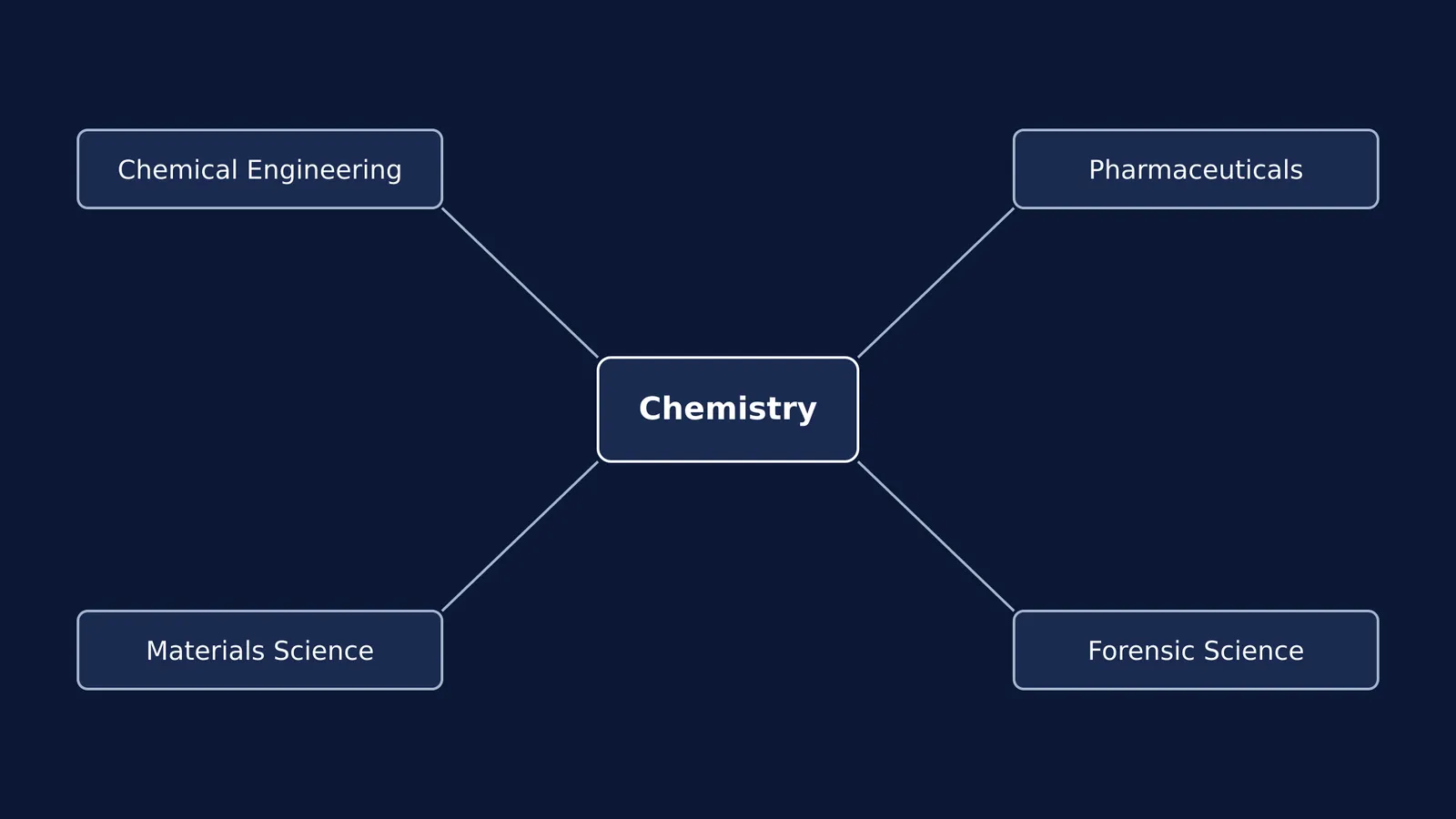
What do chemical engineers do?
A chemist invents a new plastic, fertiliser or drug in a test tube; a chemical engineer figures out how to make a million tonnes of it safely, consistently and cheaply. If you enjoy the maths and physics of fluid flow and heat transfer alongside chemistry, this is the path for you.
Chemical engineers work in oil refineries, food processing plants, and the booming specialty chemicals sector. They are responsible for designing the complex equipment and continuous processes that transform raw materials into finished products on an industrial scale. The Indian chemical and petrochemical industry is projected to reach $300 billion by 2028. While traditional roles in petrochemicals remain strong, this growth is increasingly driven by the shift toward green hydrogen, electric vehicle battery materials, and sustainable waste-to-energy processes.
What careers are in pharmaceuticals?
India is known as the "pharmacy of the world," supplying 20% of the global generic drug volume. The domestic pharmaceutical market is projected to reach $130 billion by 2030, driven by both domestic healthcare demand and government manufacturing incentives like the Production Linked Incentive (PLI) scheme.
Careers here range from research and development (finding new active pharmaceutical ingredients) to quality control and quality assurance (ensuring every single pill has the exact right dose). If you enjoy organic chemistry, molecular biology and biological systems, a path in pharmacology, biochemistry or pharmacy offers immense scope.
For understanding the complex 3D structures of these drugs and how they interact with human proteins, you can try tools for molecule visualisation.
How does materials science build the future?
Materials scientists invent the physical stuff of the future: lighter alloys for fuel-efficient aircraft, better silicon for solar panels, and biodegradable plastics that reduce pollution. This field sits squarely at the intersection of solid-state chemistry, physics and engineering, focusing heavily on how a material's internal structure determines its properties.
If you are fascinated by crystal lattices and how molecular structure dictates a material's strength, flexibility or electrical conductivity, this is an excellent choice. This sector is absolutely crucial for developing next-generation lithium-ion batteries and advanced semiconductors, which are industries that are seeing massive global investment right now. Discussing these fields is a great example of talking about STEM careers beyond engineering and medicine.
How is chemistry used in forensic science?
Forensic scientists apply rigorous chemical analysis directly to criminal investigations and legal proceedings. They analyse blood and DNA samples, carefully identify unknown powders or explosive residues, and use advanced techniques like gas chromatography to trace invisible poisons. Their detailed lab work often forms the factual backbone of the critical evidence presented in a courtroom.
Demand for this field is surging in India. Under the Bharatiya Nagarik Suraksha Sanhita (BNSS) 2023, forensic experts are now legally required to visit crime scenes for offenses punishable by seven years of imprisonment or more. This strict legal mandate is actively creating a massive, immediate need for highly trained professionals in State and Central Forensic Science Laboratories across the entire country.
While many enter through a dedicated B.Sc. in Forensic Science, a strong foundation in general chemistry or biology is often just as valuable when paired with specialized postgraduate training.
Where should you start today?
If you are in high school, the best way to test your love for the subject is to look at real-world problems. Try exploring the chemistry olympiad in India to see how professional chemists approach complex puzzles.
When you hit a roadblock in balancing a complex equation or understanding an organic mechanism, Fermi's AI tutor can work out what you already know and build a plan for the session, so you sit down to a clear next step.


