

On this page
Optical power measures how strongly a lens bends light. A thick lens with steep curvature bends rays sharply, focusing them close to the optical centre. A flatter lens bends rays gently, focusing them farther away. While focal lengths in school experiments and exam problems are almost always measured in centimetres, power is defined in dioptres. This unit difference makes the lens power calculation one of the most common sources of lost marks in physics exams.
Why is power of a lens 100 over f in centimetres?
By definition, optical power P is the reciprocal of focal length f in metres: P = 1 / f. The coherent SI unit of optical power is the reciprocal metre (m⁻¹), widely designated in optics by the special name dioptre (symbol D, where 1 D = 1 m⁻¹), as documented in the BIPM SI Brochure (9th edition). The unit was introduced in 1872 by French ophthalmologist Ferdinand Monoyer (Wikipedia: Dioptre).
Laboratory optical benches and metre scales record distances in centimetres. Since 1 metre equals 100 centimetres, converting a focal length from centimetres into metres requires dividing by 100: f(m) = f(cm) / 100. Substituting this into the power formula gives:
P = 1 / (f / 100) = 100 / f
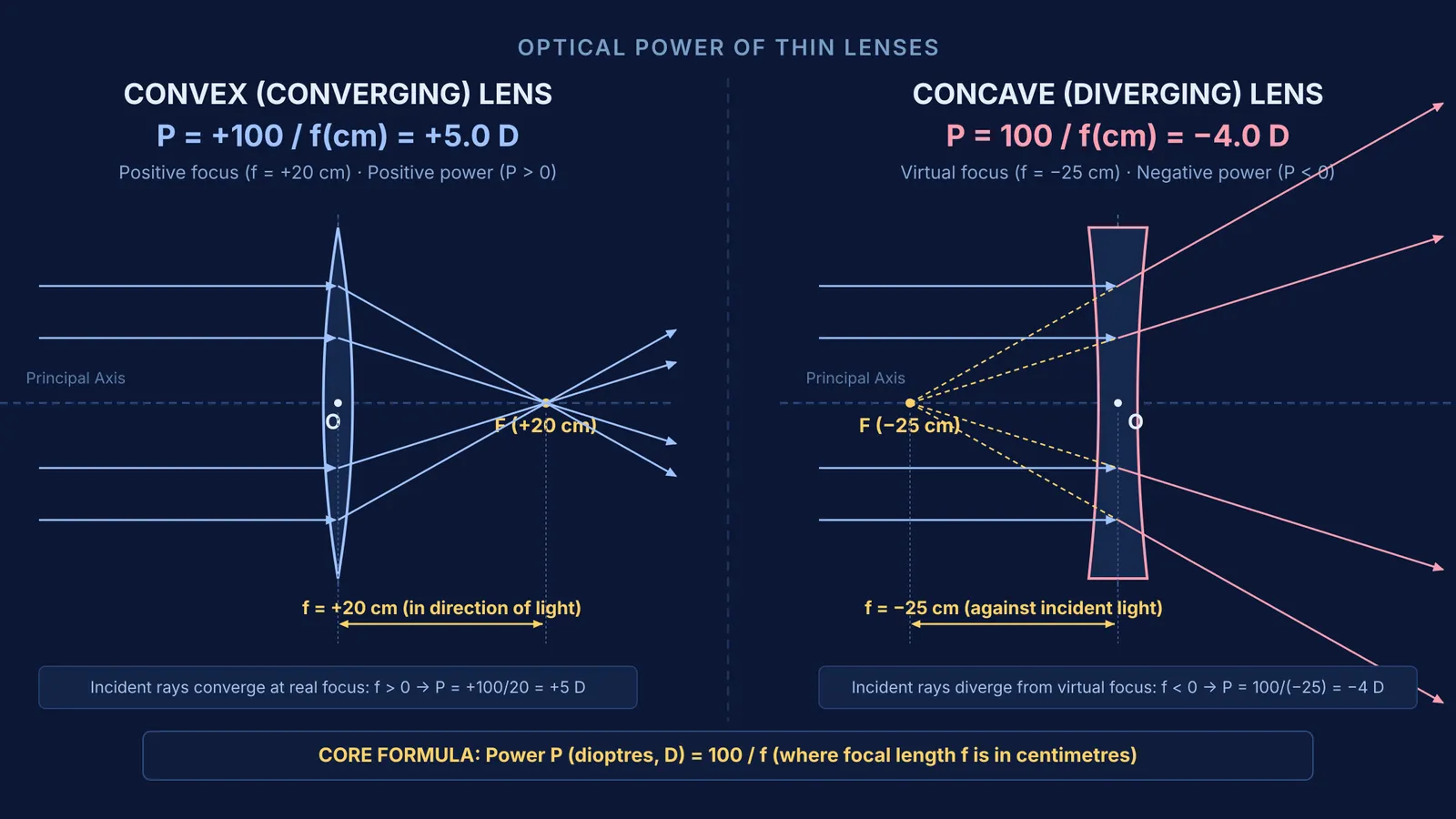
When f is expressed in centimetres, P = 100 / f yields the correct power in dioptres directly. For example, a lens with a focal length of 20 cm has an optical power of P = 100 / 20 = +5 D. As explained in our guide to Light in Class 10: reflection, refraction and the lens formula, remembering this factor of 100 prevents calculation errors in timed tests.
How do sign conventions determine lens power for convex and concave lenses?
The Cartesian sign convention measures all distances from the optical centre. Distances in the direction of incident light are positive; distances against incident light are negative.
Convex (converging) lenses focus parallel rays at a real focal point behind the lens, in the direction of light travel. The focal length is positive (+f), so the optical power is positive (+P). An optician prescribing +2.5 D is providing a converging lens to correct hypermetropia (farsightedness), as detailed in OpenStax University Physics: The Eye.
Concave (diverging) lenses cause parallel rays to diverge as if originating from a virtual focus in front of the lens. Because this focus lies against the direction of incident light, the focal length is negative (−f), giving negative power (−P). A prescription of −2.0 D specifies a diverging lens for myopia (nearsightedness). For additional coordinate rules, see our guide to Ray optics sign conventions: mirror and lens formula mistakes.
How do you calculate power for lens combinations in contact?
When two or more thin lenses are placed in coaxial contact, their powers add algebraically, as detailed in optical physics (OpenStax University Physics: The Eye):
P_net = P₁ + P₂ + P₃ + ...
If individual focal lengths are in centimetres, the relation becomes:
P_net = (100 / f₁) + (100 / f₂) + (100 / f₃) + ...
The equivalent focal length F in centimetres is F = 100 / P_net. Derivations for separated lenses are detailed in our overview of Lens maker's formula and lens combinations.
Suppose a convex lens of focal length 25 cm is placed in contact with a concave lens of focal length 50 cm:
Identify signs: convex lens f₁ = +25 cm; concave lens f₂ = −50 cm.
Calculate individual powers: P₁ = 100 / (+25) = +4.0 D; P₂ = 100 / (−50) = −2.0 D.
Add algebraically: P_net = +4.0 D + (−2.0 D) = +2.0 D.
Determine equivalent focal length: F = 100 / (+2.0) = +50 cm.
Because P_net is positive, the combination functions as a converging lens. When practising multi-lens problems, the Fermi Problem Library offers worked problems with a step-by-step solver that explains the reasoning rather than printing an answer.
What are common exam mistakes when calculating lens power?
Under the CBSE Academic Curriculum, numerical questions on lenses often test unit conversion and sign discipline:
Substituting centimetres into P = 1/f: writing P = 1 / 20 = 0.05 D instead of 5 D for f = 20 cm.
Omitting negative signs: treating a concave lens of focal length 40 cm as +2.5 D rather than −2.5 D.
Forgetting the dioptre unit: writing P = 4 instead of +4 D, which forfeits half a mark in board marking schemes.
Adding powers of separated lenses: P_net = P₁ + P₂ applies only to lenses in direct contact, not lenses separated by a gap.
To review the ray diagrams behind these formulas, the Fermi Concept Library covers every concept in physics, each with its own lesson and its place in the map. For optical setups and ray traces that are easier to see than to read, the Fermi Simulation Lab provides interactive simulations.


