On this page
If the classroom board looks blurred while your phone looks sharp, you are describing short sight, a Class 10 science topic that comes back in later optics problems. This post works it like an experiment: predict, choose a lens, then test it.
Where does a myopic eye focus a distant object?
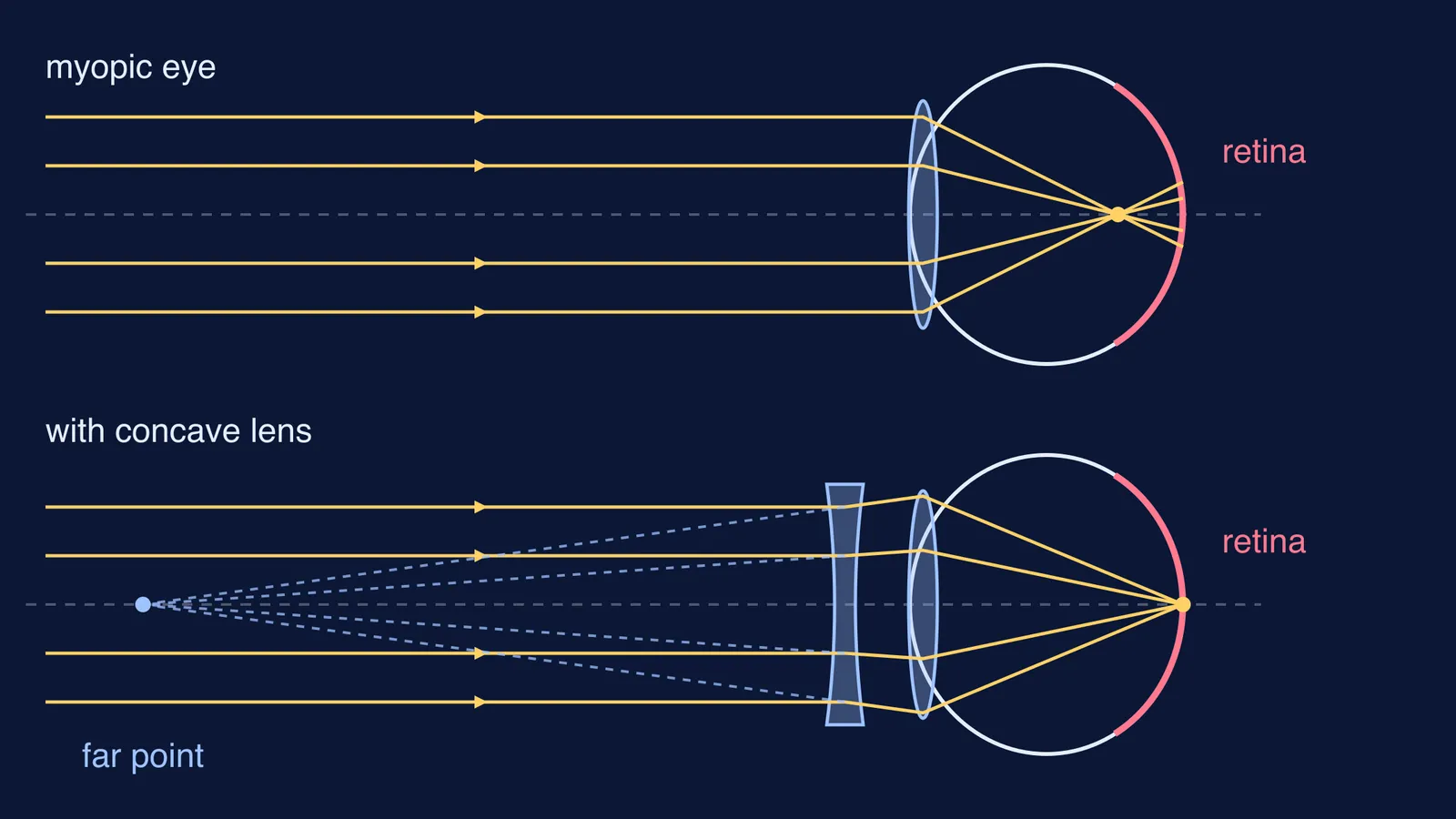
The US National Eye Institute describes nearsightedness (myopia) as a refractive error that makes far-away objects look blurry because light focuses in front of the retina instead of on it. Causes include an eyeball that has grown too long from front to back, or a cornea or lens with a problem in its shape.
The OpenStax College Physics chapter on vision correction puts the same thing in ray language: the eye overconverges the nearly parallel rays from a distant object, and the rays cross in front of the retina. The same chapter defines the far point as the distance to the farthest object the eye can see clearly, normally infinity.
So predict before you look at a diagram: parallel rays meet before the retina, cross, and spread again, so the retina gets a blurred patch, not a point. The far point of a myopic eye is a finite distance, such as 50 cm.
A 2020 meta-analysis in PLOS ONE of Indian studies from the last four decades found a pooled crude myopia prevalence of 7.5% among children aged 5 to 15, with the highest figure, 15.0%, among urban 11 to 15 year olds in the last decade. Worldwide, Holden and colleagues projected in Ophthalmology that 4,758 million people, 49.8% of the world population, will have myopia by 2050.
Which lens corrects short sight, and why concave?
OpenStax states that the correction for nearsightedness is a diverging spectacle lens placed in front of the eye, which reduces the power of an eye that is too powerful (OpenStax, vision correction).
A concave lens takes parallel rays from a distant object and makes them diverge as if they came from the eye's far point. The eye can already focus an object at its far point, so it now forms a sharp image on the retina.
That gives the rule. For glasses worn close to the eye, the correcting lens has a focal length equal to minus the far-point distance, so P = −1/(far point in metres), with power in dioptres (D).
How do you calculate the lens power? A worked example
Say your far point is 50 cm.
Convert to metres: 50 cm = 0.50 m.
The lens must form a virtual image of a distant object 0.50 m in front of the eye, so f = −0.50 m.
Power: P = 1/f = 1/(−0.50) = −2.0 D.
The minus sign tells you the lens is diverging, which is concave.
Real glasses sit slightly in front of the eye. With the lens 1.5 cm away, the image must be 48.5 cm from the lens, and P = 1/(−0.485) ≈ −2.06 D. OpenStax works the same method for a 30.0 cm far point with glasses 1.50 cm from the eye and gets −3.51 D (OpenStax worked example). Our post on finding lens power when the focal length is in centimetres shows the 100/f shortcut.
What happens if the lens power is wrong?
Keep the far point at 50 cm and try three lenses, predicting each result before you check it.
−1 D: the virtual image of a distant object sits 100 cm away, beyond the far point. The eye still focuses it in front of the retina: better, but blurred. Too weak.
−2 D: the virtual image sits exactly at the far point, 50 cm away, and the relaxed eye focuses it on the retina. This is the correction.
−3 D: the virtual image sits about 33 cm away, inside the far point. The relaxed eye now focuses it behind the retina, so the eye must accommodate, as for near work. Stronger than needed.
The pattern to remember: the right concave lens moves a distant object to the far point, no nearer and no further.
The Fermi Simulation Lab has interactive simulations for ideas that are easier to see than to read, so you can make your prediction first and then check it.
What should you do if the board looks blurry?
Physics tells you the kind of lens; only an eye examination tells you the power. The National Eye Institute says myopia is diagnosed with a simple, painless comprehensive eye exam, and that the most common treatments are glasses or contact lenses (NEI). It notes that myopia usually starts between ages 6 and 14, and lists squinting and eye strain among its symptoms.
Next, compare long sight in the lens power that corrects hypermetropia, and see how the eye lens changes shape between near and far objects in eye accommodation explained.