

On this page
The lift on every aeroplane wing over Delhi or Bengaluru is described by an equation a Moscow professor published over a century ago. Nikolai Zhukovsky (also spelled Joukowski) linked a wing's lift to the circulation of air around it, and built the laboratories to test the idea.
What does the Kutta–Joukowski theorem say?
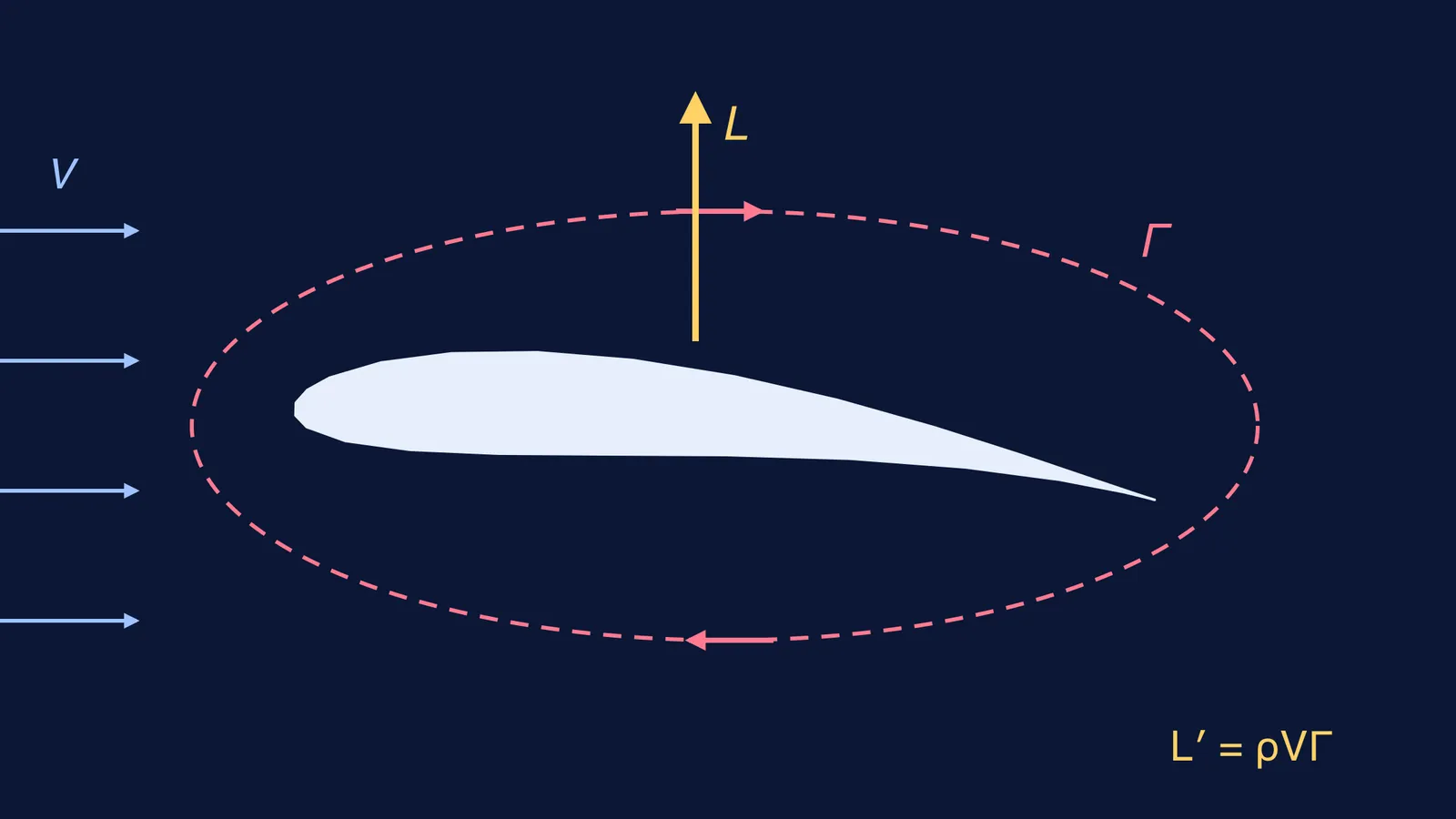
The Kutta–Joukowski theorem states that the lift per unit span of a wing is L′ = ρVΓ, where ρ is the air density, V is the speed of the oncoming air and Γ (gamma) is the circulation (Kutta–Joukowski theorem).
Circulation is the line integral, around a closed loop enclosing the wing, of the air's velocity along that loop (same source). In plain words: walk a loop around the wing, add up how much the air moves along your path, and you get Γ. Around a lifting wing, that total is not zero.
NASA Glenn applies the same equation to a spinning cylinder, whose rotation sets up the vortex (NASA Glenn: lift of a rotating cylinder). A related effect makes a spinning ball curve, as told in Gustav Magnus and the physics of a spinning ball's curve.
Who was Nikolai Zhukovsky?
Zhukovsky was born on 17 January 1847 and studied applied mathematics at Moscow University, graduating in 1868 (MacTutor biography). He became interested in heavier-than-air flight in the late 1880s, and in 1895 he visited Otto Lilienthal in Berlin and bought one of the eight gliders Lilienthal sold to the public (same source).
In 1906 he published two papers giving a mathematical expression for the lift on an aerofoil (same source). Kutta pointed out that the same equation appeared in his 1902 dissertation, so the theorem carries both names (same source); Kutta was a German mathematician (Wikipedia)). The Joukowski transformation, a mapping for designing aerofoil shapes with complex numbers, also carries his name (MacTutor).
What wind tunnels did Zhukovsky set up in Moscow?
MacTutor notes that his theoretical work on lift, vortices and stability was complemented by experimental observations in every case (MacTutor).
1902: he supervised the building of a suction-type wind tunnel at the Mechanical Department of Moscow University (Russian Post stamp notes).
1904: he headed an aerodynamic institute at Kuchino near Moscow, paid for by D. Ryabushinsky (same source).
1909: he led the founding of the Aerodynamic Laboratory at the Moscow Technical School (same source).
1911-12: his lectures there on the theoretical basis of aeronautics were the world's first systematic course in aviation theory (MacTutor).
December 1918: the Soviet government founded the Central Aerohydrodynamic Institute (TsAGI) at his proposal, with him as its first head (Wikipedia)).
Why is the longer-path explanation of lift wrong?
A common story says air over the curved top travels further, so it must speed up to meet the air underneath at the back edge. NASA calls this the equal transit theory and shows why it fails: a symmetric aerofoil, with top and bottom the same length, still makes plenty of lift, and air over the top reaches the trailing edge before the air underneath (NASA Glenn: equal transit). The lift it predicts is much less than the lift observed (same source).
Circulation fixes this. The Kutta condition says a body with a sharp trailing edge sets up just enough circulation to hold the rear stagnation point at that edge, so the flow leaves it smoothly (Kutta condition). That fixes Γ, and the theorem turns it into lift. Faster air above and lower pressure, as in how Bernoulli's principle explains lift, atomisers and storms, is still true; circulation sets how much faster.
How do you use L′ = ρVΓ in a worked example?
Standard sea-level air has a density of 1.225 kg/m³ (density of air).
A model glider wing meets air at V = 20 m/s, with circulation Γ = 10 m²/s around each section.
Lift per metre of span: L′ = 1.225 × 20 × 10 = 245 N/m.
Check the units: kg/m³ × m/s × m²/s = kg/s², which is N/m.
For a 2 m span, ignoring the wingtips, lift ≈ 245 × 2 = 490 N, about the weight of a 50 kg mass (490 ÷ 9.8).
Run it backwards: to carry 600 N on a 1.5 m span at 25 m/s you need L′ = 400 N/m, so Γ = 400 ÷ (1.225 × 25) ≈ 13.1 m²/s.
One trap: the theorem looks as if lift grows in step with speed. But NASA's lift equation, L = Cl × ½ρV² × A, says lift depends on the square of the velocity (NASA Glenn: lift equation). Set the two equal for a wing of chord c and you get Γ = ½ Cl V c. At a fixed angle, circulation grows with speed: fly twice as fast and Γ doubles, so lift goes up four times.
If circulation is hard to picture, the Fermi Simulation Lab has interactive simulations for ideas that are easier to see than to read. If the gap is in pressure or flow, the Fermi Concept Library gives each physics concept its own lesson.
For more on swirling air, read what a Kármán vortex street is and why wires hum.


