

On this page
In 1926 two researchers in Leningrad, Yu. B. Chariton and Z. Valta, found that phosphorus vapour would not ignite in oxygen below a certain pressure, a lower limit Semenov credits to them in his Nobel lecture. According to the 1956 Nobel presentation speech, Max Bodenstein, then the leading expert on reaction rates, said the results must be wrong. Nikolay Semenov (also spelled Semyonov) repeated the work: the mixture did not react if the pressure was too low or too high, but exploded in between.
What is a branched chain reaction?
In a chain reaction, each step makes a very reactive particle that sets off the next step; Bodenstein proposed the idea in 1913 (presentation speech). In his lecture, Semenov identifies these active particles as free radicals: atoms or fragments with an unpaired electron.
In an ordinary chain, one radical goes in and one comes out, as in Cl + H₂ → HCl + H. In a branched chain reaction, a single step produces more radicals than it uses up. Semenov's example is hydrogen burning in oxygen:
H + O₂ → OH + O
O + H₂ → OH + H
OH + H₂ → H₂O + H
Add the steps, the last one twice: H + O₂ + 3H₂ → 2H₂O + 3H. One hydrogen atom goes in, three come out, and each starts its own cycle.
Why do some gas mixtures explode only at certain pressures?
Radicals are destroyed as well as made. Semenov's lecture says they vanish when trapped at the vessel walls, by impurities or by recombining: "This is when the chains break." Each branched reaction is a race:
Branching beats termination: the radical "avalanche" grows very fast and the mixture explodes.
Termination beats branching: the avalanche never starts, and phosphorus vapour can sit with oxygen for days without reacting.
The lower limit comes from the walls. At low pressure, radicals reach the wall and are destroyed before they can branch (LibreTexts/05%3A_Moving_Molecules_and_Chemical_Kinetics/5.19%3A_Chain_Branching_Explosions)). Semenov's lecture notes that raising the oxygen pressure, using a bigger vessel or removing thin metal wires that soak up radicals can each trigger the explosion.
The upper limit comes from crowding. Hinshelwood's group in Oxford saw a second, upper limit in the hydrogen–oxygen reaction: at higher pressure, chains end inside the gas when three molecules collide at once.
How fast can one radical multiply? A worked example
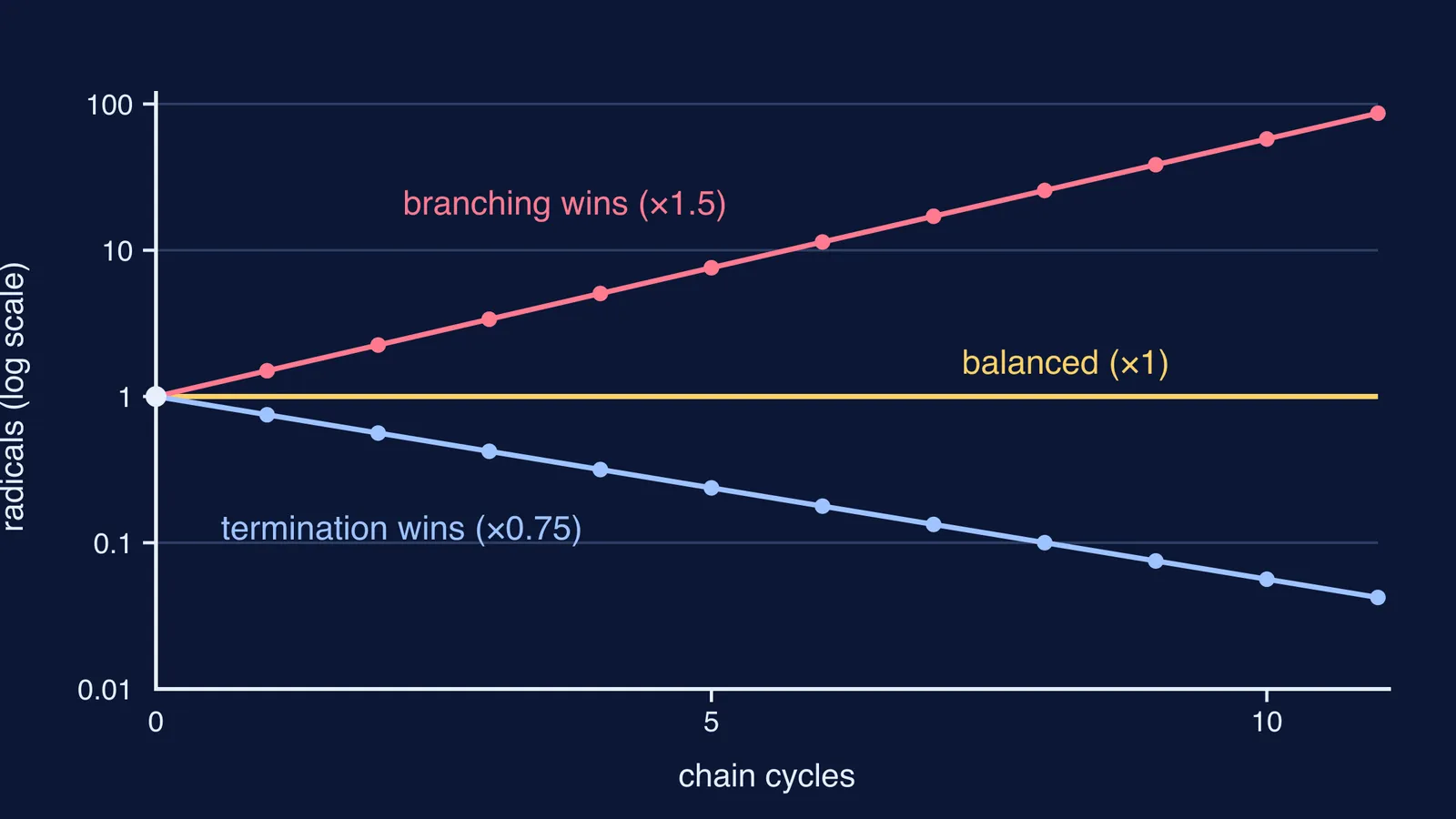
Take a toy model of Semenov's cycle. Each H atom has a chance p of being destroyed before finishing the cycle; if it survives, it becomes three. Each cycle multiplies the radicals by 3(1 − p) on average.
p = 0.5: ×1.5 per cycle, so radicals grow.
p = 2/3: ×1 exactly, the explosion limit in this model.
p = 0.75: ×0.75 per cycle, so chains die out.
How many cycles until one radical becomes a mole? The Avogadro constant is exactly 6.022 140 76 × 10²³ per mole. With no losses, 3⁵⁰ ≈ 7.2 × 10²³, so 50 cycles are enough. Lose half of them every cycle and 1.5¹³⁶ ≈ 8.9 × 10²³, so 136 cycles: slower, but still an explosion.
The line between calm and explosion is one number crossing 1, which is why Semenov notes that a change within "extremely close limits" can flip a mixture from inert to violent. Real hydrogen–oxygen chemistry has more steps than this model. The same logic decides when a nuclear chain reaction sustains itself.
For ideas like this that are easier to see than to read, the Fermi Simulation Lab has interactive simulations.
How do you spot branching in a reaction mechanism?
Count the unpaired electrons (free valences) on each side of every step. Radicals usually come from homolytic fission, where each fragment keeps one electron.
None in, some out (a molecule splitting): initiation.
Same in and out: propagation.
More out than in (H + O₂ → OH + O: one free valence becomes three): branching.
Some in, none out (recombination, capture at the wall): termination.
A stable product that later splits into radicals (ROOH → RO + OH): degenerate branching, seen as a slow start then a speed-up.
Label every step this way before deriving a rate law. The Fermi Problem Library has worked problems with a step-by-step solver that explains the reasoning rather than printing an answer.
Why did Semenov win the 1956 Nobel Prize?
Semenov shared the 1956 Nobel Prize in Chemistry with Cyril Hinshelwood "for their researches into the mechanism of chemical reactions". Born in Saratov on 3 April 1896, he led the Institute of Chemical Physics from 1931, and his 1934 book *Chemical Kinetics and Chain Reactions* set out the theory of branched chains (Nobel biography).
His lecture names cracking, combustion, polymerisation and chlorination as typical chain reactions, and builds his heat theory of ignition on Arrhenius and activation energy. The presentation speech links the work to engine knock and high-octane petrol. Semenov died on 25 September 1986.
Next time you meet a mechanism, count the radicals: whether they multiply or die out decides whether you get an explosion.


