

On this page
Every organic reaction starts with a bond breaking, and a covalent bond holds two electrons. Homolytic versus heterolytic fission comes down to one question: where do those two electrons go? Answer that and the intermediates, the arrows and the conditions in a mechanism question follow.
What is the difference between homolytic and heterolytic fission?
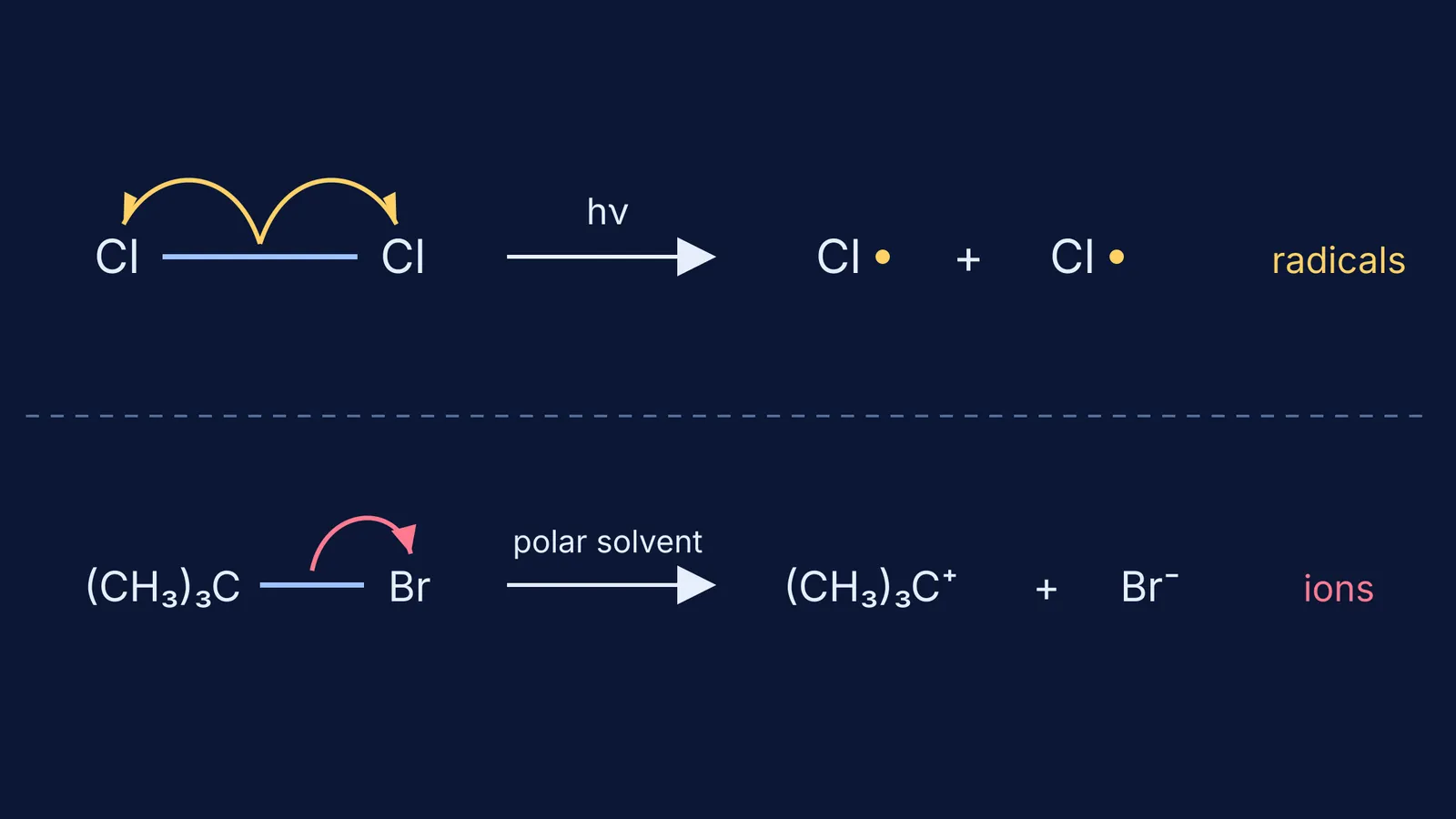
Homolytic fission (homolysis) is bond breaking in which one electron of the shared pair stays with each fragment, according to the LibreTexts chapter on how organic reactions occur. Each fragment ends up with an unpaired electron, so the products are free radicals: neutral and very reactive. Chemists call these radical reactions.
Heterolytic fission (heterolysis) is bond breaking in which both electrons of the shared pair stay with one fragment, the same chapter explains. One fragment becomes an anion and the other a cation, often a carbocation. Chemists call these polar reactions.
Homolytic bond dissociation energy is the energy needed to break a mole of bonds in the gas phase into pairs of radicals, as this LibreTexts page on bond energies defines it.
How do you draw half and full curly arrows?
A curly arrow starts where the electrons are (a bond or a lone pair) and ends where they go. The head tells you how many move.
A full head shows an electron pair moving (LibreTexts).
A half head, called a fishhook, shows a single electron moving.
So a homolytic break needs two fishhooks, one from the middle of the bond to each atom. A heterolytic break needs one full arrow, from the bond to the atom that keeps both electrons, usually the more electronegative atom or the leaving group.
Which conditions favour homolytic or heterolytic fission?
Making ions means pulling positive and negative charge apart, which costs energy, and a solvent can pay some of it back by surrounding the ions. Ionic reactions normally take place in liquid solutions, where solvent molecules help form the charged intermediates, according to LibreTexts. Polar protic solvents such as water and alcohols speed up SN1 reactions: they hydrogen-bond to the leaving group and lower the energy of the step that makes the carbocation (LibreTexts SN1 vs SN2/07%3A_Nucleophilic_Substitution_Reactions/7.05%3A_SN1_vs_SN2)).
Radicals carry no charge, so they need no help from a solvent. They need energy to split a weak, non-polar bond evenly. In halogenation, ultraviolet light or heat breaks the halogen-halogen bond homolytically into two halogen radicals (LibreTexts radical chain mechanism/03._Reactions_of_Alkanes%3A_Bond-Dissociation_Energies_Radical_Halogenation_and_Relative_Reactivity/3-04_Chlorination_of__Methane%3A_The__Radical_Chain__Mechanism)).
Light or heat, no polar solvent, symmetric bond such as Cl–Cl: think homolytic.
Polar solvent, polar bond with a good leaving group such as C–Br: think heterolytic.
Worked example 1: chlorination of methane
Methane and chlorine react by a radical chain, covered step by step in our post on free radical chlorination of methane from initiation to termination.
Initiation: Cl–Cl breaks homolytically under UV light or heat. Two fishhooks give 2 Cl•. The energy calculation in the Vollhardt and Schore chapter on LibreTexts/03._Reactions_of_Alkanes%3A_Bond-Dissociation_Energies_Radical_Halogenation_and_Relative_Reactivity/3-04_Chlorination_of__Methane%3A_The__Radical_Chain__Mechanism) uses 58 kcal/mol for this bond, about 243 kJ/mol.
Propagation: Cl• takes a hydrogen atom from CH4, giving HCl and CH3•. Three fishhooks: one from Cl•, two from the breaking C–H bond.
Propagation: CH3• reacts with Cl2, giving CH3Cl and a new Cl•, which keeps the chain going.
No ions appear anywhere. That is the signature of a homolytic mechanism.
Worked example 2: SN1 hydrolysis of tert-butyl bromide
2-Bromo-2-methylpropane, (CH3)3C–Br, dissociates on its own to the tert-butyl carbocation and Br−, and this slow step sets the rate, according to the OpenStax SN1 section on LibreTexts/11%3A_Reactions_of_Alkyl_Halides-_Nucleophilic_Substitutions_and_Eliminations/11.4%3A_The_(S_N1)_Reaction).
Heterolysis: one full arrow from the C–Br bond to Br, giving (CH3)3C+ and Br−.
Water attacks the carbocation: one full arrow from an oxygen lone pair to carbon.
Loss of a proton gives tert-butyl alcohol.
The rate depends only on the alkyl halide concentration, and the tertiary halide reacts with water more than a million times faster than CH3Br does in the corresponding reaction (OpenStax via LibreTexts/11%3A_Reactions_of_Alkyl_Halides-_Nucleophilic_Substitutions_and_Eliminations/11.4%3A_The_(S_N1)_Reaction)). A stable carbocation makes the difference; see why allylic and benzylic halides react fast by the SN1 route and how to spot nucleophiles and electrophiles.
A four-question check for any mechanism
Run through this before you draw a single arrow in a board or JEE paper:
Is the breaking bond symmetric (Cl–Cl, Br–Br) or polar (C–Br, C–Cl)?
What do the conditions say: light or heat, or water and alcohols?
Which intermediate do you expect: a radical, or a carbocation or carbanion?
Do your arrowheads match: fishhooks for radicals, full heads for ions?
If you keep mixing up which arrow goes where, the Fermi Problem Library has worked problems with a step-by-step solver that explains the reasoning rather than printing an answer. To see how bond fission connects radicals, carbocations and substitution, the Fermi Concept Library gives each chemistry concept its own lesson and its place in the map.
Try the four questions on the next five mechanisms in your NCERT chapter, and say aloud where each electron goes.


