On this page
Picture a ball of uranium-235 that you can make bigger, one thin shell at a time. A stray neutron splits one nucleus, and that fission throws out more neutrons. Before you read on, predict: as the ball grows, does the number of neutrons per generation fall, stay level, or climb? Write your answer down.
What is critical mass in a nuclear chain reaction?
Critical mass is "the minimum mass of the fissile material needed for a sustained nuclear chain reaction in a particular setup", as the Wikipedia article on critical mass defines it.
Fission of uranium-235 typically releases 2 or 3 neutrons, with an average of almost 2.5, according to the World Nuclear Association. Each of those neutrons has three possible fates:
it hits another uranium-235 nucleus and causes a fission
it is absorbed without causing a fission
it escapes through the surface and is lost
The effective multiplication factor, k, is the average number of neutrons from each fission that go on to cause another fission (Wikipedia). If k is below 1 the neutron population dies away, if k equals 1 it holds steady, and if k is above 1 it grows.
What happens to the neutron count as the lump grows?
Neutrons are born throughout the volume of the lump, but they escape only through its surface. For a sphere of radius r, volume grows as r cubed and surface as r squared, so surface per unit volume is 3/r. Double the radius and each cubic centimetre of fuel has half as much surface to leak through.
So a bigger lump keeps a larger share of its neutrons, and k rises with size. At one particular size k reaches exactly 1. That is the critical size. A sphere has the lowest surface-area-to-volume ratio of any shape, so it gives the smallest critical size (Wikipedia).
For bare spheres, the same source lists a critical mass of 52 kg (about 17 cm across) for uranium-235 and 10 kg (about 9.9 cm across) for plutonium-239. Squeezing the metal to a higher density lowers the critical mass, and so does wrapping it in a neutron reflector that bounces escaping neutrons back in. Why splitting heavy nuclei releases energy at all is shown by the binding energy per nucleon curve.
A worked example: three lumps, ten generations
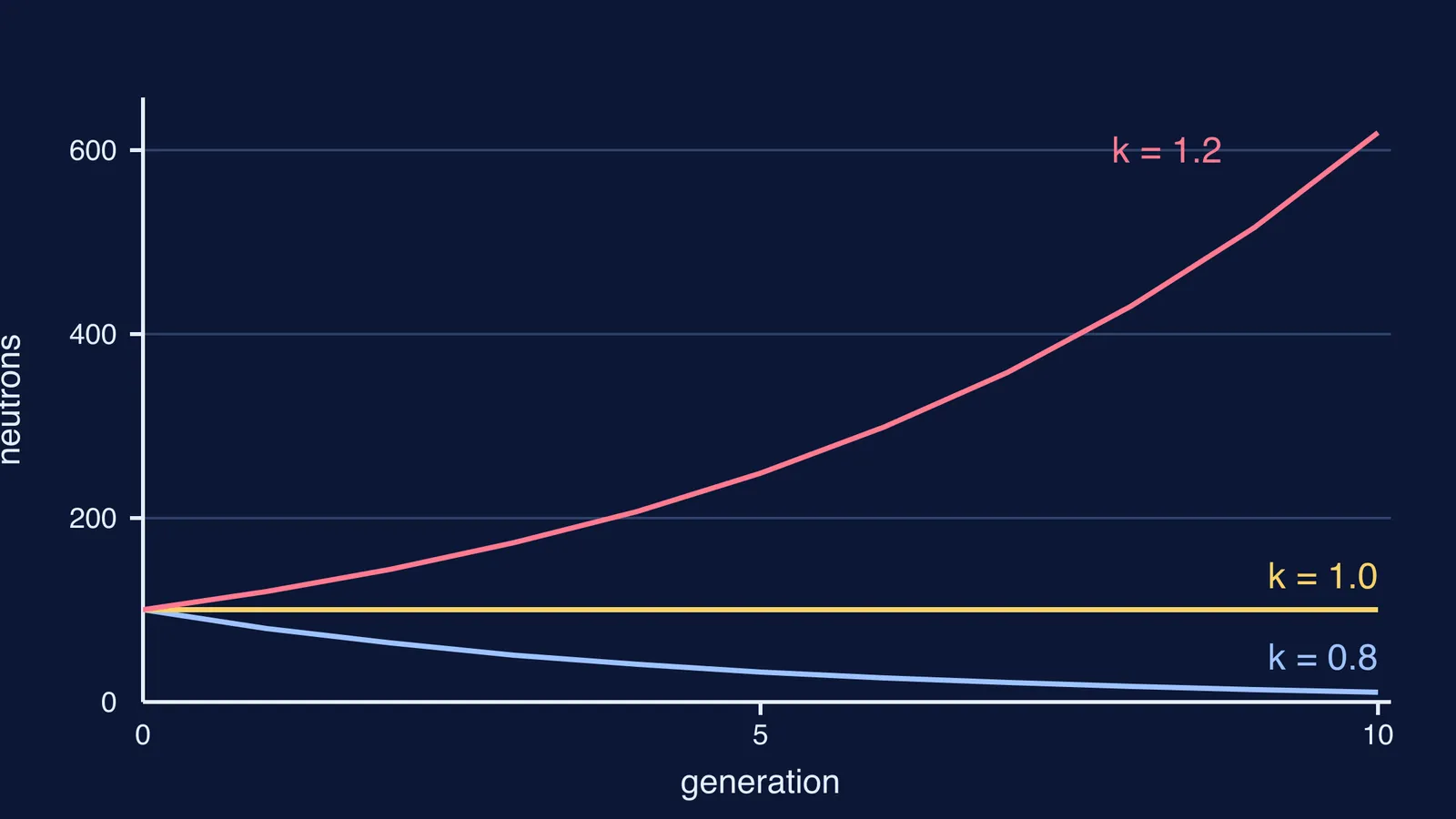
Here is a toy model you can check with a calculator. Take the World Nuclear Association's average of about 2.5 neutrons per fission (source). Call p the fraction of those neutrons that cause another fission. Then k = 2.5 x p. The values of p below are made up to show the arithmetic; they are not measurements of any real lump.
Small lump, p = 0.32, so k = 0.8. Start with 100 neutrons: 100, 80, 64, 51, 41, 33 and so on. After 10 generations about 11 are left.
Critical lump, p = 0.40, so k = 1.0. The count stays at 100 every generation.
Large lump, p = 0.48, so k = 1.2. The count goes 100, 120, 144, 173, 207, 249. After 10 generations it is about 619.
The rule behind all three is N = N0 x k^n, where n is the number of generations. That is exponential change; see our post on exponential vs linear growth.
How did the first reactor show k crossing 1?
The idea itself came years earlier, as our post on how Leo Szilard got the chain reaction idea tells. On 2 December 1942, the reactor called Chicago Pile-1 went critical, according to the US Department of Energy's Manhattan Project history. The pile was built brick by brick in layers, from over six tons of uranium metal, 34 more tons of uranium oxide and almost 400 tons of graphite. As control rods were pulled out, the clicking of the neutron counters sped up until it became a steady hum. The pile reached a k of 1.0006 while generating about half a watt, the same page records.
How can you test your own intuition?
Use this predict-then-check routine on any critical mass question:
Predict the direction first. Will this change make more neutrons leak out, or fewer?
Find the surface-to-volume effect. A flattened sheet or a long thin rod has far more surface per unit volume than a sphere, so it leaks more and needs more fuel to go critical.
Check density and surroundings. Denser fuel and a reflector both push k up.
Decide whether k is below, at or above 1, and say in one sentence what the neutron count will do.
Only then calculate, and compare with what you predicted.
The hard part is picturing neutrons leaking out of a growing sphere. The Fermi Simulation Lab has interactive simulations for ideas that are easier to see than to read, and Fermi's AI tutor notices where you are stuck and decides whether to explain, ask or show.
Next time you meet the words critical mass, start by asking where the neutrons leak out.