

On this page
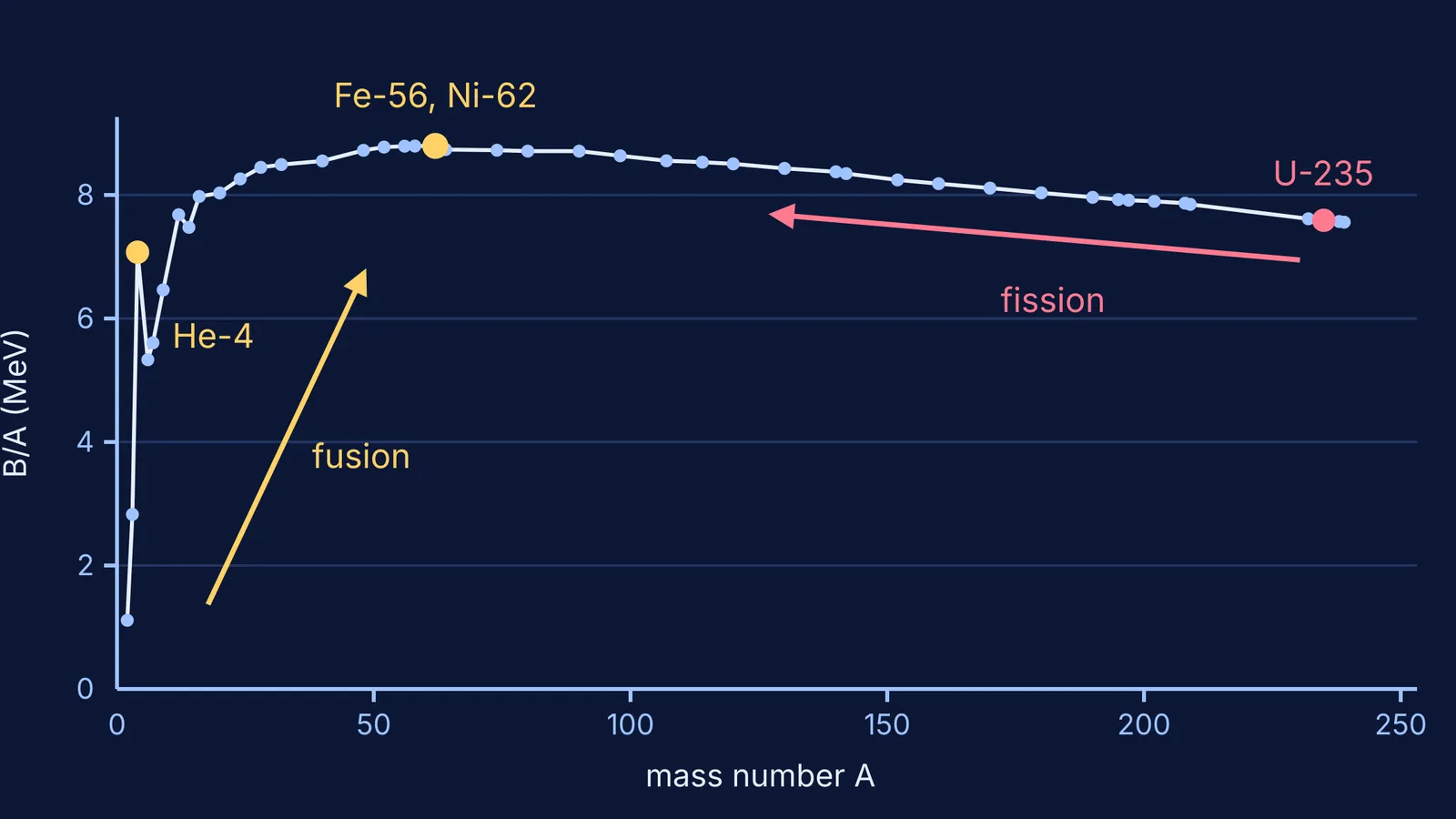
The binding energy per nucleon graph answers three exam questions at once: which nuclei are most tightly held, why heavy nuclei split, and why light nuclei fuse. Below we walk along the curve marker by marker, then turn it into a rule for predicting any reaction.
What does the binding energy per nucleon graph show?
A nucleus weighs less than the protons and neutrons that make it up, and that missing mass is called the mass defect (OpenStax University Physics, 10.2). Binding energy is that mass defect converted to energy, E = Δm c², and binding energy per nucleon is the binding energy divided by the mass number A (NCERT Class 12 Physics, Nuclei). NCERT describes it as the average energy per nucleon needed to separate a nucleus into its individual nucleons.
Higher on the curve means more tightly bound. Five markers worth memorising, from the AME2020 atomic mass evaluation hosted by the IAEA:
Deuterium (H-2): 1.11 MeV per nucleon, the loosest nucleus on the chart.
Helium-4: 7.07 MeV, a sharp spike far above lithium-6 at 5.33 MeV.
Iron-56: 8.790 MeV, near the top.
Nickel-62: 8.795 MeV, the actual highest point.
Uranium-235: 7.59 MeV, back down on the heavy side.
NCERT notes that the curve is almost flat, at roughly 8 MeV, between A = 30 and A = 170, and lower for both lighter and heavier nuclei (NCERT, Section 13.7).
Why does iron sit at the peak of the curve?
Two forces pull in opposite directions. The nuclear force is attractive but short-ranged, so each nucleon feels only its nearest neighbours, a property NCERT calls saturation (NCERT Class 12 Physics, Nuclei). In a small nucleus, a large share of nucleons sit on the surface with fewer neighbours, so binding per nucleon is low.
Meanwhile, every proton repels every other proton, and at high A these electrostatic forces begin to dominate (OpenStax University Physics, 10.2). The two effects balance in the iron and nickel region.
One fine print: a 1995 paper by M. P. Fewell in the American Journal of Physics showed that iron-58 and nickel-62 are both more tightly bound than iron-56, with nickel-62 the highest (Fewell, 1995). The AME2020 numbers above agree: nickel-62 beats iron-56 by about 0.004 MeV per nucleon.
How do you predict whether a nuclear reaction releases energy?
Proton and neutron numbers are both conserved in nuclear reactions (NCERT, Example 13.4), so you can compare total binding energies directly (see why mass number is conserved but mass is not). Use this four-step check:
Find each reactant on the curve and multiply its value by A to get its total binding energy.
Do the same for every product. A free neutron or proton counts as zero.
Subtract: Q = (total for products) minus (total for reactants).
If Q is positive, energy is released. If negative, energy must be supplied.
Worked with the AME2020 values:
Fusion, H-2 + H-3 → He-4 + n: reactants 2 × 1.112 + 3 × 2.827 = 10.71 MeV; product 4 × 7.074 = 28.30 MeV. Q ≈ +17.6 MeV.
Fission, U-235 + n → Ba-141 + Kr-92 + 3n: reactant 235 × 7.591 = 1783.9 MeV; products 141 × 8.326 + 92 × 8.513 = 1957.1 MeV. Q ≈ +173 MeV.
Splitting iron, Fe-56 → Mg-26 + Si-30: reactant 56 × 8.790 = 492.3 MeV; products 26 × 8.334 + 30 × 8.521 = 472.3 MeV. Q ≈ −20.0 MeV, so it costs energy.
The helium trap, C-12 → 3 He-4: reactant 12 × 7.680 = 92.2 MeV; products 3 × 28.30 = 84.9 MeV. Q ≈ −7.3 MeV, even though helium is lighter.
The same Q comes out of a mass-difference calculation; our guide on how to calculate the Q value of a nuclear reaction shows that route. For practice, the Fermi Problem Library has worked problems with a step-by-step solver that explains the reasoning rather than printing an answer.
Why do both fission and fusion release energy?
Because both move nucleons uphill towards the peak. NCERT's example: a nucleus with A = 240 is less tightly bound than one with A = 120, so splitting it into two halves releases energy, while two very light nuclei that fuse end up more tightly bound (NCERT Class 12 Physics, Nuclei).
The scale is huge. NCERT states that fission of 1 kg of uranium gives about 10^14 J, against about 10^7 J from burning 1 kg of coal (NCERT, Section 13.7). Fusion has its own catch: the nuclei must get close despite their repulsion, which is why nuclear fusion needs very high temperatures.
To test yourself, point at any two nuclei and predict which way the energy flows before you calculate. To see ideas like this move, the Fermi Simulation Lab has interactive simulations for ideas that are easier to see than to read.


