

On this page
Many nuclear physics numericals ask how much energy comes out. That number is the Q value. Here are the two ways to calculate it, three worked examples using real measured masses, and a check to run before you write your answer.
What is the Q value of a nuclear reaction?
The Q value is the energy absorbed or released in a reaction: initial mass minus final mass, times c² (Q value overview)). Because energy is conserved, Q also equals the kinetic energy of the products minus that of the reactants (MIT 22.01 study sheet).
One atomic mass unit is equivalent to 931.494 103 72 MeV, according to the CODATA 2022 value published by NIST.
How do you calculate Q from the mass difference?
Write the balanced reaction. Check that mass number A and charge Z add up on both sides.
Look up atomic masses in the NIST table of atomic masses. For alpha and beta-minus decay the electrons cancel; positron emission needs an extra 2mₑ subtracted.
Take mass before minus mass after, keeping every decimal (the MIT sheet: "Don't round masses in amu!").
Multiply the difference in u by 931.494 MeV.
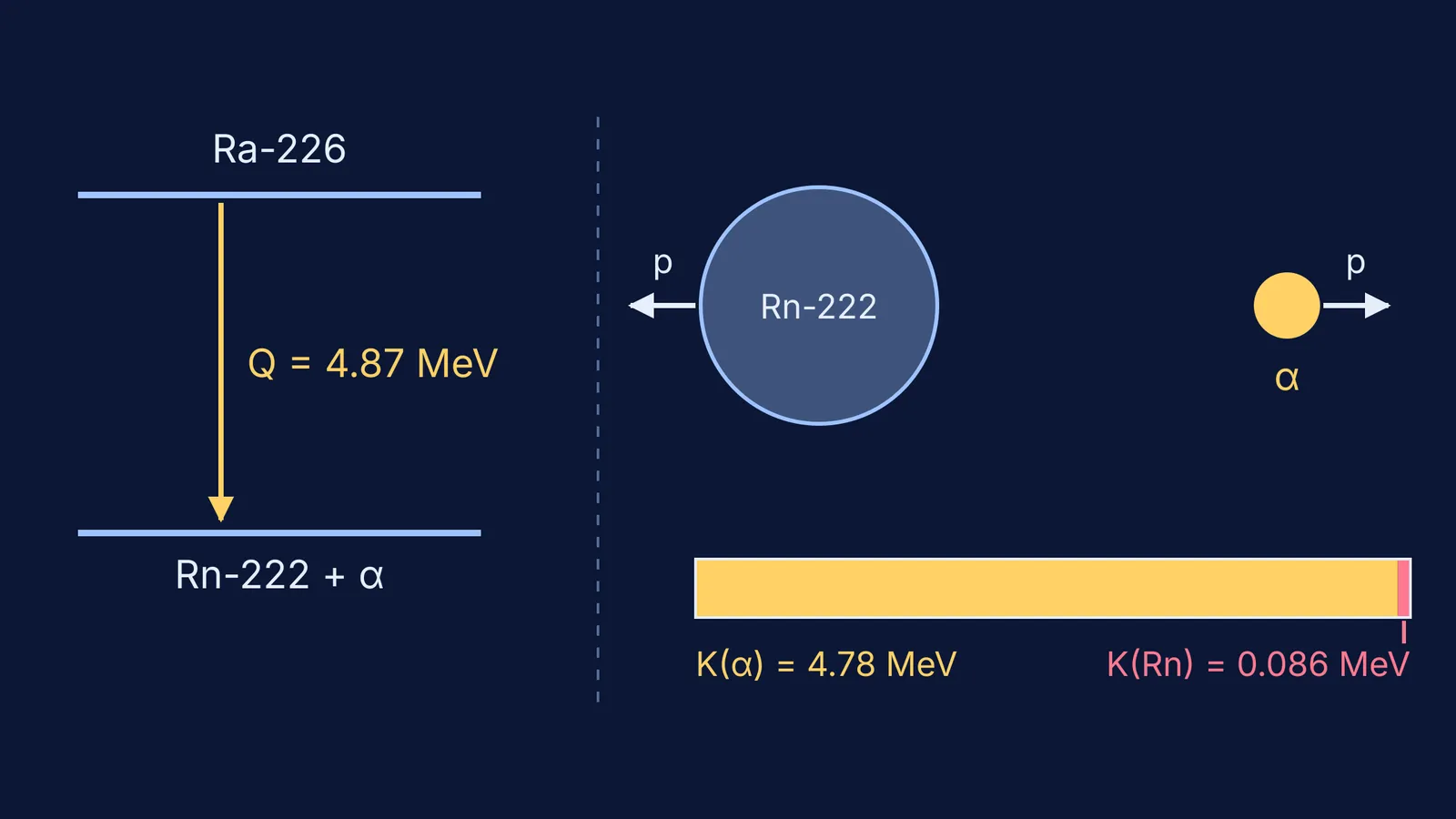
Worked example 1: radium-226 alpha decay. Ra-226 → Rn-222 + He-4. NIST lists 226.025 4103 u, 222.017 5782 u and 4.002 603 25 u. The difference is 0.005 228 85 u, so Q = 0.005 228 85 × 931.494 = 4.871 MeV.
For more practice with mass defects, see our mass defect and binding energy problems, solved step by step.
How do you get Q from binding energies?
Binding energy is the energy equivalent of the mass a nucleus loses compared with its separate protons and neutrons (HyperPhysics on binding energy). Free nucleons are the same on both sides of a reaction, so they cancel, leaving:
Q = (total binding energy of products) − (total binding energy of reactants)
Worked example 2: deuterium-tritium fusion. H-2 + H-3 → He-4 + n. From NIST atomic masses and the CODATA neutron mass, the binding energies are 2.225 MeV (deuterium), 8.482 MeV (tritium) and 28.296 MeV (helium-4); a free neutron has none. Q = 28.296 − 10.707 = 17.589 MeV, the same as the mass method and the 17.59 MeV HyperPhysics quotes.
Our post on fission and fusion energy applies this to reactors.
What does a positive or negative Q value mean?
A positive Q means the reaction is exothermic: rest mass turns into kinetic energy of the products (Q value overview)). A spontaneous radioactive decay must have Q > 0 (MIT 22.01 study sheet).
A negative Q means the reaction is endothermic: the projectile must bring in the missing energy. The threshold energy is approximately −Q × (m + M)/M, where m is the projectile mass and M the target mass (same MIT sheet). It exceeds |Q| because momentum is conserved, so the products cannot end up at rest.
Worked example 3: alpha on nitrogen. N-14 + He-4 → O-17 + H-1, the kind of collision in Rutherford's 1919 paper on nitrogen. With NIST atomic masses, 18.005 677 u go in and 18.006 957 u come out, so Q = −0.001 280 u × 931.494 = −1.192 MeV. The threshold is 1.192 × (1 + 4.003/14.003) ≈ 1.53 MeV.
How is the kinetic energy shared between decay products?
A parent at rest that splits in two sends the products off with equal and opposite momentum. Since K = p²/2m, the lighter particle takes the larger share:
K(alpha) = Q × M(daughter) / (M(daughter) + M(alpha))
For radium-226, the alpha gets 4.871 × 222.018/226.020 = 4.784 MeV and the radon recoils with 0.086 MeV. In D-T fusion the same rule gives the neutron 14.05 MeV and the helium 3.54 MeV, matching the HyperPhysics figure of 79.87% for the neutron. More in our post on daughter-nucleus recoil in alpha decay.
Beta decay is different: three particles share Q, so the electron's energy is spread continuously up to a maximum (MIT 22.01 study sheet).
What should you check before writing your answer?
A and Z balance on both sides.
Atomic masses throughout, or nuclear masses throughout, never a mix.
At least five decimal places kept until the last step.
Before minus after, so released energy comes out positive.
In a two-body decay, the lighter particle gets most of Q.
If you get Q right but keep splitting it wrongly, the Fermi Problem Library has worked problems with a step-by-step solver that explains the reasoning rather than printing an answer. If binding energy itself is shaky, start with its lesson in the Fermi Concept Library.


