On this page
Board and entrance papers ask the same three things about nuclear energy: why fission and fusion release energy, how much, and how a reactor controls it. Students often memorise "200 MeV" without knowing where it comes from, and then cannot handle a question that gives masses instead. This post builds each number step by step, then explains reactor basics.
Why do both fission and fusion release energy?
NCERT's Nuclei chapter answers this with the binding energy curve. Binding energy per nucleon is roughly 8 MeV across the middle of the periodic table (mass numbers about 30 to 170) and lower at both ends. Whenever nuclei rearrange into products that are more tightly bound, the difference is released.
A heavy nucleus splitting into two medium nuclei moves up the curve: fission.
Two light nuclei joining into a heavier one also moves up the curve: fusion.
Nuclear fission and fusion are listed in the JEE (Main) 2026 syllabus and the NEET (UG) 2026 syllabus; the JEE (Advanced) 2026 brochure adds "energy calculation in these processes". Check the current year's syllabus. If binding energy itself is shaky, start with our post on mass defect and binding energy.
How much energy does one fission release?
NCERT's estimate is a model of how to think. Take a nucleus with A = 240 splitting into two fragments of A = 120. Binding energy per nucleon is about 7.6 MeV for A = 240 and about 8.5 MeV for A = 120. The gain is about 0.9 MeV per nucleon, so the total is 240 × 0.9 ≈ 216 MeV. The measured Q value for uranium fission is of the order of 200 MeV, which first appears as kinetic energy of the fragments and neutrons and ends up as heat.
Example 1. Estimate the energy from complete fission of 1.0 g of U-235, at 200 MeV per fission.
Number of nuclei: N = (1.0/235) × 6.022 × 10²³ = 2.56 × 10²¹.
Energy per fission: 200 MeV × 1.602 × 10⁻¹³ J/MeV = 3.20 × 10⁻¹¹ J.
Total: 2.56 × 10²¹ × 3.20 × 10⁻¹¹ ≈ 8.2 × 10¹⁰ J.
For 1 kg that is about 8 × 10¹³ J, consistent with NCERT's round figure of 10¹⁴ J. NCERT compares it with about 10⁷ J from burning 1 kg of coal, a factor of roughly ten million.
How do you find a fusion Q value from masses?
Example 2. Find the energy released in D + T → ⁴He + n. Use atomic masses from NIST: ²H = 2.014102 u, ³H = 3.016049 u; ⁴He = 4.002603 u from the NIST helium table; neutron = 1.008665 u from CODATA.
Mass before: 2.014102 + 3.016049 = 5.030151 u.
Mass after: 4.002603 + 1.008665 = 5.011268 u.
Mass defect: 0.018883 u.
Q = 0.018883 × 931.5 MeV ≈ 17.6 MeV.
Atomic masses include electrons, but both sides have two electrons, so they cancel. Per nucleon involved, this is 17.6/5 ≈ 3.5 MeV, against 200/236 ≈ 0.85 MeV for fission. Fusion gives more energy per unit mass of fuel, but needs extreme temperatures. ITER describes D-T as the most efficient laboratory fusion reaction, requiring about 150 million °C, ten times the Sun's core temperature.
How does a reactor keep the chain reaction steady?
Each fission releases a few neutrons (two to four in NCERT's example reactions), which can cause further fissions. The US Department of Energy's Nuclear 101 explainer summarises the parts:
Fuel: uranium pellets stacked into fuel rods.
Moderator: slows the fast neutrons from fission, because slow neutrons are better at causing further fission in U-235. Light-water reactors use ordinary water as both moderator and coolant.
Control rods: inserted to reduce the reaction rate, withdrawn to increase it.
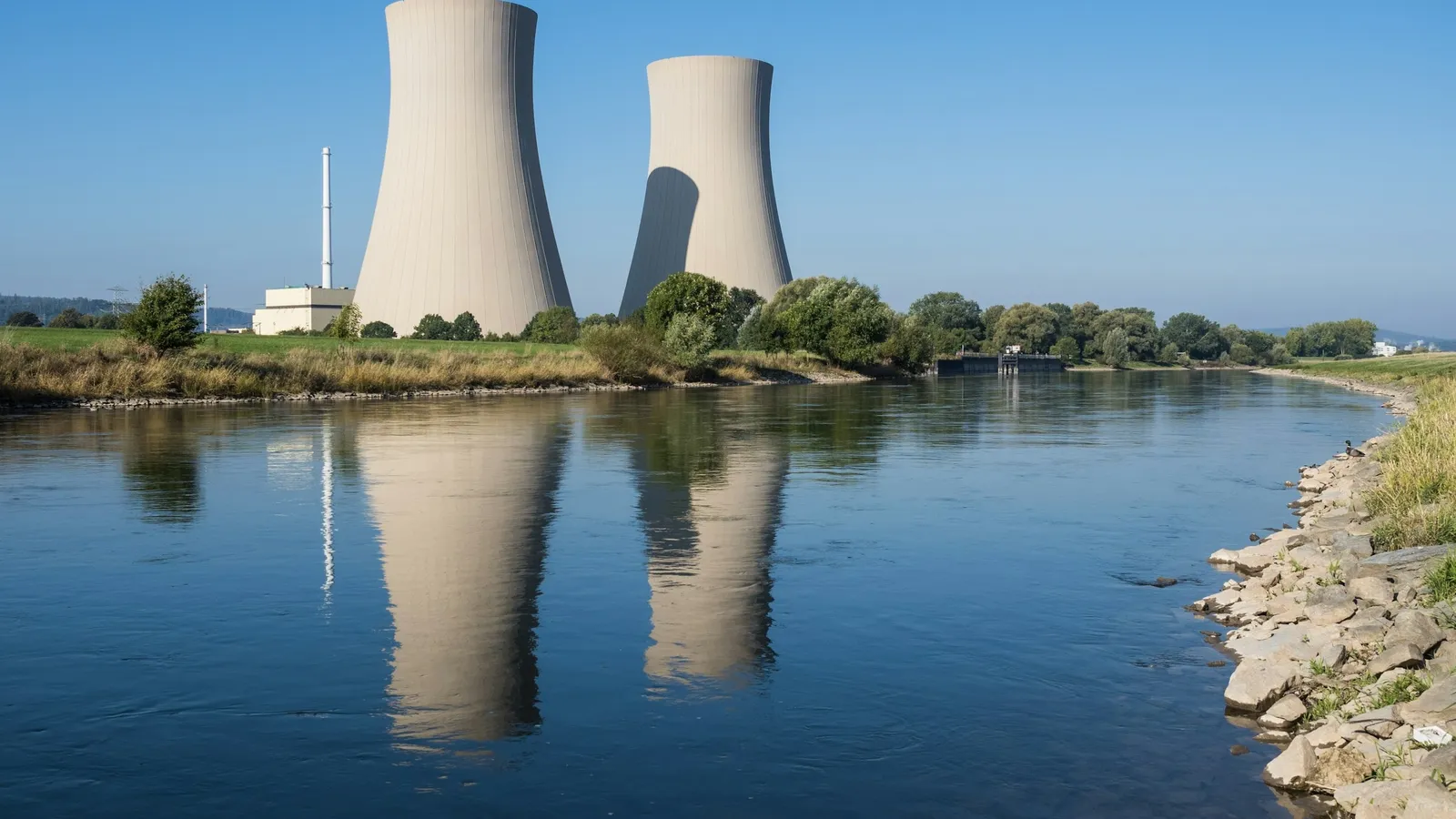
Coolant: carries heat away. The heat makes steam that spins a turbine.
A reactor runs steadily when, on average, exactly one neutron from each fission goes on to cause another. More than one and the rate grows; less than one and it dies out. Most reactors operated by India's NPCIL are pressurised heavy water reactors, which use heavy water as moderator. For how fission was discovered and explained, see our profile of Lise Meitner and the discovery of fission.
Common mistakes
Saying mass is destroyed but nucleons are not conserved. Proton and neutron numbers balance; the mass defect comes from binding energy.
Using the wrong conversion. 1 u = 931.5 MeV/c², and 1 MeV = 1.602 × 10⁻¹³ J.
Mixing nuclear and atomic masses without checking that electrons cancel.
Confusing moderator and control rods. The moderator slows neutrons; control rods absorb them.
Calling fusion "easy" because it releases more per nucleon. The Coulomb barrier is why it needs such high temperatures.
Practice routine
Work Example 1 for 1 g of fuel at 180 MeV per fission and compare.
Find Q for D + D → ³He + n using masses, and check against NCERT's 3.27 MeV.
Write three lines explaining what would happen if a moderator were removed or control rods withdrawn.
To see a step you got wrong, the Fermi Problem Library has a step-by-step solver that explains the reasoning rather than just printing a number.
Start with question 2 from the routine today; it uses only one table of masses.