

On this page
When studying nuclear physics, distinguishing between mass and mass number is a common stumbling block. If mass cannot be created or destroyed, why does it change in a nuclear reactor? The answer lies in separating the *count* of nucleons from their *rest mass*. Nucleons are rearranged but not destroyed, but the energy holding them together changes their physical mass.
Why is mass number conserved?
The mass number (A) is simply an integer: the total number of protons and neutrons (collectively called nucleons) inside a nucleus.
In everyday nuclear reactions—whether it is alpha decay, beta decay, fission, or fusion—the total number of these heavy particles remains constant. Even in beta decay, where a neutron transforms into a proton, the total count of nucleons stays exactly the same. You start with a certain number of baryons (protons and neutrons) and you end with the exact same number. Therefore, the sum of the mass numbers on the left side of a nuclear equation always equals the sum on the right side.
If you are solving radioactive decay series problems, this conservation of A (along with atomic number Z) is the primary rule you use to balance equations and identify unknown daughter nuclei.
What is mass defect, and where does the mass go?
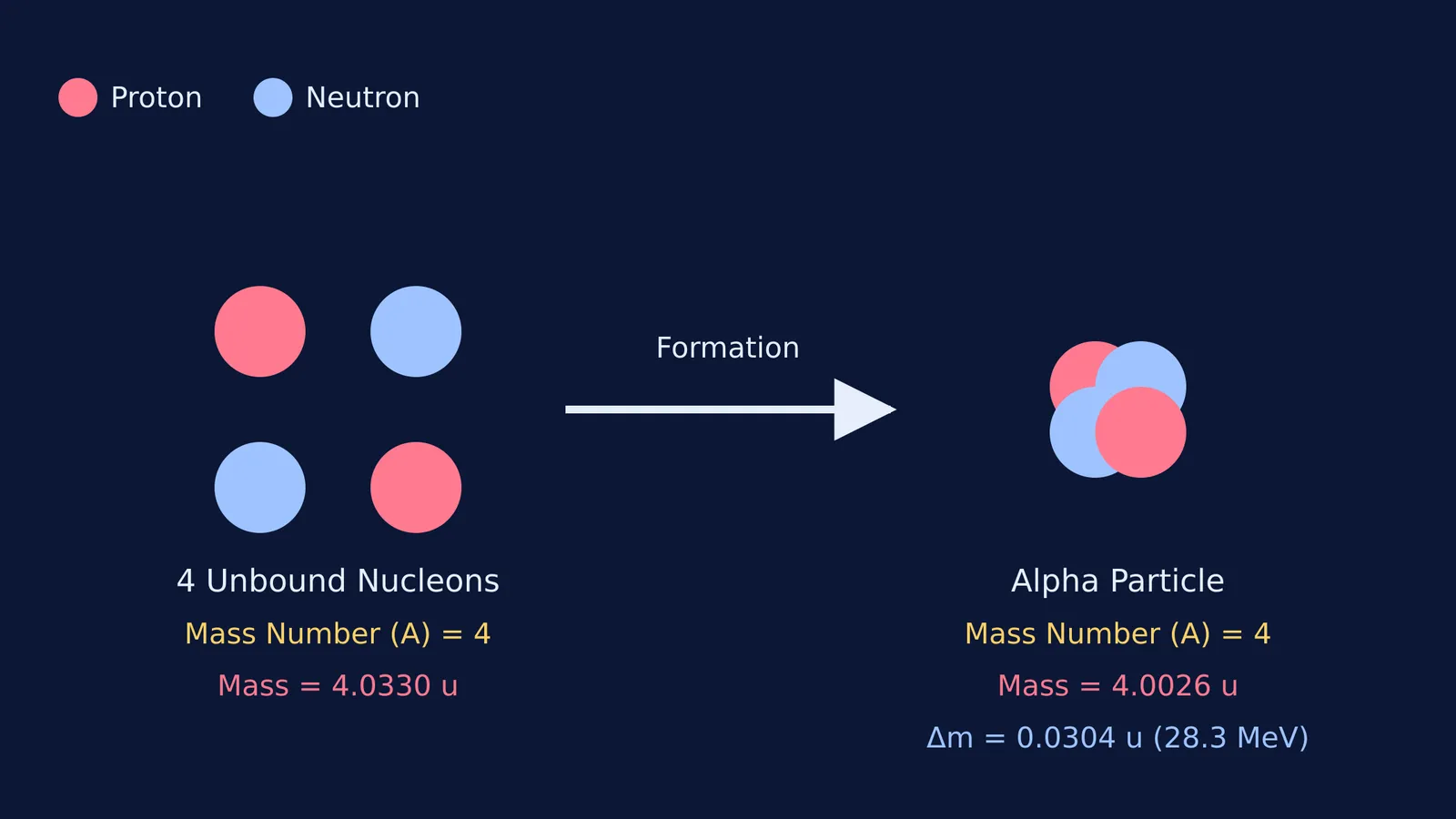
While the *number* of particles is conserved, their *actual physical mass* is not. The mass of a nucleus is always slightly less than the sum of the masses of its individual, separated protons and neutrons. This missing mass is called the mass defect (Δm).
According to HyperPhysics, this missing mass has not vanished; it has been converted into nuclear binding energy. Binding energy is the exact energy that holds the nucleus together. The relationship is governed by Einstein's mass-energy equivalence principle, E = Δmc².
Because energy and mass are two forms of the same thing, the "missing" mass is simply the energy that was released when the nucleus formed. For example, when two protons and two neutrons bind to form an alpha particle (a helium nucleus), their combined mass drops by 0.0304 atomic mass units (u). That tiny mass defect is converted into 28.3 MeV of binding energy, which is released as kinetic energy or radiation.
If you are struggling to picture how particles can lose mass by binding together, the Fermi Concept Library can help you trace the energy changes from unbound nucleons to stable nuclei step by step.
How does this apply to fission and fusion?
The concept of mass defect explains why nuclear reactors and stars produce such immense power. It all comes down to how tightly bound the nucleons are in different elements.
According to HyperPhysics, the binding energy per nucleon varies across the periodic table, peaking at iron (specifically, iron-56 has a binding energy per nucleon of 8.8 MeV, though nickel-62 is technically the most tightly bound of all nuclides).
In nuclear fusion: Light nuclei combine to form a heavier nucleus. Because the new nucleus is more tightly bound, it has a larger mass defect than the reactants. The difference in mass is released as energy.
In nuclear fission: A very heavy nucleus (like uranium-235) splits into lighter fragments. The fragments are closer to the iron peak, meaning they are more tightly bound than the original uranium. Again, the total mass decreases, and the difference is released as energy.
In both nuclear fission and fusion, the mass number is perfectly conserved. The count of protons and neutrons you put in is the count you get out. The energy released comes entirely from the fact that those rearranged nucleons now have a slightly lower total rest mass.
How to calculate the Q-value for exams
To find the energy released in any nuclear reaction, follow these steps:
Sum the reactant masses: Add up the atomic masses of the initial nucleus and incident particles.
Sum the product masses: Add up the masses of the daughter nucleus and emitted particles.
Find the mass defect: Subtract the product mass from the reactant mass (Δm = m_reactants - m_products).
Convert to energy: Multiply Δm by 931.5 MeV/u (since 1 u = 931.5 MeV/c²). If Δm is positive, energy is released. If it is negative, energy must be supplied.
The true conservation law
In chemistry, we often talk about the Law of Conservation of Mass. Chemical reactions do involve tiny mass changes because electrons change energy levels, but the change is so small (on the order of electron volts, or eV) that it is practically unmeasurable. In nuclear reactions, the energies are millions of times greater (MeV), making the mass defect significant and easily measurable.
This is why physicists prefer to talk about the conservation of *mass-energy*. Mass alone is not conserved, but the total energy of the system—including the rest mass energy (mc²) and the kinetic energy—remains strictly constant. If you want to practice calculating these mass-energy conversions, reviewing nuclear binding energy and mass defect problems is the best way to master the mathematics for your exams.


