

On this page
Nuclear fusion powers the Sun and promises a nearly limitless source of clean energy on Earth. However, forcing atomic nuclei to fuse is one of the hardest challenges in modern physics. To make nuclear fusion happen in a laboratory, you have to heat a gas to temperatures far hotter than the core of a star.
But why does fusion demand such extreme heat?
What is the Coulomb barrier?
At the heart of the problem is electrostatic repulsion. Every atomic nucleus contains protons, meaning every nucleus is positively charged. As you know from Coulomb's law, like charges repel each other.
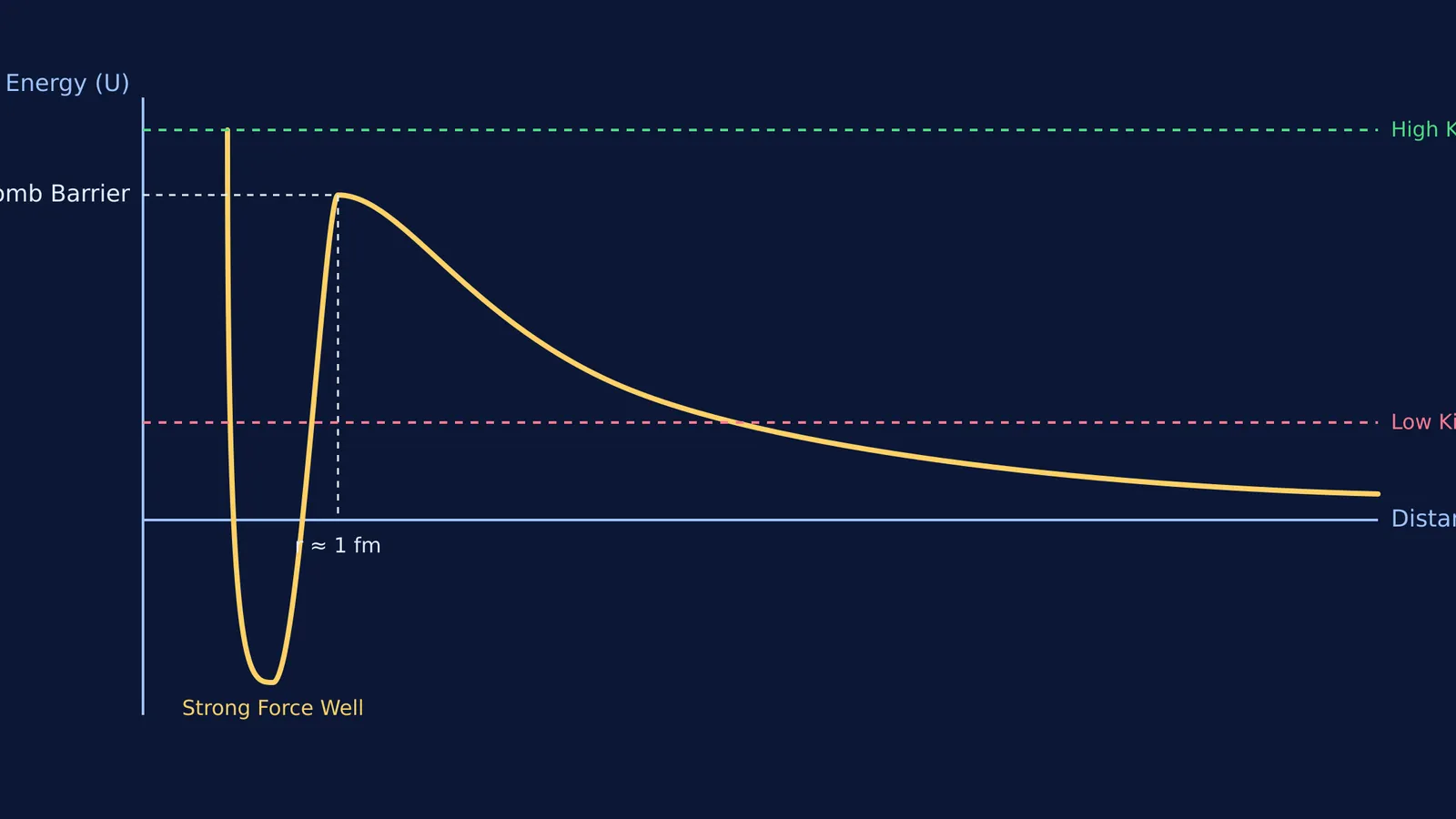
As two nuclei get closer, this repulsive force grows rapidly. This invisible wall of electrostatic force is known as the Coulomb barrier. At room temperature, nuclei bounce off this barrier long before they can touch.
However, there is another force at play: the strong nuclear force. The strong force is what binds protons and neutrons together inside a nucleus, and it is vastly more powerful than Coulomb repulsion. The catch is that it only works at incredibly short distances. To fuse, nuclei must get extremely close—about 100,000 times smaller than the diameter of an atom—for the strong nuclear force to take over (Department of Energy, 2024).
Why does nuclear fusion need very high temperature?
In physics, temperature is simply a measure of the average kinetic energy of particles in a substance. When you heat a gas, its particles move faster.
To overcome the massive Coulomb barrier, the nuclei must be slammed together at tremendous speeds. The only way to give a bulk collection of nuclei enough kinetic energy to power through this repulsion is to heat them to extreme temperatures.
At the core of the Sun, the temperature is roughly 15 million °C, and immense gravitational pressure helps force the nuclei together (ITER, 2024). On Earth, we do not have the Sun's gravity to help us. To compensate and achieve a self-sustaining reaction in a laboratory, fusion reactors like ITER must heat hydrogen isotopes to 150 million °C — ten times hotter than the centre of the Sun.
How does quantum tunnelling help?
Interestingly, classical physics predicts that even the 15 million °C temperature in the Sun's core (ITER, 2024) is not quite enough to overcome the Coulomb barrier.
Fusion happens at lower temperatures than classically expected because of a phenomenon called quantum tunnelling. In the quantum world, a particle's position is defined by probability. There is a tiny chance that a nucleus can simply "tunnel" through the energy barrier rather than having enough kinetic energy to go entirely over it. Even with quantum tunnelling, temperatures still must be in the millions of degrees to make collisions frequent and energetic enough to sustain a reaction.
If you are studying these nuclear physics concepts, the Fermi Concept Library has a dedicated lesson on the strong nuclear force and the Coulomb barrier. If you are struggling with the calculations, the Fermi Problem Library has worked problems with a step-by-step solver that explains the reasoning rather than printing an answer.
How do you find the distance of closest approach?
In exams, you are often asked to find the "distance of closest approach" when a charged particle is fired at a nucleus. You can solve this by applying the conservation of energy.
Imagine firing an alpha particle (charge 2e) directly at a gold nucleus (charge 79e) with kinetic energy K.
At the starting point, all its energy is kinetic (K).
As it approaches the nucleus, it slows down, and kinetic energy turns into electrostatic potential energy.
At the distance of closest approach (r), it momentarily stops. Its kinetic energy is zero, and its potential energy is at maximum.
By equating the initial kinetic energy to the electric potential energy, K = (1 / 4πε₀) × (q₁q₂ / r), you can rearrange the formula to solve for r. This simple energy balance is the mathematical reason why high initial kinetic energy (and therefore high temperature) is the only way to make r small enough for fusion.


