

On this page
In September 1933, Leo Szilard, a Hungarian physicist who had recently fled Nazi Germany, read a newspaper article that annoyed him. *The Times* had reported on a speech by Lord Ernest Rutherford, a giant of nuclear physics. Rutherford had dismissed the idea of harnessing atomic energy, saying that anyone looking for power in the transformation of atoms was "talking moonshine" (Wikipedia).
Szilard went for a walk in Bloomsbury, London, to clear his head. As he waited for a traffic light to change at Southampton Row and Russell Square, an idea crystallised. When the light turned green and he stepped off the curb, he had imagined the nuclear chain reaction—a concept that reshaped physics.
How did Leo Szilard get the idea of the nuclear chain reaction?
Why was Rutherford so skeptical? Rutherford was thinking in terms of alpha particles—the positively charged fragments familiar to students counting alpha and beta decays in a radioactive series. Because the target nucleus is also positive, they strongly repel each other. To overcome this Coulomb barrier, you have to fire them with massive kinetic energy, much larger than typical alpha decay recoil energy. Rutherford thought the energy required would always exceed the energy produced.
Szilard's breakthrough was to think about the neutron. The neutron, which has no electric charge, was discovered by James Chadwick in February 1932 (Wikipedia). Because neutrons have no charge, they can slip into a nucleus without being repelled by the positive protons inside.
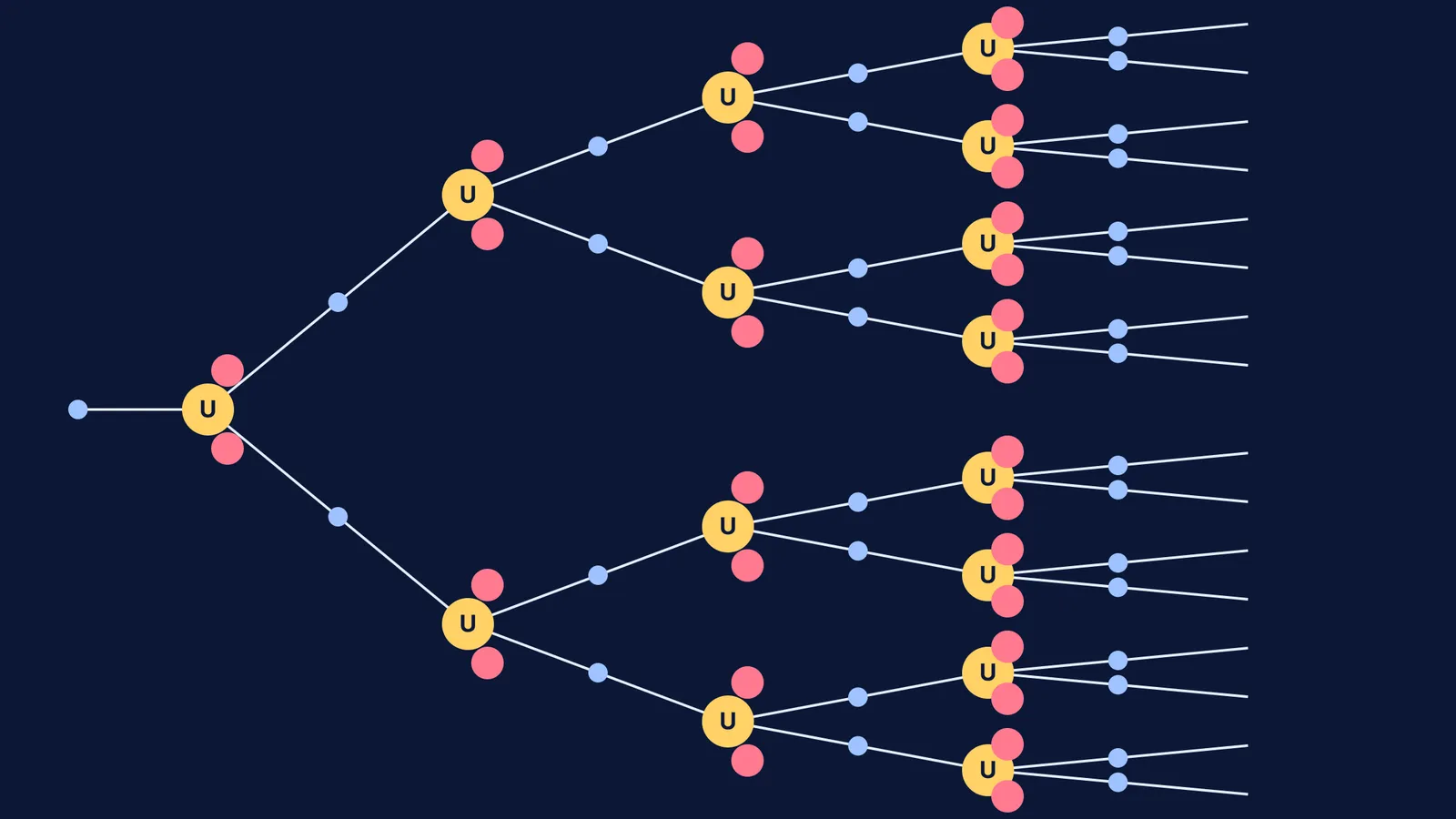
Szilard reasoned from first principles: if we can find an element that splits when hit by one neutron, and in the process releases two or more neutrons, those new neutrons could split more nuclei. One becomes two, two become four, four become eight. This exponential multiplication creates a self-sustaining chain reaction. It was a theoretical leap that required imagining a process no one had yet observed in a laboratory.
What was the nuclear chain reaction patent?
At the time, Szilard's idea was purely theoretical. He did not know which element would work; uranium fission was not discovered until late 1938 by Otto Hahn and Fritz Strassmann.
But Szilard knew the implications. Having read H. G. Wells' science fiction, specifically *The World Set Free*, he feared what would happen if such immense energy was turned into a weapon, especially by Nazi Germany.
In June 1934, he filed a UK patent for the chain reaction concept. To keep it out of the public domain, he assigned the patent (GB 630726) to the British Admiralty in 1936 under a secrecy act. Because of this precaution, it remained secret and was not published until 1949 (Wikipedia).
What did the Einstein-Szilard letter achieve?
Once uranium fission was proven possible, Szilard's theoretical chain reaction became a terrifying physical reality. In August 1939, Szilard drafted a letter to US President Franklin D. Roosevelt and convinced his former colleague Albert Einstein to sign it (Wikipedia).
The Einstein-Szilard letter warned that a nuclear chain reaction in a large mass of uranium was now almost certain, and that Germany might use this to build extremely powerful bombs of a new type. This warning prompted the US government to launch the advisory committee that eventually grew into the Manhattan Project.
Why do the best physics ideas happen away from the desk?
Szilard's traffic light epiphany is a perfect example of how the human brain solves hard problems. He did not find the answer by staring endlessly at the newspaper or sitting rigidly at a desk. He read the constraints, got annoyed, and went for a walk outside.
Cognitive science calls this shifting from focused mode to diffuse mode. When you relax your active concentration, your brain continues to connect distant ideas in the background.
If you are working on a difficult numerical problem and get stuck, try the Traffic Light Framework:
Load the problem: Read the question carefully. What is given? What is missing? Try to solve it with focus for a short time.
Step away: If you are stuck, do not just sit there. Go for a walk, do a chore, or get a drink of water. Let your brain process the physics in the background.
Check your assumptions: Rutherford assumed alpha particles were the only tool; Szilard switched to neutrons. Ask yourself: "What rule or force am I ignoring here?"
Trace the logic: Follow the reasoning from first principles instead of trying to remember a final formula.
When you sit back down at your desk, a clear path often emerges. For daily practice, the Fermi Problem Library has worked problems with a step-by-step solver that explains the reasoning rather than printing an answer. And if you have gaps in your concepts, Fermi's AI tutor teaches rather than answers: it holds a line of reasoning across a session, notices where a student is stuck, and decides whether to explain, ask or show.


