On this page
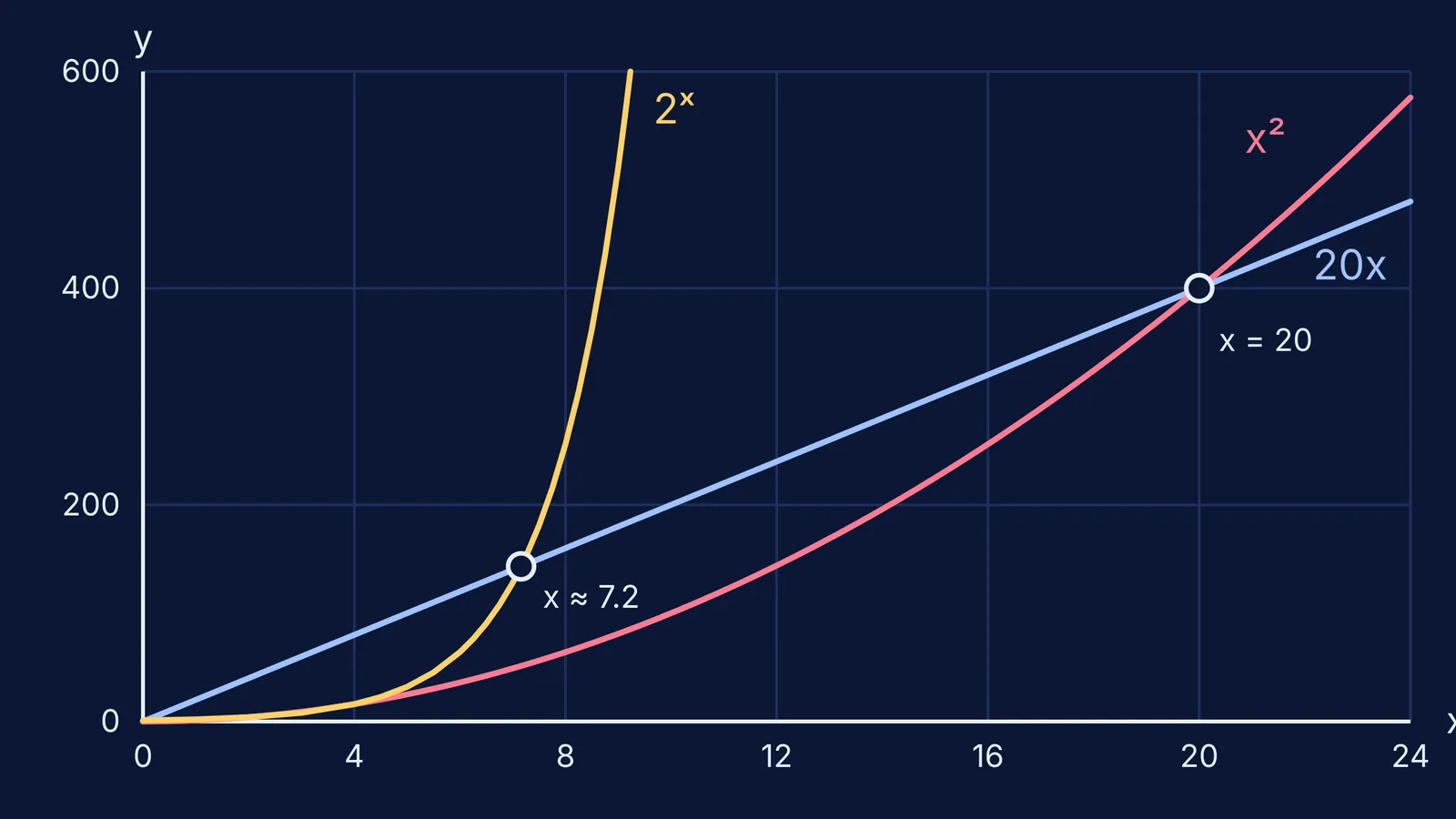
Put y = 20x, y = x² and y = 2^x on one graph. For the first few steps the straight line is ahead, which is why exponential growth fools people. By x = 8 the doubling curve has passed it, and by x = 10 it has left the top of the graph. Here is how to predict those crossovers, two doubling-time rules, and a paper-folding example.
Exponential vs linear growth: which wins in the long run?
The difference is in the step size.
Linear growth adds the same amount each step: 20x gains 20 every time x goes up by 1.
Quadratic growth adds a little more each step: x² gains 1, then 3, then 5, then 7.
Exponential growth multiplies by the same factor each step: 2^x doubles every time x goes up by 1.
"In the long run, exponential growth of any kind will overtake linear growth of any kind" and "any polynomial growth", as the overview of exponential growth on Wikipedia puts it. The linear step never changes and the quadratic step grows by a fixed 2, but the exponential step is always as big as everything so far.
How do you predict the crossover points?
Linear vs quadratic: x² = 20x gives x = 20. In general, a·x = b·x² crosses at x = a ÷ b.
Exponential vs linear: algebra cannot solve 2^x = 20x exactly, so make a doubling table. At x = 7, 128 is less than 140; at x = 8, 256 beats 160. The crossover is about x = 7.2.
Exponential vs quadratic: 2^x = x² at x = 2 and x = 4. After x = 4, doubling wins for good.
The exponential passes the line at about 7.2, long before the parabola does at 20. The curve that starts slowest is often the first to win.
What are the rule of 70 and the rule of 72?
The rule of 70 says that something growing at r% per period doubles in roughly 70 ÷ r periods, according to the Wikipedia article on exponential growth. The rule of 72 is a close cousin that provides "a good approximation for annual compounding, and for compounding at typical rates (from 6% to 10%)", and the exact doubling time is t = ln 2 ÷ ln(1 + r/100), as set out in the rule of 72 article.
A worked check: at 7% a year, 72 ÷ 7 ≈ 10.3 years, and the exact answer is 0.6931 ÷ 0.0677 ≈ 10.24 years. At 10% a year, the rule gives 7.2 years against an exact 7.27.
For continuous growth, 69 or 69.3 gives accurate results at any rate because ln 2 ≈ 0.693, the same article notes. That matches the doubling time ln 2 ÷ k you get from the model in our post on exponential growth and cooling with dy/dt = ky.
How many paper folds would reach the Moon?
The Moon is an average of 384,400 km away, according to NASA. Suppose a sheet is 0.1 mm thick. Each fold doubles the thickness, so after n folds the stack is 0.1 × 2^n mm.
7 folds: 12.8 mm.
12 folds: 409.6 mm, about 41 cm.
23 folds: about 839 m.
42 folds: about 440,000 km.
So 42 folds would pass the Moon while 41 folds (about 220,000 km) would fall short. Compare linear growth: adding one sheet per step for 42 steps gives 43 sheets, just 4.3 mm.
In real life, Britney Gallivan of Pomona, California, folded a single piece of paper in half 12 times on 27 January 2002, using tissue paper 1,219 m long, as recorded by Guinness World Records. Her formula for the minimum paper length, L = (π d ÷ 6)(2^n + 4)(2^n − 1), is given by Wolfram MathWorld. Because it contains 2^n × 2^n, each extra fold needs roughly four times as much paper.
How do you spot the type of growth in any data?
Differences: equal steps mean linear; steps rising by a fixed amount mean quadratic.
Ratios: if each value divided by the one before stays the same, it is exponential.
Log scale: an exponential becomes a straight line on a log y-axis.
Limits: real populations run out of room, which is why the logistic curve of Pierre Verhulst flattens.
Tables first: bracket a crossover with a short table before solving anything.
Crossovers are easier to see than to read, which is what the interactive simulations in the Fermi Simulation Lab are for. If logarithms are the shaky step, the Fermi Concept Library has a lesson for every concept in mathematics.
Try it tonight: grow a number by 10% a step, predict its doubling time with the rule of 72, then check with eight lines of multiplication.