

On this page
In algebra, expressions with absolute values (modulus) often look intimidating because they change their behaviour depending on whether the inside is positive or negative. The traditional way to handle |x - 1| + |x - 3| is to split it into three cases: x < 1, x between 1 and 3, and x > 3.
However, reading the expression geometrically turns a long algebraic slog into an instant mental check.
What does |x - 1| + |x - 3| mean?
The absolute value |x - a| is simply the distance between x and a on a number line. It is always positive or zero.
Therefore, the expression |x - 1| + |x - 3| asks for the total sum of distances from a point x to the point 1 and to the point 3. If you picture yourself standing at position x, this is the total distance you would have to walk to visit position 1 and then return to x and walk to position 3.
If you struggle with the algebra of these expressions, reading related guides on Equations and inequalities with modulus: the case-split method can help build your foundation.
How to find the minimum value of |x - 1| + |x - 3|?
To find the minimum, picture placing x in different zones on the number line:
Outside the points: If you pick x = 5, your distance to 3 is 2, and your distance to 1 is 4. The sum is 6. If you move further right, both distances grow.
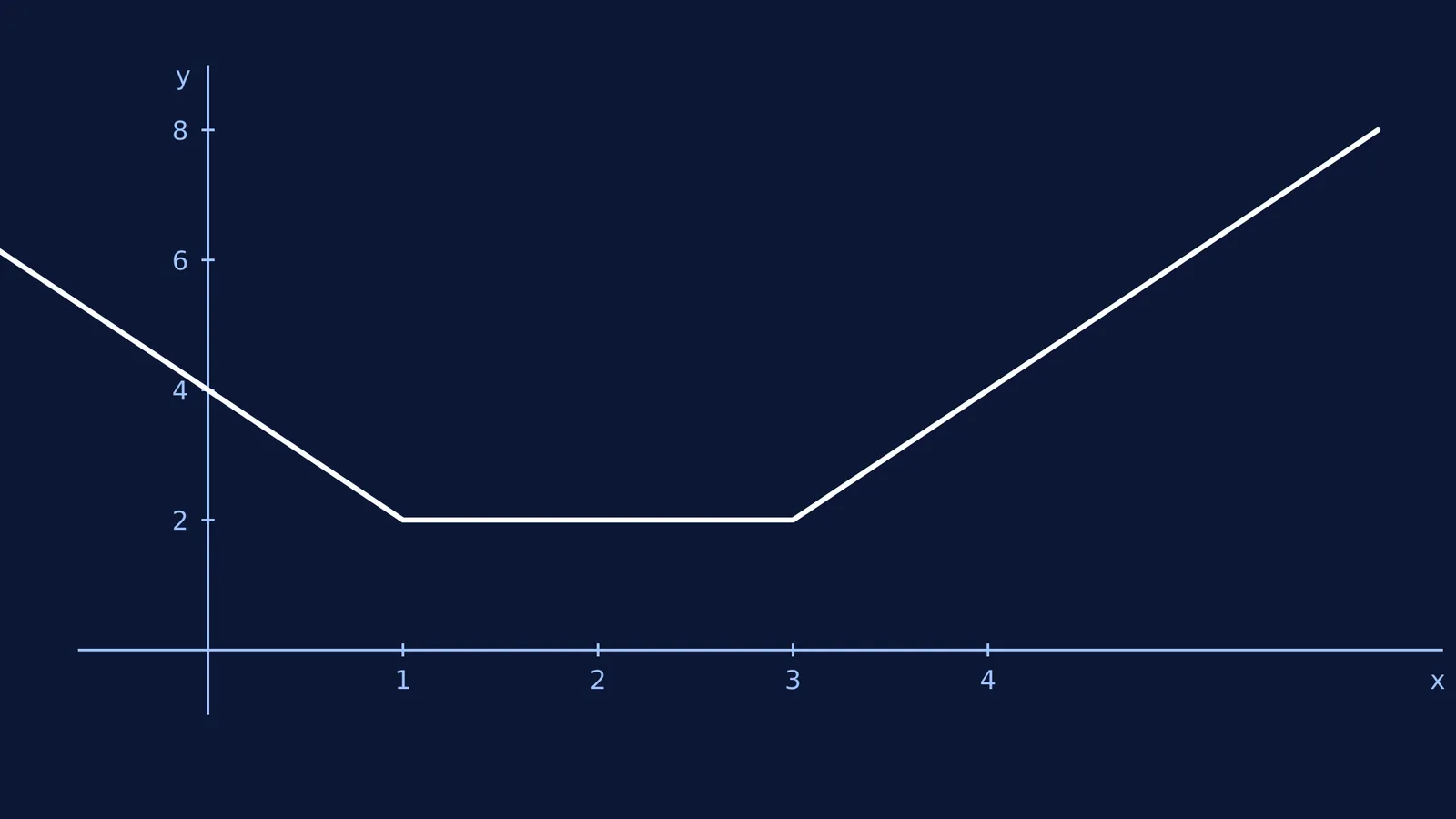
Between the points: If you place x exactly halfway at x = 2, your distance to 1 is 1, and your distance to 3 is 1. The sum is 2.
On the points: If you place x right on 1, your distance to 1 is 0, and your distance to 3 is 2. The sum is still 2.
For any point x chosen between 1 and 3, the sum of its distances to 1 and 3 is simply the total distance between 1 and 3. Since the gap between 1 and 3 is 2, the minimum value of the expression is exactly 2. This minimum is not a single point; it is attained for any value of x in the interval [1, 3].
When tackling similar modulus problems, the Fermi Concept Library can step you through these geometric interpretations, checking your understanding as you map the equations back to the number line.
What happens with three or more terms?
Questions in JEE and other competitive exams often extend this idea to three or more terms, such as |x - 1| + |x - 3| + |x - 7|.
You cannot just say the minimum is anywhere between the outer points anymore. Instead, there is a formal statistical property: the median minimizes the sum of absolute deviations. In a 1990 paper published in The American Statistician, mathematicians Neil C. Schwertman, A. J. Gilks, and J. Cameron proved using simple non-calculus methods that the sum of |x_i - m| is always minimized when m is the median of the given points.
For an odd number of terms (like 1, 3, 7), the median is the middle point. The minimum of |x - 1| + |x - 3| + |x - 7| occurs exactly at x = 3.
For an even number of terms (like 1, 3, 7, 9), the median is any value between the two middle numbers. The minimum occurs for any x in the interval [3, 7].
A checklist for modulus minimum questions
When you face a "minimum of sum of absolute values" question in an exam, use this framework to solve it in seconds:
Find the roots: Identify the critical points where each absolute value is zero (the numbers inside the modulus). For |x - 1| + |x - 3|, the roots are 1 and 3.
Sort them: Arrange the roots in increasing order on a number line.
Locate the median: If there are an odd number of roots, find the exact middle root. If there are an even number, locate the interval between the two middle roots.
Calculate the value: Substitute the median (or any easy number in the median interval) back into the original expression to find the minimum value.
If you keep dropping cases in modulus equations or dropping terms during calculations, the Fermi Problem Library will walk you through the logic, step by step, rather than just printing the final answer. Understanding these properties will also give you stronger geometric intuition for related algebra topics, such as identifying When is ax² + bx + c positive for all x? The discriminant test.


