

On this page
In 1889, while working at Leipzig University, Swedish scientist Svante Arrhenius proposed a mathematical formula to explain why chemical reactions run faster when heated. Building on the 1884 work of Dutch chemist Jacobus Henricus van 't Hoff, Arrhenius provided a physical justification for how temperature affects reaction rates [[1]](https://en.wikipedia.org/wiki/Arrhenius_equation).
Who introduced the concept of activation energy?
Svante Arrhenius introduced the idea of activation energy (Ea): a minimum energy barrier that molecules must overcome before they can turn into products. He proposed that only a fraction of molecules in a system possess this threshold energy at any given time.
What is the Arrhenius equation?
The Arrhenius equation describes how the rate constant of a chemical reaction depends on the absolute temperature [[1]](https://en.wikipedia.org/wiki/Arrhenius_equation). It is written as:
k = A e^(−Ea/RT)
Here is what each term means:
k is the rate constant.
A is the pre-exponential factor, representing the frequency of collisions that have the correct orientation to react.
e^(−Ea/RT) is the fraction of those collisions that actually have enough energy to overcome the activation barrier.
Ea is the molar activation energy.
R is the universal gas constant.
T is the absolute temperature in kelvin.
This exponential relationship explains a common rule of thumb in chemistry. For many reactions near room temperature, a 10 °C rise in temperature roughly doubles the reaction rate [[2]](https://en.wikipedia.org/wiki/Q10_(temperature_coefficient)). Because the temperature T is in the exponent, even a small increase provides a massive boost to the fraction of molecules with enough energy to react. To see the maths behind this rule, read our guide on the temperature coefficient of rate: why rates double every 10 °C.
How do molecules overcome the energy barrier?
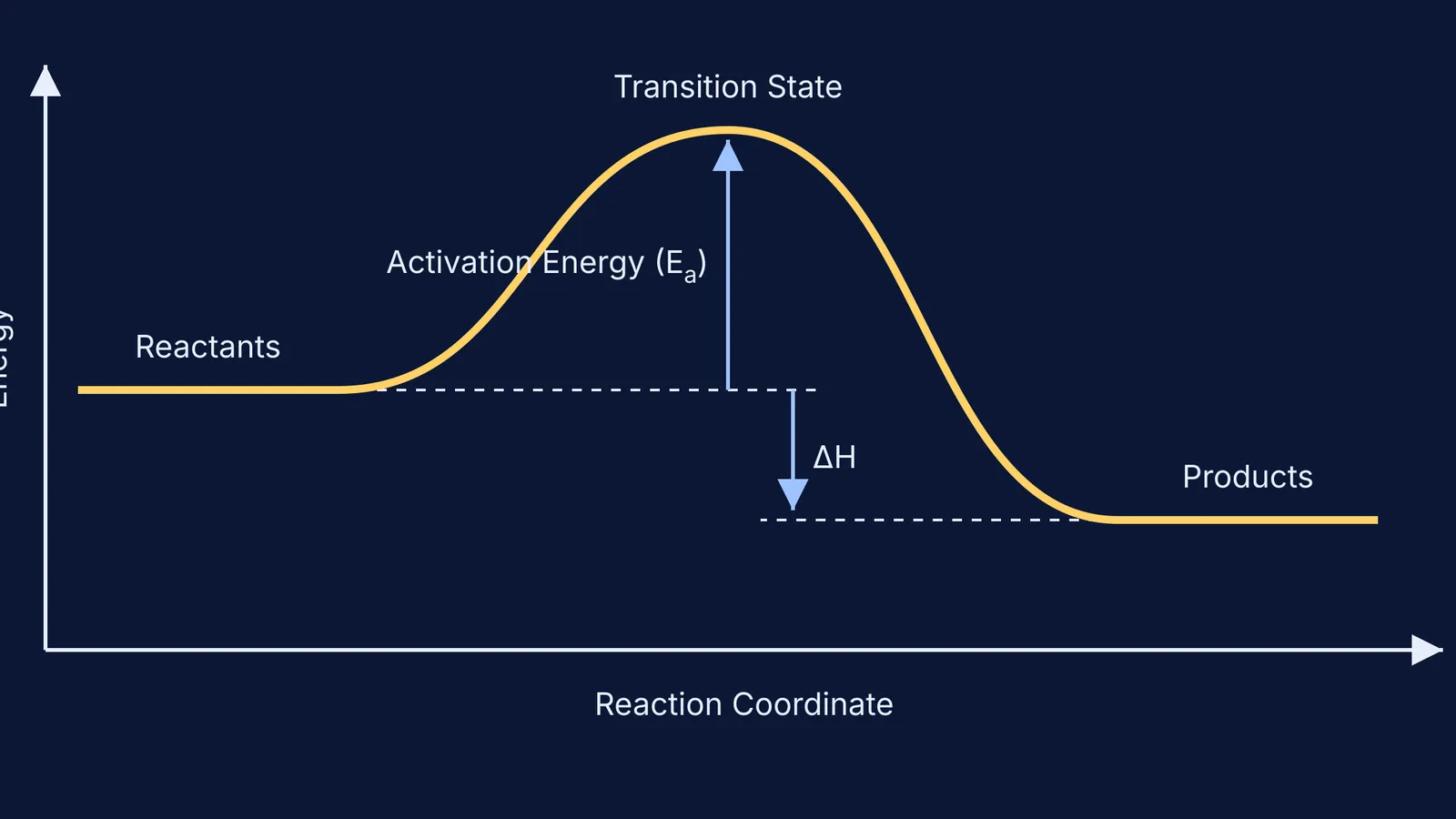
Imagine the reaction as a physical landscape. The reactants sit in an energy valley. To turn into products, they cannot simply slide across; they must first be pushed up a hill to a peak called the transition state. The height of this hill from the reactant valley is the activation energy (Ea).
At any given temperature, the molecules in a gas or liquid are moving at different speeds. Only a tiny fraction of them have enough kinetic energy to make it over the hill. When you increase the temperature, the average energy of the molecules rises. More importantly, the high-energy tail of the energy distribution grows significantly, meaning far more molecules can now clear the barrier.
If this physical picture is hard to visualise, the Concept Library has every concept in physics, chemistry, biology, mathematics and computing, each with its own lesson and its place in the map.
How do you calculate activation energy?
In many chemistry problems, you are rarely asked to use the exponential form directly. Instead, you use the two-point form of the Arrhenius equation. If you know the rate constants (k₁ and k₂) at two different temperatures (T₁ and T₂), you can find the activation energy without knowing the frequency factor A.
Taking the natural logarithm of the equation at both temperatures and subtracting them gives:
ln(k₂/k₁) = (Ea/R) × (1/T₁ − 1/T₂)
Worked example: Suppose a reaction's rate constant doubles when the temperature is raised from 298 K (T₁) to 308 K (T₂). What is its activation energy?
The ratio k₂/k₁ is 2, so ln(2) ≈ 0.693.
The temperature term is (1/298) − (1/308) ≈ 1.089 × 10⁻⁴ K⁻¹.
Rearranging for Ea gives Ea = [8.314 × 0.693] / (1.089 × 10⁻⁴) ≈ 52,900 J/mol, or 52.9 kJ/mol.
If you get stuck on the algebra or unit conversions in these calculations, the Problem Library has worked problems with a step-by-step solver that explains the reasoning rather than printing an answer. And if you are confused by whether to use natural logs (ln) or base-10 logs (log), Fermi's AI tutor works out what you already know, builds a plan for the session, and teaches through it — writing on a board and checking understanding as it goes.
Once you are comfortable with how rate constants depend on temperature, you can also explore how to use rate constants to predict equilibrium positions in our post on the reaction quotient Q vs K: predicting which way a reaction moves.


