

On this page
When air speeds up, its pressure drops. That one idea explains a wing, a perfume atomiser, a roof torn off in a cyclone and part of a ball's swing. Here is how each works.
What does Bernoulli's principle actually say?
For a fluid with no friction and constant density, P + ½ρv² + ρgh stays constant along a streamline (OpenStax College Physics, Bernoulli's equation). At a fixed height, pressure drops where the fluid moves faster. Daniel Bernoulli's *Hydrodynamica*, which applied energy conservation to fluids, was published in 1738 (NASA Glenn Research Center).
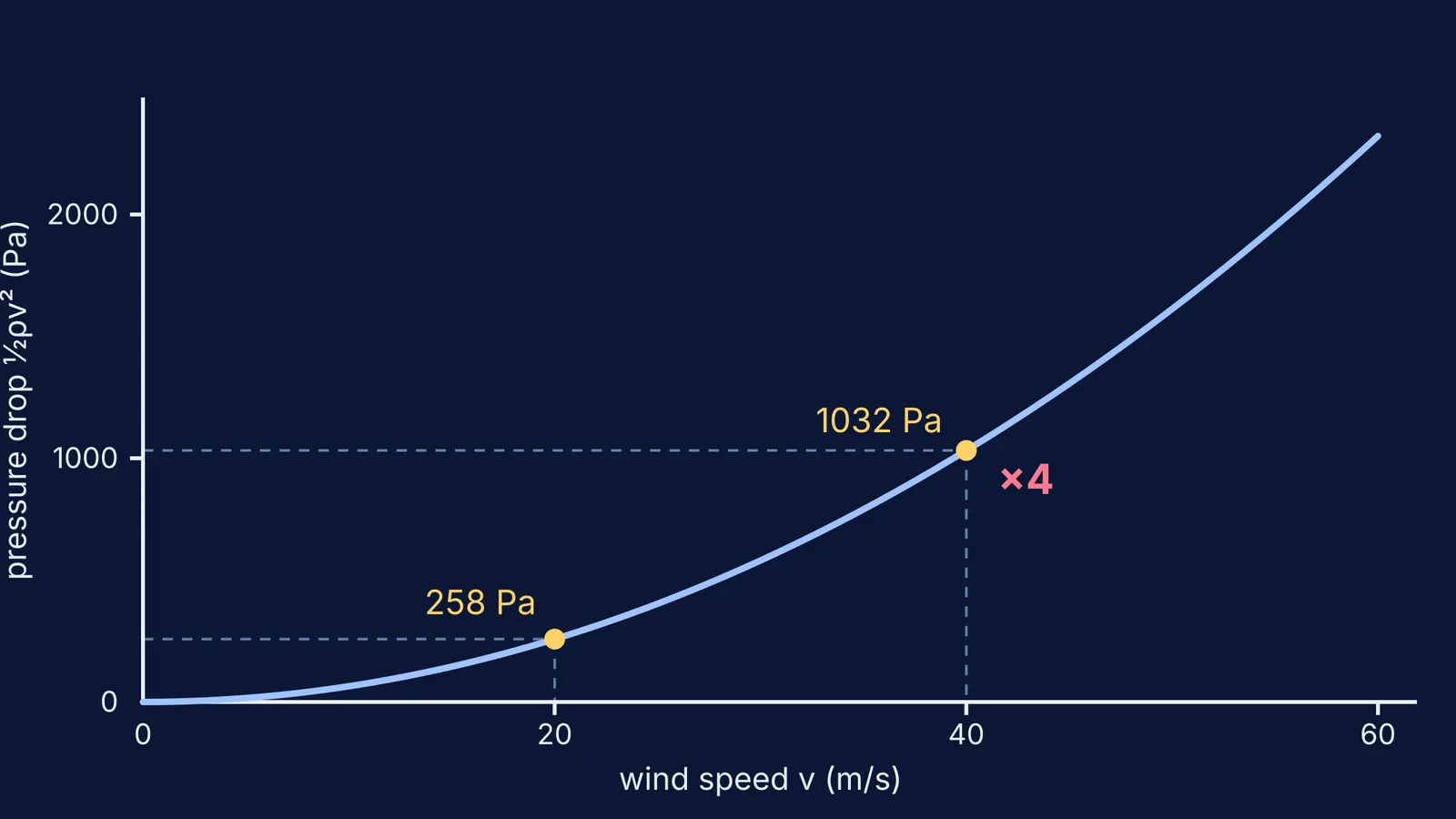
Because ½ρv² grows with the square of speed, doubling the speed quadruples the pressure drop. For why fluid speeds up in a narrow nozzle, see our guide to the equation of continuity and flow speed in pipes.
How does Bernoulli's principle explain aeroplane lift?
A wing turns the air flowing past it. Holger Babinsky of Cambridge's Department of Engineering explains that the wing's shape curves the streamlines and creates "lower pressure on the upper surface and higher pressure on the lower surface" (University of Cambridge). Faster air above means lower pressure there, and the difference pushes the wing up.
The popular "equal transit time" story says air over the longer top surface must hurry to meet the air underneath at the back edge. NASA calls this a non-physical assumption: top-surface air arrives first, and the theory's predicted lift "is much less than the observed lift" (NASA Glenn on the equal transit theory). As Babinsky notes, a sail is the same length on both sides yet lifts because it curves when rigged: "it's the curvature that creates lift, not the distance."
How does an atomiser or sprayer work?
Squeeze an atomiser's bulb and a fast air jet shoots across the top of a thin tube dipping into the liquid. The jet is at lower pressure than the still air pressing on the liquid in the bottle, so liquid is pushed up the tube and torn into droplets. OpenStax lists atomisers, paint sprayers and Bunsen burners as examples of this entrainment (OpenStax).
Why do strong winds blow roofs off?
Wind races over a roof while the air inside stays nearly still, so pressure above the roof falls and the roof is pushed up. FEMA's school wind-safety guide shows this uplift, and warns that air entering through windward openings pressurises the building and pushes the roof up from below (FEMA 424, chapter 6).
In FEMA's example, uplift on a roof corner is 37.72 pounds per square foot at a basic wind speed of 85 mph and rises fourfold to 151 psf when the speed doubles to 170 mph (FEMA 424). FEMA explains that wind speed is squared in these calculations, the same v² as in Bernoulli's equation.
Worked example: the force on a roof
Take a 40 m/s wind (144 km/h) over a flat roof 10 m by 10 m, with still air inside, and an air density of 1.29 kg/m³ from the OpenStax density table.
Pressure drop above the roof: ½ρv² = 0.5 × 1.29 × 40² = 1032 Pa.
Roof area: 100 m².
Net upward force: 1032 × 100 ≈ 1.03 × 10⁵ N.
That is the weight of about 10.5 tonnes (1.03 × 10⁵ ÷ 9.8 ≈ 10,500 kg).
This is an ideal estimate; engineers use wind-load codes for real buildings.
Does Bernoulli explain a spinning ball's swing?
Partly. NASA explains that a spinning ball turns the flow: air moves faster on one side and slower on the other, the pressure changes to match, and the ball is pushed sideways (NASA Glenn on the lift of a spinning ball). Real flow round a stitched ball "is very complex", NASA adds. This is the Magnus effect; read about Gustav Magnus and the physics of a spinning ball's curve.
A fast bowler's swing in cricket is different. Rabindra Mehta of NASA Ames Research Center explains that the seam, angled at release, trips the thin air layer on one side into turbulence. That layer clings to the ball longer than the smooth layer opposite, creating a pressure difference and a side force (Mehta, Cricket Ball Aerodynamics: Myth Versus Science). In his wind-tunnel tests, the side force peaked at about 0.3 times the ball's weight near 30 m/s with the seam angled at 20°. Backspin along the seam keeps the seam steady; it does not cause the swing.
How do you answer a Bernoulli exam question?
Find where the fluid moves fastest: a narrow section, a curved surface, or one side of a spinning ball.
Mark that region low pressure and the slower region high pressure.
Draw the net force from high to low pressure; multiply the pressure difference by area for a number.
Check for traps: equal transit time, or seam swing, which comes from the boundary layer rather than simple Bernoulli reasoning.
See also our list of pressure, buoyancy and Bernoulli mistakes to avoid. For practice, the Fermi Problem Library has worked problems with a step-by-step solver that explains the reasoning rather than printing an answer. If the gap is the idea itself, the Fermi Concept Library gives each physics concept its own lesson and its place in the map.


