On this page
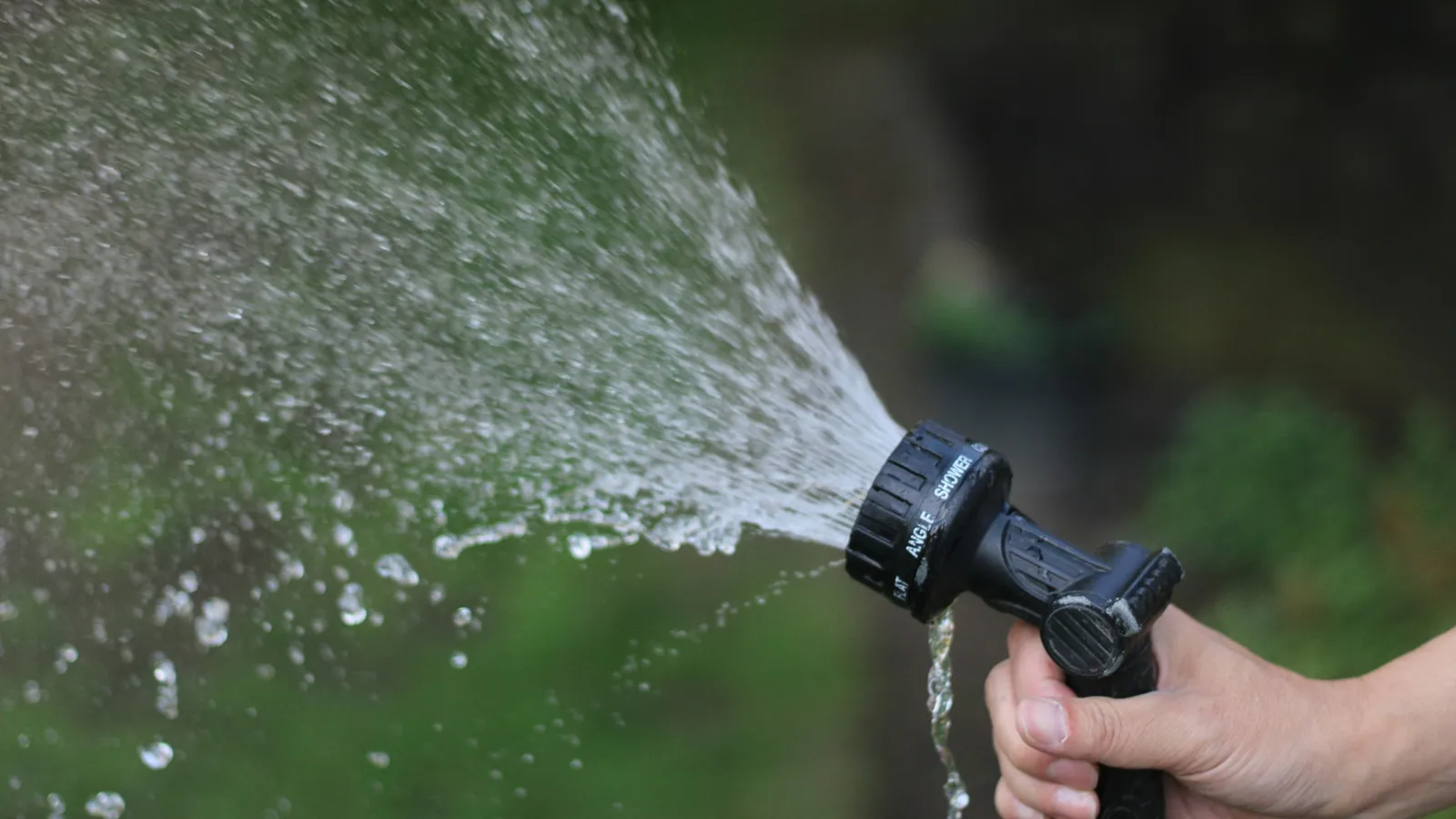
Put your thumb over the end of a garden hose and the water shoots further. Nothing has added energy; the same water is simply squeezed through a smaller opening. That is the equation of continuity, and it is usually the first line of any Bernoulli problem. This post explains where it comes from, works through three examples and lists the slips that cost marks.
Where does the equation of continuity come from?
NCERT's Mechanical Properties of Fluids chapter derives it from conservation of mass. In steady flow, the mass entering a section of pipe in time Δt equals the mass leaving it: ρ₁A₁v₁Δt = ρ₂A₂v₂Δt. For an incompressible fluid the densities are equal, which leaves
A₁v₁ = A₂v₂, or Av = constant.
The product Av is the volume flow rate Q, in m³/s. NCERT notes the picture in streamlines: where they crowd together the speed is higher. The equation holds only for steady, streamline flow; above a critical speed the flow turns turbulent.
The JEE (Advanced) 2026 brochure names "equation of continuity" next to Bernoulli's theorem, and the CBSE 2026-27 physics curriculum lists streamline flow and Bernoulli's theorem. Always check the current year's documents.
How fast does water leave a nozzle?
Example 1. Water flows at 0.30 L/s through a hose of inner diameter 2.0 cm, which ends in a nozzle of diameter 0.50 cm. Find the speed in the hose and at the nozzle.
Convert: Q = 0.30 L/s = 3.0 × 10⁻⁴ m³/s. Hose radius = 1.0 × 10⁻² m.
v₁ = Q/(πr₁²) = 3.0 × 10⁻⁴ / (π × 1.0 × 10⁻⁴) = 0.95 m/s.
v₂ = v₁ × (r₁/r₂)² = 0.95 × (1.0/0.25)² = 0.95 × 16 = 15 m/s.
A diameter four times smaller gives a speed sixteen times larger. OpenStax College Physics works a similar hose example and makes the same point: speed varies as the inverse square of the radius.
Why does a falling stream of tap water get narrower?
This is a favourite JEE question because it joins continuity with kinematics.
Example 2. Water leaves a tap of diameter 1.0 cm at 0.50 m/s. What is the stream's diameter 10 cm below the tap? Take g = 9.8 m/s².
Free fall: v² = u² + 2gh = 0.25 + 2 × 9.8 × 0.10 = 2.21, so v = 1.49 m/s.
Continuity: d₁²v₁ = d₂²v₂, so d₂ = d₁√(v₁/v₂) = 1.0 × √(0.50/1.49) = 0.58 cm.
The water accelerates as it falls, so to carry the same flow rate the stream must thin out. Look at a slow, smooth tap stream and you will see the taper.
What happens when a pipe branches?
When one pipe feeds many, continuity applies to the total flow: A₁v₁ = n × A₂v₂, or more generally the sum of Av over all branches.
Example 3. OpenStax uses the circulatory system. For a flow rate of 5.0 L/min in an aorta of radius 10 mm, the average blood speed is about 0.27 m/s. In the capillaries it is about 0.33 mm/s. Since Q is the same, the ratio of speeds tells you the ratio of total areas: 0.27/0.00033 ≈ 800. Each capillary is tiny, but there are so many of them, about 5 × 10⁹ on OpenStax's numbers, that their combined cross-section is roughly 800 times the aorta's. Narrow single vessels, slow overall flow. Students who apply "narrower means faster" to each capillary get this backwards.
What mistakes show up in continuity problems?
Forgetting to square. Using A ∝ r, or plugging the diameter into πr².
Unit slips. 1 L = 10⁻³ m³, 1 cm² = 10⁻⁴ m². Convert flow rates in L/min to m³/s before using SI.
Ignoring branches. Sum the areas of all parallel branches.
Assuming narrow means high pressure. In a horizontal pipe, the narrow part has higher speed and lower pressure. That comes from Bernoulli, not continuity, and our guide to fluid pressure and Bernoulli mistakes covers it.
Using it for gases at high speed. Av = constant needs constant density. For gases with large pressure changes you need the ρAv form.
Applying it to turbulent or unsteady flow. The textbook form assumes steady streamline flow. Viscosity and turbulence are covered in our post on surface tension and viscosity.
A practice routine
Warm-up (10 minutes): five quick ratio questions. If the diameter changes by a factor of 3, what happens to the speed? To the flow rate?
Core (20 minutes): two hose or pipe problems with unit conversions, one tap-stream problem, and one branching problem.
Link-up (15 minutes): two problems that need continuity first and Bernoulli second, such as a venturi meter. Write the continuity line before touching Bernoulli.
Check: after each answer, ask whether the speed went up where the area went down.
Flow is easier to understand when you can watch it change. The Fermi Simulation Lab has interactive simulations for ideas that are easier to see than read, so you can test a prediction about speed and area before you write the equations.
Next time you use a tap, slow the flow until the stream is smooth and look for the taper from Example 2.