

On this page
Surface tension and viscosity sit at the end of the fluids chapter, and many students rush them. Then a question asks why water rises in a thin tube but mercury falls, or why a soap bubble has twice the excess pressure of a drop, and the formulas get mixed up. This post works through each formula with real numbers and shows you the checks that keep answers sensible.
What do the syllabi expect?
The JEE (Main) 2026 syllabus lists viscosity, Stokes' law, terminal velocity, surface energy and surface tension, angle of contact, excess pressure across a curved surface, and drops, bubbles and capillary rise. Its experiment list includes surface tension by capillary rise and viscosity from the terminal velocity of a sphere. The CBSE 2026-27 curriculum has the same two experiments for Class 11, plus an activity on how detergent changes capillary rise. The JEE (Advanced) 2026 brochure includes these topics but excludes Poiseuille's equation. Check the current documents for your exam.
Why does water rise in a thin tube?
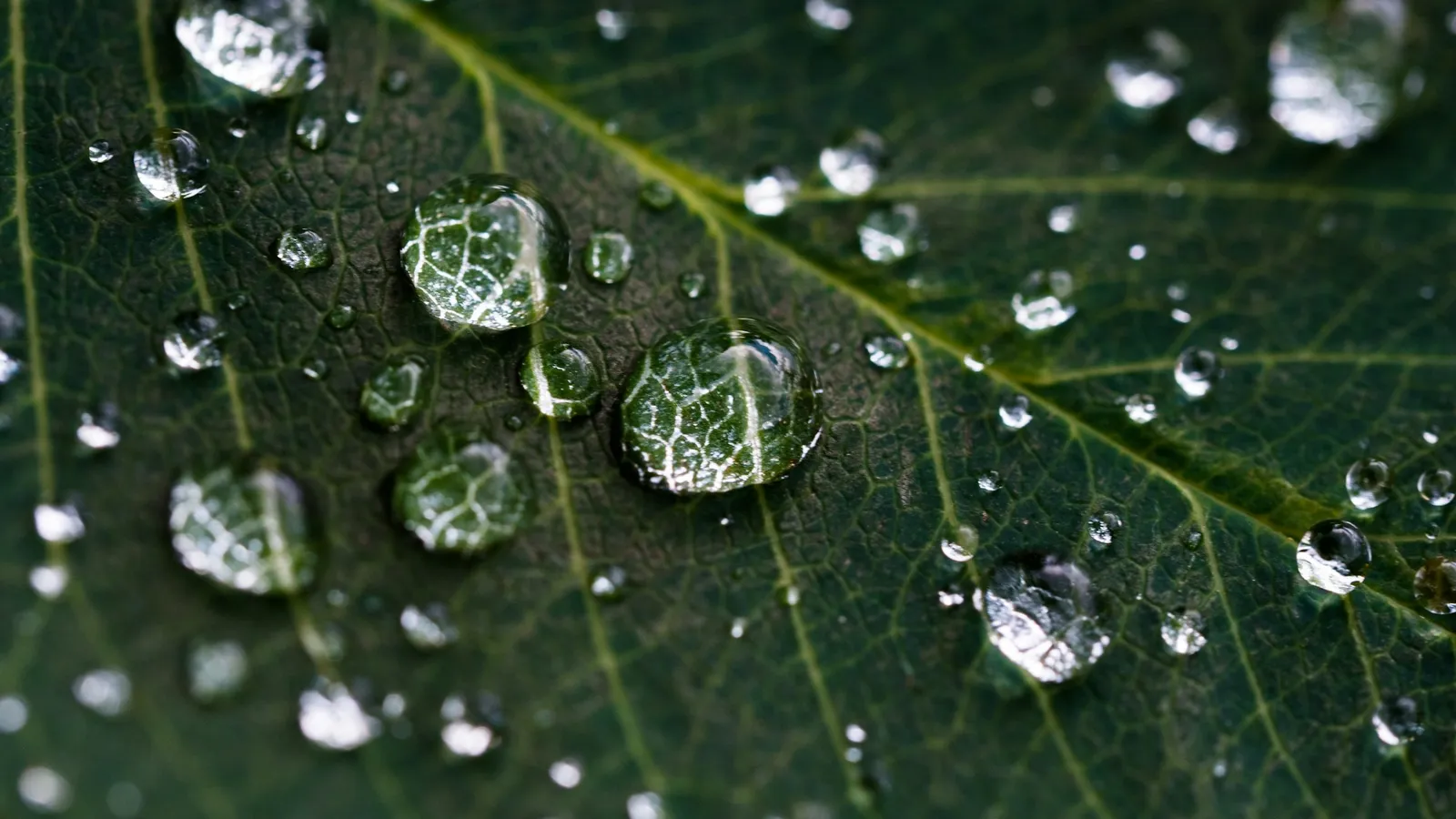
At a liquid surface, molecules are pulled inwards, so the surface behaves as if it were under tension. Surface tension S is force per unit length, or equivalently energy per unit area. In the NCERT chapter Mechanical Properties of Fluids, the value for water at 20 °C is 0.0727 N/m, and the capillary rise in a tube of radius a is
h = 2S cos θ / (ρga)
where θ is the angle of contact. Water wets clean glass, so θ is close to zero and cos θ close to 1. For mercury on glass, θ is obtuse and cos θ is negative, so NCERT notes the level in the tube falls instead.
Students often picture surface tension as a "skin" without knowing which way it pulls. Marchand and colleagues (2011) wrote a teaching paper on exactly the conceptual questions that come up when capillarity is taught, including why the force acts parallel to the surface. It is a good read if the textbook picture does not satisfy you.
Example 1. Water rises in a clean glass tube of internal diameter 0.50 mm. Take ρ = 1000 kg/m³, g = 9.8 m/s² and θ = 0. The radius is 2.5 × 10⁻⁴ m, so
h = 2 × 0.0727 / (1000 × 9.8 × 2.5 × 10⁻⁴) = 0.1454 / 2.45 ≈ 0.059 m, about 5.9 cm.
The short-tube trap. If the tube sticks out only 3 cm above the water, the water does not overflow. It rises to the top and the meniscus flattens until its radius of curvature R satisfies hR = constant. Here R ≈ 0.25 mm × 5.9 / 3 ≈ 0.49 mm.
Why does a soap bubble have twice the excess pressure of a drop?
A liquid drop has one surface, so the pressure inside is higher by 2S/r. A soap bubble is a thin film with two surfaces, inside and outside, so the excess pressure is 4S/r. NCERT also points out that an air bubble inside a liquid has only one surface, so it is 2S/r again.
Example 2. A soap bubble of radius 1.0 cm is made from a solution with S = 0.030 N/m (a value given in the problem). Excess pressure = 4 × 0.030 / 0.010 = 12 Pa.
Example 3: splitting a drop. A water drop of radius 1.0 mm splits into 1000 identical droplets. Volume is conserved, so each droplet has radius 0.1 mm. Total surface area becomes 1000 × 4π(0.1 mm)², which is ten times the original 4π(1 mm)². The extra area is 9 × 4π × (10⁻³ m)² ≈ 1.13 × 10⁻⁴ m², so the work needed is 0.0727 × 1.13 × 10⁻⁴ ≈ 8.2 × 10⁻⁶ J.
How do you find terminal velocity?
Viscosity is a fluid's resistance to flow. NCERT's table gives about 1.0 mPa s for water and 830 mPa s for glycerine at 20 °C. A small sphere of radius a moving slowly through a fluid feels a drag force 6πηav (Stokes' law). It speeds up until drag plus buoyancy equals its weight, then falls at its terminal velocity:
v_t = 2a²(ρ − σ)g / (9η)
where ρ is the sphere's density and σ the fluid's.
Example 4. A steel ball of radius 1.0 mm (density 7800 kg/m³) falls through glycerine (density 1260 kg/m³, η = 0.83 Pa s).
v_t = 2 × (10⁻³)² × (7800 − 1260) × 9.8 / (9 × 0.83) = 0.128 / 7.47 ≈ 0.017 m/s, about 1.7 cm/s.
Check the assumption. Stokes' law holds only for slow, smooth flow. A quick test is the Reynolds number, ρ_fluid × v × diameter / η = 1260 × 0.017 × 0.002 / 0.83 ≈ 0.05. That is far below 1, so the formula is fine. Owen and Ryu (2005) describe a lab that measures the terminal velocity of spheres at low and high Reynolds number and compares the results with drag that is linear or quadratic in speed. Stokes' law is the linear case, which fits slow flow. A large raindrop or a cricket ball is in the second regime, where Stokes' law does not apply.
Which mistakes cost the most marks?
Diameter for radius. Capillary rise doubles and terminal velocity is out by a factor of four.
Forgetting buoyancy. It is (ρ − σ), not ρ, in the terminal velocity formula.
Dropping the contact angle. For mercury, cos θ is negative and the answer is a fall, not a rise.
Surface tension in mN/m. 72.7 mN/m is 0.0727 N/m.
For the rest of the fluids chapter, see our post on pressure, buoyancy and Bernoulli mistakes. If you want to see a sphere approach terminal velocity rather than read about it, the Fermi Simulation Lab has interactive simulations for ideas that are easier to see than read.
A practice routine
Day 1: Four capillary problems, including one with mercury and one with a tube that is too short.
Day 2: Four excess-pressure problems: drops, air bubbles, soap bubbles and two bubbles joined by a tube.
Day 3: Three energy problems on splitting or merging drops.
Day 4: Three terminal velocity problems, with a Reynolds number check on each.
Tonight, redo Example 4 with a ball of radius 2.0 mm and confirm that the terminal velocity is four times larger.


