On this page
When a steady wind blows across a thin telephone wire, you can sometimes hear a distinct humming sound. When that same wind hits a skyscraper or a chimney, the structure can sway violently. Both of these effects come from the same fluid dynamics phenomenon: the Kármán vortex street.
Theodore von Kármán, a pioneering aerospace engineer, published his mathematical proof of this effect in a 1911 paper (Kármán vortex street, Wikipedia). He proved that when a fluid flows past an obstacle, the swirls left behind cannot arrange themselves symmetrically; they must stagger.
If you are trying to picture invisible fluid dynamics, the Fermi Simulation Lab provides interactive simulations for the ideas that are easier to see than to read.
What is a Kármán vortex street?
When a fluid, such as air or water, hits a blunt body like a cylinder, it cannot smoothly follow the object's rear curvature. Instead, the flow separates from the surface and rolls up into swirling eddies called vortices.
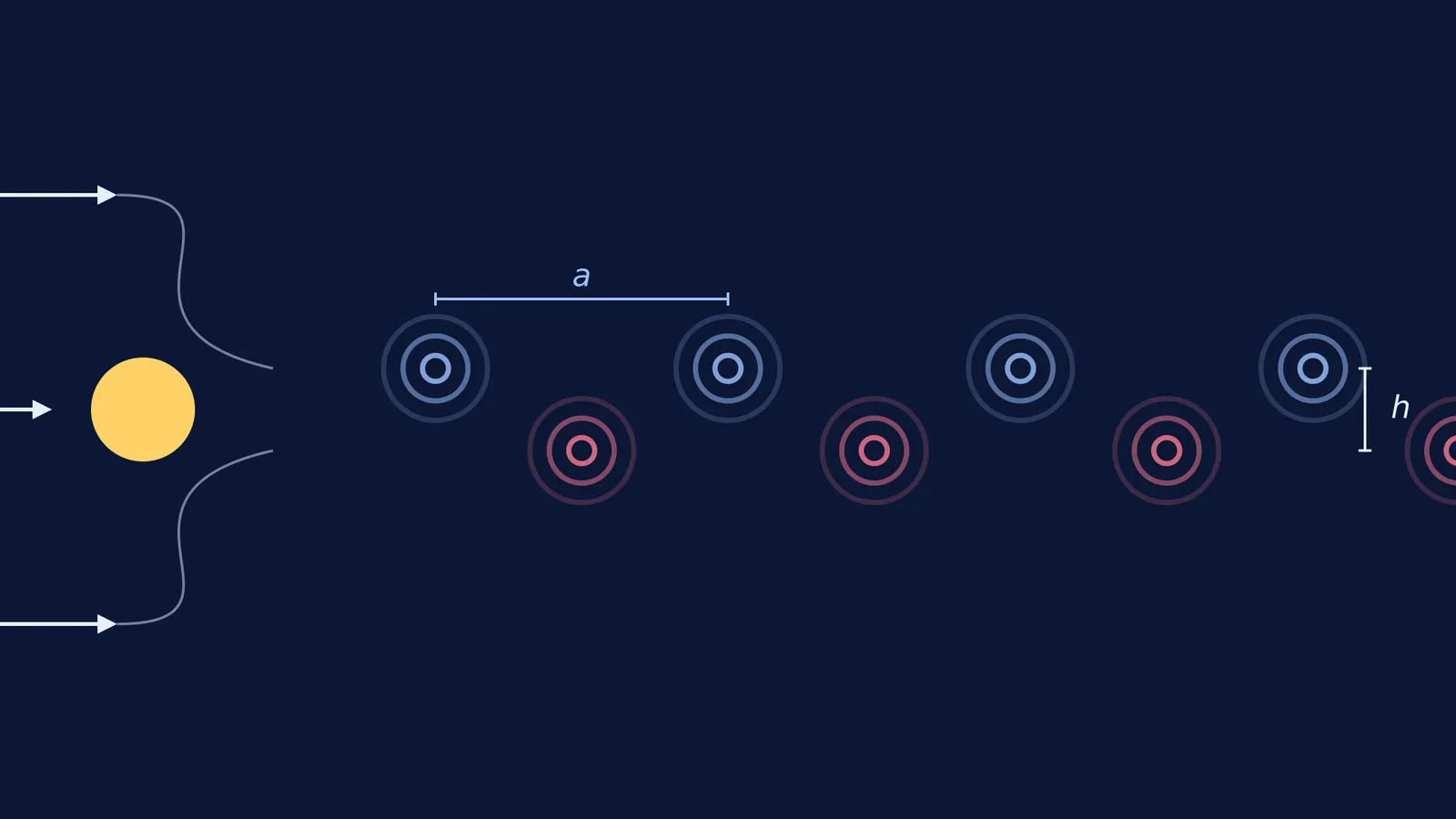
These vortices do not shed all at once. They pinch off alternately from one side of the object and then the other. As they trail downstream, they form two parallel rows, with the vortices of one row perfectly staggered between the vortices of the other. This alternating wake is the Kármán vortex street.
The pattern only appears under specific flow conditions, dictated by the Reynolds number (Re), which compares inertial forces to viscous forces (Kármán vortex street, Wikipedia):
Re < 47: The flow wraps smoothly around the object without shedding vortices.
47 < Re < 10⁵: The flow produces a stable, perfectly periodic Kármán vortex street.
Re > 10⁵: The wake becomes increasingly chaotic and turbulent.
When studying fluid mechanics, getting the intuition right before jumping into the formulas is crucial. You can read more about how to visualise hard physics ideas: a chooser by topic to build that foundation.
Why do telephone wires hum in the wind?
Every time a vortex sheds from one side of an object, it creates a brief area of low pressure on that side, pulling the object slightly. Because the vortices shed alternately, the object experiences a rhythmic, side-to-side force.
When the wind flows over thin telephone lines or power cables, it sheds vortices at a high frequency. If this shedding frequency matches the wire's natural mechanical frequency, the wire goes into resonance and vibrates rapidly. This vibration produces a whistling or humming sound, historically known as Aeolian tones.
You can review the physics of resonance and natural frequencies in our guide to damped vs forced oscillations: amplitude, resonance and graphs.
How does vortex shedding affect swaying towers?
While high-frequency shedding makes wires sing, low-frequency shedding exerts massive lateral forces on large structures.
If the frequency of the vortex street matches the natural sway frequency of a skyscraper, chimney, or bridge, the structure can oscillate dangerously. On November 1, 1965, winds reaching 137 km/h triggered severe vortex-induced vibrations at the Ferrybridge C power station in England, causing three of its massive concrete cooling towers to collapse (Ferrybridge power stations, Wikipedia).
Today, engineers disrupt the vortex street to protect buildings. Car antennas and metal chimneys often have spiral ridges, called helical strakes, wrapped around them. These ridges break up the wind, preventing the vortices from shedding in a synchronised pattern.
If you are working through the engineering maths of forces and oscillations, the Fermi Problem Library has worked problems with a step-by-step solver that explains the reasoning rather than printing an answer.
The 1911 math that explained the swirls
Before 1911, physicists knew that wakes oscillated, but nobody could explain why they did not form a neat, symmetrical double row. Von Kármán used mathematical stability analysis to prove that a symmetrical arrangement of vortices is inherently unstable; any slight disturbance will destroy it (Kármán vortex street, Wikipedia).
He found that the only stable geometry is an asymmetrical, staggered street where the ratio of the width of the street (h) to the distance between consecutive vortices in the same row (a) is strictly h/a ≈ 0.281 (Kármán vortex street, Wikipedia).
Von Kármán noted in his autobiography that his curiosity was partly inspired by a 14th-century Italian painting of St. Christopher carrying the Christ Child across a river, where the artist had perfectly captured the alternating vortices in the water behind the saint's legs.
To understand the dimensions and units in equations like this, you can explore the Fermi Concept Library, which covers every concept in physics, chemistry, biology, mathematics and computing, each with its own lesson and its place in the map.