

On this page
Stop pushing a swing and it slowly comes to rest. Push it in time with its own motion and it goes higher with every push. Those two everyday facts are damped and forced oscillations, and the moment when your pushes match the swing's own rhythm is resonance.
What is the difference between damped and forced oscillations?
A damped oscillation has no outside push. Air drag or friction takes energy out on every cycle, so the amplitude keeps falling. As OpenStax University Physics puts it, "In the real world, oscillations seldom follow true SHM. Friction of some sort usually acts to dampen the motion so it dies away, or needs more force to continue."
A forced oscillation has a periodic driving force that puts energy into the system at a certain frequency, according to OpenStax's chapter on forced oscillations. Once the starting transients die out, the system settles into a steady state and moves at the driving frequency, not its own.
The natural frequency is "the frequency at which a system would oscillate if there were no driving and no damping force" (OpenStax). Resonance means driving a system at its natural frequency, which gives a very large response when damping is light.
What does damping do to amplitude?
Take a mass m on a spring of stiffness k, with a damping force of −bv. Its displacement is x(t) = A₀e^(−bt/2m) cos(ωt + φ), so the amplitude decays exponentially (OpenStax).
Damping also slows the oscillation slightly: the damped angular frequency is ω = √(ω₀² − (b/2m)²), where ω₀ = √(k/m). The same OpenStax section sorts systems into three cases:
Underdamped (b < √(4mk)): it oscillates while the amplitude decays.
Critically damped (b = √(4mk)): it does not oscillate and returns to equilibrium as quickly as possible. OpenStax gives car shock absorbers as an example.
Overdamped (b > √(4mk)): it also does not oscillate, but it creeps back more slowly.
What happens when you drive a system near its natural frequency?
For a damped spring driven by a force F₀cos(ωt), the steady-state amplitude is A = F₀ / √(m²(ω² − ω₀²)² + b²ω²) (OpenStax). Near ω₀ the first term under the root vanishes, so only damping limits the amplitude.
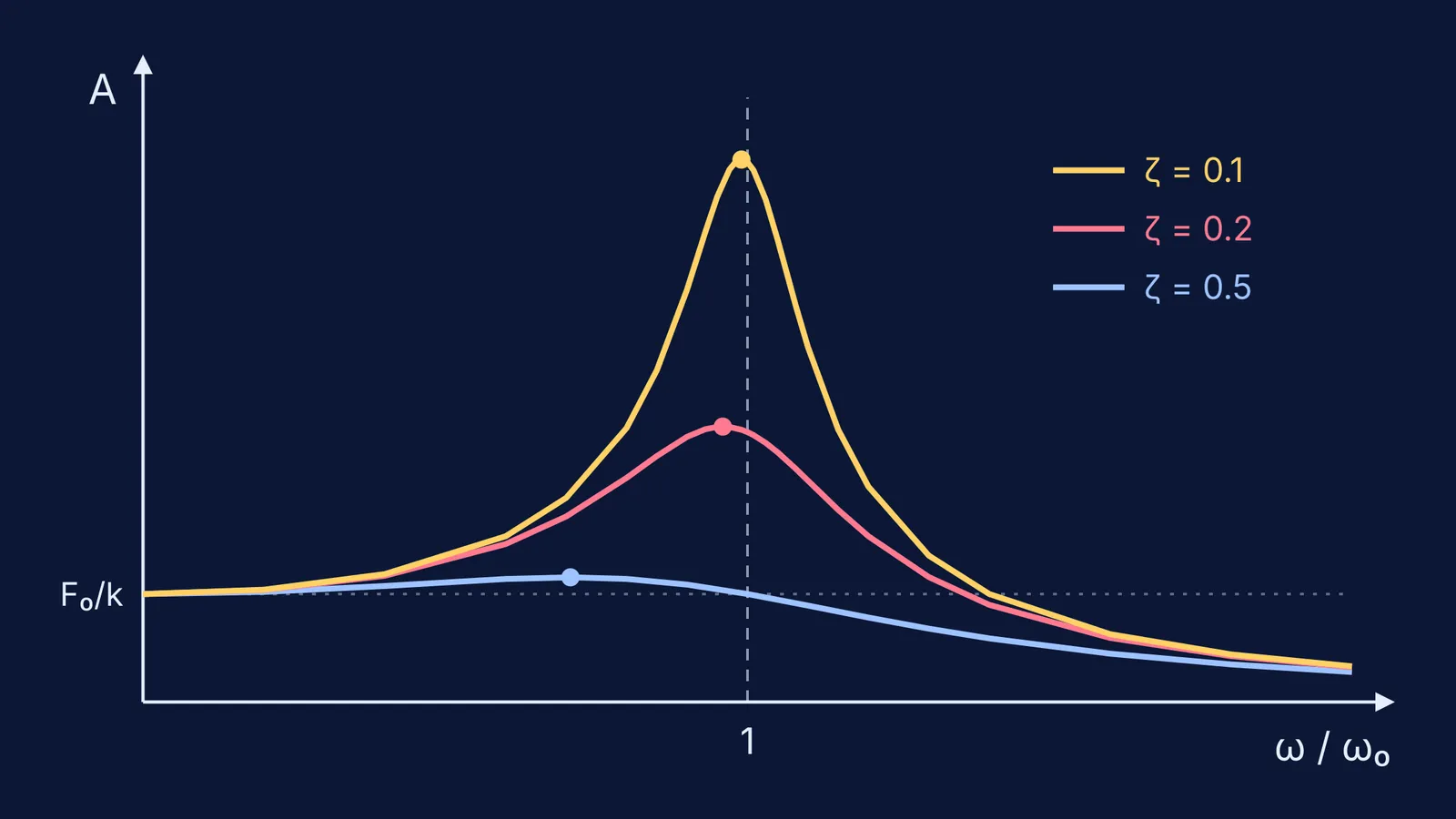
OpenStax states that "the less the damping, the narrower the resonance" and that the highest peak belongs to the least damping, because less energy is removed. With damping, the peak also sits slightly below ω₀, at ω = √(ω₀² − (b/m)²/2), as shown in LibreTexts' forced damped oscillator section/23:_Simple_Harmonic_Motion/23.06:_Forced_Damped_Oscillator). The sharpness is measured by the quality factor Q = ω₀/Δω, which is about mω₀/b for light damping.
London's Millennium Footbridge swayed so much under walkers that it was closed for roughly two years to get rid of the motion (OpenStax). Be careful with the most famous example, though. Billah and Scanlan, writing in the American Journal of Physics in 1991, argued that the 1940 Tacoma Narrows bridge failure was related to self-excitation, or "negative damping", in a twisting motion, not to simple forced resonance.
Worked example: one spring, damped and then driven
Take m = 0.5 kg, k = 200 N/m and b = 2 kg/s, and use the OpenStax formulas above.
Natural frequency: ω₀ = √(200/0.5) = 20 rad/s.
Type of damping: √(4mk) = √400 = 20 kg/s. Since b = 2 kg/s is far below that, the system is underdamped.
Damped frequency: ω = √(400 − 2²) = √396 ≈ 19.9 rad/s, almost unchanged.
Decay: the envelope is e^(−2t), so the amplitude halves in ln2/2 ≈ 0.35 s.
Drive with F₀ = 1 N at 20 rad/s: A = F₀/(bω) = 1/40 m = 2.5 cm.
Drive at 10 rad/s instead: A = 1/√(0.25 × 90000 + 4 × 100) = 1/151.3 m ≈ 0.66 cm.
Compare with a steady 1 N push: F₀/k = 0.5 cm. Resonance gives 5 times that, and Q = mω₀/b = 0.5 × 20/2 = 5.
Remember it: with light damping, resonance amplitude is about Q times the static stretch.
Which resonance graphs do exams ask about?
Displacement against time (damped): a cosine squeezed inside a falling exponential envelope, with crests losing the same fraction each cycle.
The three damping cases: underdamped wiggles, critically damped returns fastest without crossing, overdamped returns slowly.
Amplitude against driving frequency: it starts at F₀/k when ω = 0, peaks near ω₀, and falls towards zero at high frequency.
More damping: a lower, wider peak that shifts slightly to the left.
Less damping: a taller, sharper peak and a higher Q.
If the shapes still feel abstract, the Fermi Simulation Lab has interactive simulations for ideas that are easier to see than to read.
For practice, the Fermi Problem Library has worked problems with a step-by-step solver that explains the reasoning rather than printing an answer. To go further, revise how kinetic and potential energy vary in SHM, how to prove SHM and find the period, and LCR resonance, quality factor and bandwidth.


