On this page
In February 1873 Willoughby Smith, a telegraph cable engineer, told London's Society of Telegraph Engineers that light changes how well selenium conducts electricity. He found the effect because his instrument readings kept disagreeing. That effect, photoconductivity, is still at work in the cheap sensor that switches a garden lamp on at dusk.
Who was Willoughby Smith and what was he testing?
Smith was born in Great Yarmouth in 1828 and joined the Gutta Percha Company in London in 1848, where he worked on insulated telegraph wire and, from 1850, on underwater cables (Wikipedia biography).
His letter of 4 February 1873, read to the Society on 12 February, explains the problem (Smith, Journal of the Society of Telegraph Engineers, 1873). While long submarine cables were being laid, his testing and signalling system needed a very high resistance at the shore station. He tried selenium bars 5 to 10 centimetres long and 1 to 1.5 millimetres thick, each sealed in a glass tube with a platinum wire at each end. Some bars measured 1,400 megohms, which was plenty of resistance. The trouble was that different operators seldom got the same reading.
What did Smith find about selenium and light in 1873?
The same letter reports what was going wrong (Smith, 1873):
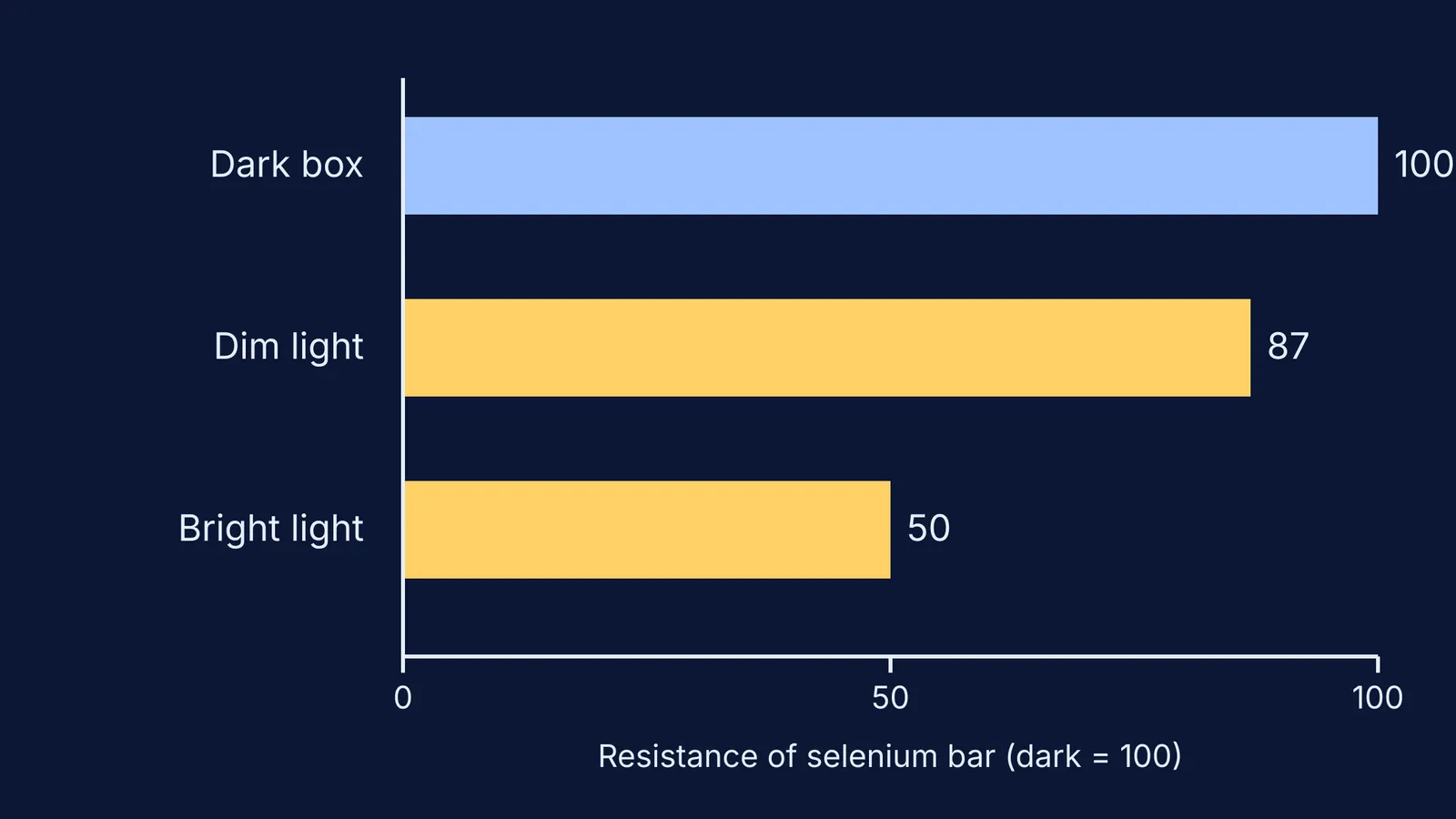
In a box with a sliding cover that kept out all light, the bars were at their highest resistance and held steady.
When the cover came off, conductivity rose by 15 to 100 per cent, depending on how bright the light was.
Passing a hand in front of a gas burner several feet away raised the resistance by 15 to 20 per cent.
Coloured glass changed the reading according to how much light got through.
Smith then checked whether heat could explain it. He put a bar in a trough of water, so the light had to pass through about an inch of water, and burned a strip of magnesium about 9 inches above it. The resistance fell by more than two-thirds, and it went straight back to normal when the flame went out. Latimer Clark, who chaired the meeting, said he had seen the experiments himself, that even a match was enough to change the reading, and that selenium seemed "to constitute a perfect photometer". A short report followed in *Nature* on 20 February 1873 (Nature, vol. 7, p. 303).
Why does light lower the resistance of a semiconductor?
Photoconductivity is the rise in a material's electrical conductivity when light falls on it. When photons with enough energy hit a semiconductor, they lift electrons from the valence band into the conduction band and leave holes behind, and both the electrons and the holes carry current (LCSC guide to LDRs). More light frees more carriers, so the resistance falls. According to the same guide, the most common LDRs use cadmium sulphide or cadmium selenide.
Selenium's story begins with the chemist who discovered it, covered in our post on Berzelius and the discovery of selenium and silicon. Later, selenium went from sensing light to making electricity in Charles Fritts's selenium solar cell.
How does a light-dependent resistor switch a lamp at dusk?
The cadmium sulphide photocell in Adafruit's guide reads about 200 kΩ in the dark and about 10 kΩ at 10 lux (Adafruit photocell guide). The same guide warns that these parts can vary by 50 per cent or more, so they are good at telling light from dark but poor at measuring exact brightness.
Worked example, using those two values: put the LDR in series with a fixed 10 kΩ resistor across a 5 V supply, and measure the voltage across the fixed resistor.
Dark: total resistance = 200 + 10 = 210 kΩ, so V = 5 × 10 / 210 ≈ 0.24 V.
At 10 lux: total resistance = 10 + 10 = 20 kΩ, so V = 5 × 10 / 20 = 2.5 V.
A comparator set at 1 V sees a clear jump between the two cases. It can switch a lamp on when the voltage drops below 1 V (dusk) and off when it rises above 1 V (morning).
This is a standard potential-divider exercise in school physics. It is worked through in our post on LDRs and thermistors in a potential divider.
If you get stuck on which resistor to measure across, the Fermi Problem Library has worked problems with a step-by-step solver that explains the reasoning rather than printing an answer. For ideas that are easier to see than to read, the Fermi Simulation Lab has interactive simulations.
Next time a garden lamp comes on by itself at dusk, it is using the effect Smith measured in a covered box in 1873.