

On this page
What made the 1883 selenium cell generate electricity?
In December 1883, New York inventor Charles Fritts published a paper in the American Journal of Science describing a device that turned sunlight directly into an electric current. Unlike steam engines or dynamos, the apparatus contained no shafts, pistons, or magnets. Unlike electrochemical batteries, it consumed no acid and produced no fumes. Fritts reported that when daylight struck his plate, it generated an electrical current that was "continuous, constant, and of considerable force."
The underlying physics rested on a property discovered a decade earlier. In 1873, telegraph engineer Willoughby Smith reported in Nature that bars of crystalline selenium dropped in electrical resistance when exposed to light. Four years later, William Grylls Adams and Richard Evans Day showed in the Philosophical Transactions of the Royal Society of London that illuminating selenium could generate an electromotive force without any external battery. Earlier researchers had already explored liquid cells, such as Edmond Becquerel's 1839 discovery of the photovoltaic effect using platinum plates in an acidic solution. However, Fritts was the first to realize a durable, solid-state photovoltaic cell.
When you want to see how band bending and electron drift work inside semiconductor junctions, the Fermi Simulation Lab provides interactive simulations for ideas that are easier to see than to read.
How did Charles Fritts solve the selenium resistance problem?
Earlier experimenters struggled because selenium is a poor electrical conductor. In its amorphous form, selenium acts as an electrical insulator. Adams and Day had attached platinum wires to the ends of thick selenium rods. Because light penetrates only a fraction of a micrometre into selenium, photons created electron-hole pairs only in a thin skin near the illuminated surface. In a rod geometry, that tiny current had to travel through inches of dark, resistive bulk material, squandering nearly all its electrical power as heat.
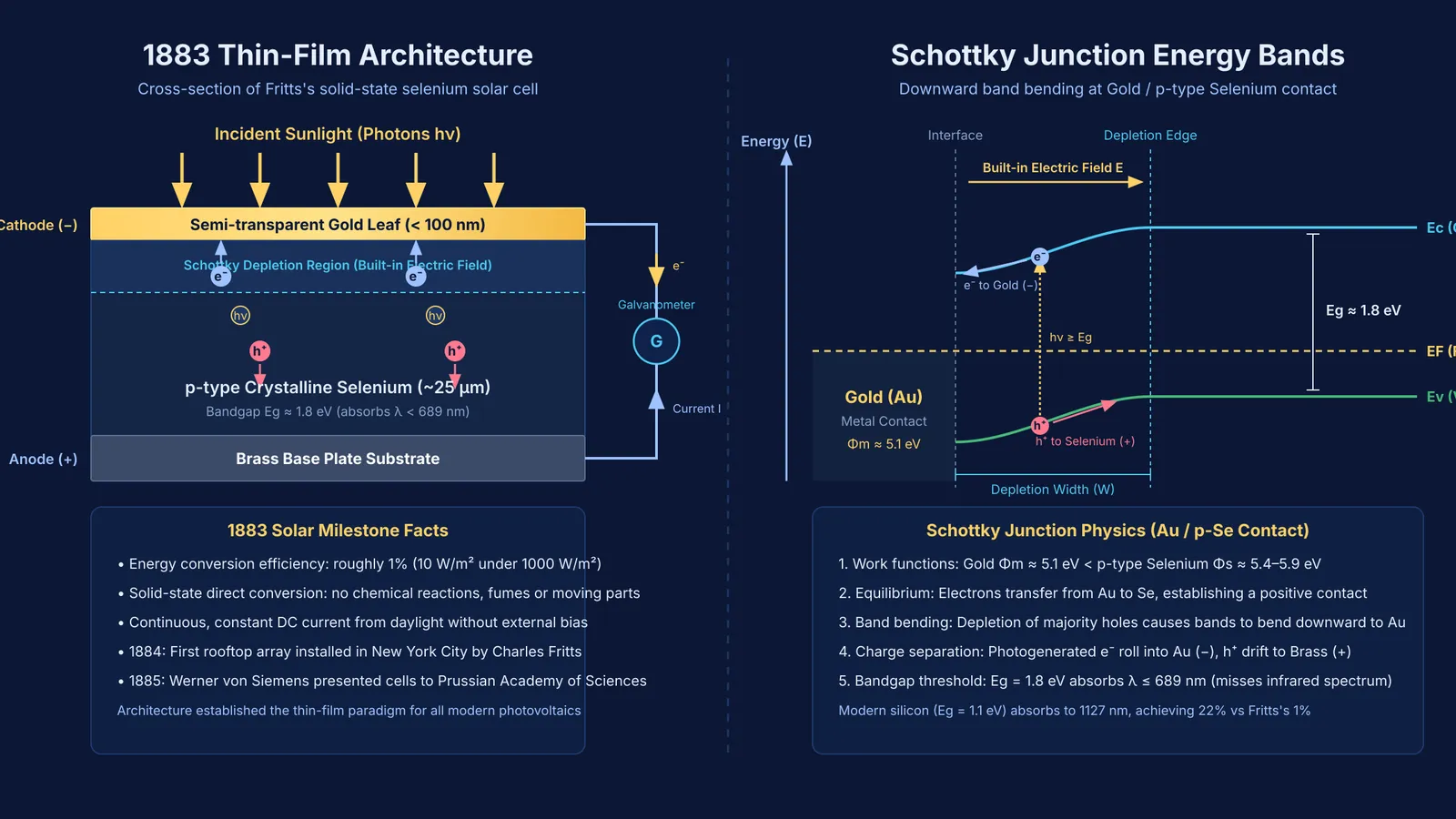
Fritts solved this geometric bottleneck by designing a thin-film sandwich. In his December 1883 paper in the American Journal of Science, he explained how he melted a thin layer of selenium onto a brass base plate, spreading it to a thickness of roughly 25 micrometres. He heated the plate and cooled it slowly under pressure, annealing the substance into its conductive, gray crystalline allotrope.
To collect current across the entire illuminated surface without blocking sunlight, Fritts applied an ultra-thin layer of gold leaf over the selenium. Gold leaf beaten to a thickness under 100 nanometres is semi-transparent, transmitting visible light while maintaining high electrical conductivity. Sunlight passed directly through the gold leaf into the junction, and photogenerated charges moved only micrometres to reach the metal electrodes.
What was the efficiency of the first solar cell?
Fritts measured the energy conversion efficiency of his selenium cells at roughly 1 percent, as documented by Smithsonian Magazine. In 1884, he assembled several panels on a New York rooftop, creating the world's first rooftop solar array. He sent sample cells to German industrialist Werner von Siemens, who presented them to the Royal Prussian Academy of Sciences in Berlin in 1885, hailing the direct conversion of light into electricity.
To understand what 1 percent efficiency means in practice, consider standard solar irradiance on Earth, which is approximately 1,000 W/m² under clear midday sun:
Electrical power output equals irradiance multiplied by cell efficiency and surface area: P = S × η × A.
For Fritts's cell with η = 1% (0.01) across 1 m², the power generated is 1,000 W/m² × 0.01 × 1 m² = 10 W.
For a modern monocrystalline silicon panel with η = 22% (0.22) across 1 m², the power generated is 1,000 W/m² × 0.22 × 1 m² = 220 W.
Modern silicon panels generate 22 times more electrical power per unit area than Fritts's prototype. Much of this difference stems from semiconductor bandgaps. Crystalline selenium has an energy bandgap of approximately 1.8 eV, meaning it absorbs only photons with wavelengths shorter than 689 nm (λ = 1240 / 1.8 nm). It misses the entire infrared band, which carries roughly half of solar energy. By contrast, silicon has a narrower bandgap of 1.1 eV, absorbing wavelengths up to 1127 nm.
If you are practicing semiconductor calculations or exploring photodiode, LED and solar cell I-V characteristics, the Fermi Problem Library offers worked problems with a step-by-step solver that explains the reasoning rather than printing an answer.
Why did solid-state solar take 70 years to reach rooftops?
Despite Fritts's enthusiasm, selenium solar cells could not compete with 19th-century steam turbines and coal generators. Gold leaf was expensive, and pure selenium was rare and difficult to standardize. Because quantum mechanics and solid-state band theory did not exist in the 1880s, inventors had no theoretical model to optimize doping or carrier lifetimes. Instead, selenium cells found a niche as photographic light meters, where durability and linear response mattered more than power output.
The real breakthrough in power generation arrived only in 1954, when Daryl Chapin, Calvin Fuller, and Gerald Pearson developed the Bell Labs' 1954 silicon solar cell. Described in the Journal of Applied Physics, their diffused silicon p-n junction achieved 6 percent efficiency, later climbing above 20 percent. Yet every modern photovoltaic module, from rooftop arrays to orbital satellites, traces its architectural lineage to Charles Fritts's 1883 thin-film sandwich.


