On this page
When you write H₂O for water or CO₂ for carbon dioxide, you are using a system invented by one person: Swedish chemist Jöns Jacob Berzelius. Born in 1779, Berzelius was one of the founders of modern chemistry. He did not just write the alphabet of chemistry; he found several of the letters.
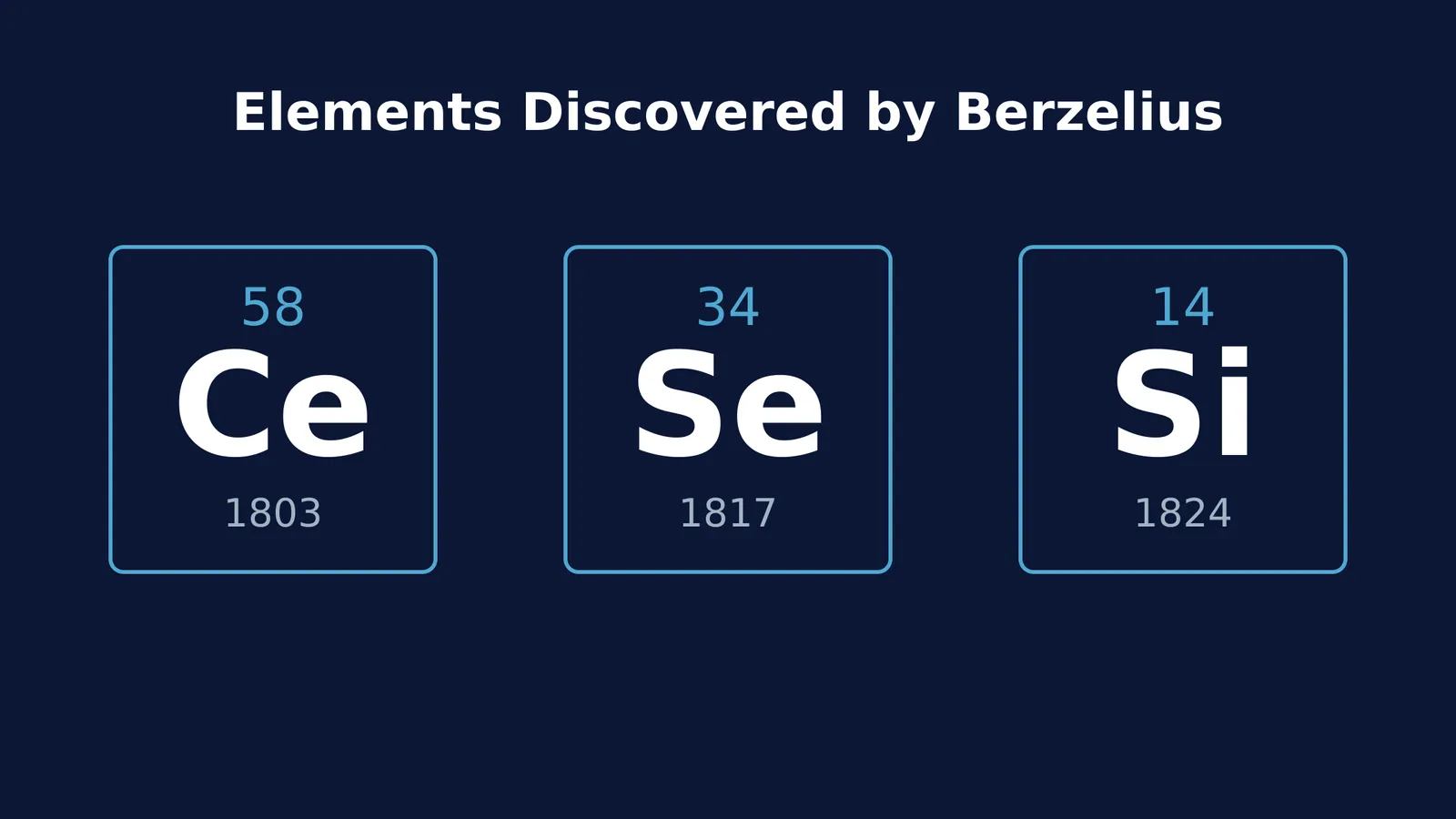
His early life was marked by hardship. Orphaned by the age of eight, he was raised by relatives and worked as a pharmacy apprentice. Despite these struggles, his careful experiments led to the discovery of cerium and selenium. He was also the first to isolate pure silicon—the element that now sits at the heart of every computer chip.
How did Berzelius invent chemical symbols?
Before Berzelius, chemists used a confusing mix of symbols. In 1808, John Dalton, who proposed modern atomic theory, used circles with dots, lines or letters inside them to represent atoms. Oxygen was an empty circle; carbon was a solid black circle; hydrogen was a circle with a dot. Dalton's system was hard to draw, hard for printing presses to reproduce, and became a mess when showing complex molecules.
In 1813, Berzelius published a simpler idea in the *Annals of Philosophy*. He threw away the pictures and used the alphabet. Each element would be represented by the first letter of its Latin name, and a second lowercase letter if needed to tell two apart. Iron became Fe (from *ferrum*), oxygen became O, and carbon became C.
He also introduced numbers to show how many atoms of each element were in a compound. Berzelius originally used superscripts, writing water as H²O, but the scientific world later shifted to the subscripts we use today (H₂O). (For more on how we proved atoms exist, see Jean Perrin and the proof that atoms exist, grain by grain.)
How did Berzelius discover cerium and selenium?
Berzelius was a relentless experimenter who carefully analysed minerals and industrial waste. Using his meticulous methods, he determined the atomic weights of nearly all 45 elements known at the time. By establishing oxygen as a reference point (set to 100), he provided the rigorous evidence needed to support Dalton’s atomic theory.
In 1803, working with Wilhelm Hisinger, he examined an unusually heavy mineral called cerite from a Swedish mine in Bastnäs. They dissolved the mineral in a mix of nitric and hydrochloric acids, then added ammonia to precipitate out the unknown substance. They had found a new element, which they named cerium after the asteroid Ceres, discovered just two years earlier.
Fourteen years later, in 1817, Berzelius was looking at a red sludge left behind in the lead chambers of a sulfuric acid factory in Gripsholm, Sweden. The factory workers thought the smell came from tellurium, a rare element named after the Earth (*Tellus*). Berzelius dissolved the sludge and treated it with sulfur dioxide gas, which forced a red powder to precipitate out.
The powder was not tellurium, but a completely new element with similar properties. Following the naming theme, Berzelius called it selenium, from the Greek word *selene*, meaning the Moon.
If you ever get stuck memorising elements and their reactions, the Fermi Concept Library contains every concept in physics, chemistry, biology, mathematics and computing, each with its own lesson and its place in the map.
How did Berzelius isolate silicon?
Chemists already knew about "silica"—silicon dioxide, the main compound in sand and quartz. But stripping the oxygen away to leave pure silicon proved difficult. Other chemists had tried and failed.
In 1824, Berzelius finally succeeded. He took potassium fluorosilicate and heated it with potassium metal in a tube. The potassium ripped the fluorine away to form potassium fluoride, leaving silicon behind.
Berzelius washed the mixture with water. The potassium fluoride dissolved, and a brown, amorphous powder remained. He had isolated pure silicon. He noted that the powder resisted almost all acids and only burned in oxygen at a white heat. Today, that same element is purified into crystals and sliced into wafers to make the transistors in your phone and computer. (Read about another chemist who shaped the periodic table: Lothar Meyer and the atomic volume curve of the elements.)
When calculating the mass of products in a reaction like this, a single mistake can ruin the answer. The Fermi Problem Library has worked problems with a step-by-step solver that explains the reasoning rather than printing an answer.
Beyond his discoveries, Berzelius coined words we still use today, including *polymer*, *isomer* and *catalysis*. From 1818 to 1848, he served as the secretary of the Royal Swedish Academy of Sciences, revitalising the institution and guiding the progress of modern chemistry. But his most visible legacy is on every chemistry blackboard in the world: the simple, logical letters that let us write the recipe for matter.