

On this page
In the early 1860s a London astronomer with a private observatory worked out what distant stars are made of, using light that reached him at home. William Huggins had built an observatory attached to his house at Tulse Hill in 1856, according to the Dictionary of National Biography entry on Huggins.
What clue did Huggins start from?
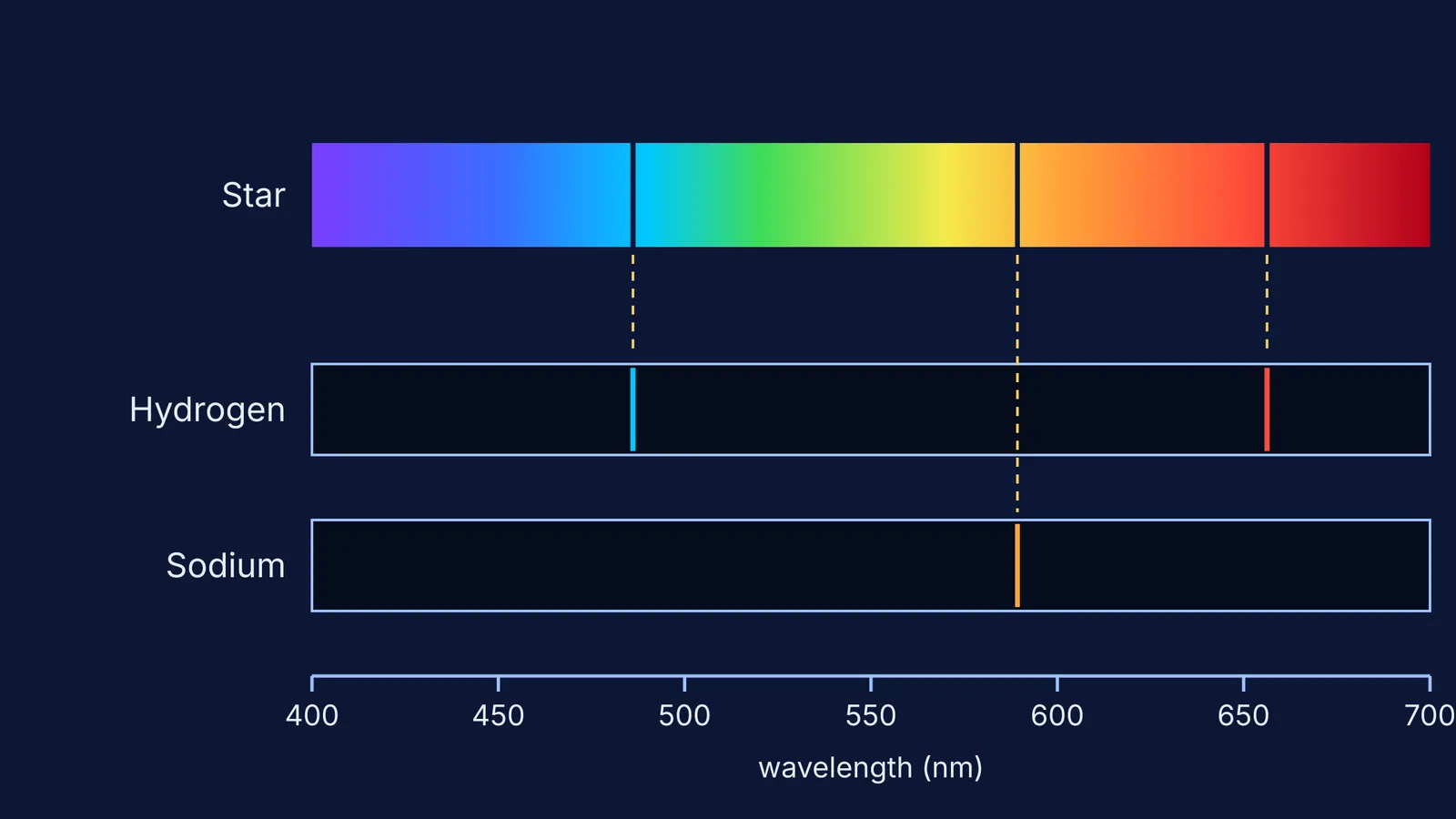
Sunlight spread into a rainbow by a prism is crossed by thin dark lines. William Hyde Wollaston first noticed them in 1802, and Joseph von Fraunhofer began measuring them systematically in 1814, as the Wikipedia article on Fraunhofer lines records. About 45 years later, Gustav Kirchhoff and Robert Bunsen noticed that several of these dark lines coincide with the bright lines given off by heated elements in a lab.
The idea is simple: a gas absorbs the same colours of light that it emits when hot. So each dark line in a spectrum is a fingerprint of the element that absorbed it. The DNB says Kirchhoff's reading of the Sun's chemistry "turned Huggins's attention in a new and more fruitful direction". If it worked for the Sun, why not for the stars?
How did William Huggins find what stars are made of?
Huggins teamed up with his neighbour William Allen Miller, a professor of chemistry at King's College London. Their 1864 paper, On the spectra of some of the fixed stars in the Philosophical Transactions, opens by saying that Kirchhoff's discovery gave experimenters a method of analysis "not rendered less certain by the distance of the objects".
The method had three parts, described in their shorter Royal Society account of the apparatus:
A telescope with an 8-inch lens, driven by clockwork so the star stayed in view.
A spectroscope with two dense flint-glass prisms to spread the starlight into a spectrum.
A spark jumping between electrodes of a chosen metal, whose bright lines were viewed at the same time as the star's spectrum.
With the lab lines and the star lines seen together, any match or mismatch was plain to see.
What did they find in Aldebaran and Betelgeuse?
The full text of the 1864 paper gives the results star by star. In Aldebaran they measured about seventy lines. They found coincidences for "sodium, magnesium, hydrogen, calcium, iron, bismuth, tellurium, antimony, and mercury". Nitrogen, cobalt, tin, lead, cadmium, lithium and barium showed no match.
In Betelgeuse (alpha Orionis) they measured about eighty lines and matched sodium, magnesium, calcium, iron and bismuth. Here the absences mattered just as much. They found no line at the red C line of hydrogen and none at F. In Sirius, by contrast, both hydrogen lines were "intensely strong".
They examined nearly 50 stars in all. Their conclusion was careful: the stars differ "the one from the other in the kinds of matter of which they consist", but are "composed of matter identical, at least in part, with the materials of our system".
Where does Margaret Huggins fit in?
Margaret Lindsay Murray married William in 1875, more than a decade after the first star papers. The Wikipedia biography of Margaret Lindsay Huggins notes that they began photographing spectra in 1875. It also says they were the first to observe and identify the series of hydrogen lines in the spectrum of Vega. The DNB calls her his "devoted and helpful coadjutor". Their joint Atlas of Representative Stellar Spectra, covering wavelengths from 4870 to 3300 angstroms, is dated 1899 by Wikipedia and 1900 by the DNB. Photography meant spectra could be kept, measured and checked later, rather than sketched by eye at the telescope.
How can you match spectral lines yourself?
This is the same reasoning you use for spectra questions in Class 11 chemistry and physics. Try it with real wavelengths from the Fraunhofer lines table.
Suppose a star shows dark lines at 486.1 nm, 589.0 nm, 589.6 nm and 656.3 nm. Your lab list says hydrogen glows at 486.134 nm and 656.281 nm, and sodium at 588.995 nm and 589.592 nm.
Line up each star line with the nearest lab line.
Check the gap. All four gaps here are under 0.1 nm.
Ask whether the full set appears. Both hydrogen lines match, and both sodium lines match, so you can claim both elements.
Write down what is missing too. If 656.3 nm and 486.1 nm were absent, as the C and F lines were in Betelgeuse, you would not claim hydrogen.
A single match can be chance. A pattern of matches is evidence. That is the habit worth taking from Huggins.
If absorption and emission still feel abstract, the Fermi Simulation Lab has interactive simulations for ideas that are easier to see than to read. To revise atomic spectra from the ground up, each concept has its own lesson in the Fermi Concept Library.
To keep going, read about Henry Draper and the first photograph of a star's spectrum, Angelo Secchi's first classification of star spectra, and Johannes Rydberg's formula for spectral lines.


