

On this page
Years earlier, scientists had mapped the dark lines in sunlight, but no one knew what caused them. In 1885, Swiss mathematician Johann Jakob Balmer published an empirical formula that accurately predicted the four visible lines of the hydrogen spectrum. However, his equation was limited—it only worked for those specific visible lines and could not explain the invisible emissions in the ultraviolet and infrared ranges.
Johannes Rydberg, a mathematician who became a physics lecturer at Lund University in Sweden, sought a more universal rule. He was driven by a deep philosophical conviction that the physical properties of elements were not random but followed a rigorous mathematical harmony.
Why did Rydberg use wavenumbers instead of wavelength?
Rydberg's genius insight was a simple shift in perspective: instead of looking at the wavelength (λ) of the light, he used the wavenumber. The wavenumber (1/λ) is the number of waves that fit into a unit of distance.
By plotting wavenumbers, Rydberg found that the lines in a spectral series formed a much simpler, linear pattern. He realised that the wavenumber of any spectral line could be written as the difference between two terms: a constant term for that specific series, and a variable term that changed with an integer.
He presented this breakthrough in 1888 and published his major work, *Recherches sur la constitution des spectres d'émission des éléments chimiques*, in 1890. His formula included a fundamental constant that was nearly identical for all elements. Today, we call this the Rydberg constant (R_H), which is approximately 1.097 × 10⁷ m⁻¹.
What is the Rydberg formula for the hydrogen spectrum?
For hydrogen, Rydberg's generalized formula is:
1/λ = R_H × (1/n₁² - 1/n₂²)
Here, R_H is the Rydberg constant, n₁ is the lower level, and n₂ is the higher level (where n₂ > n₁).
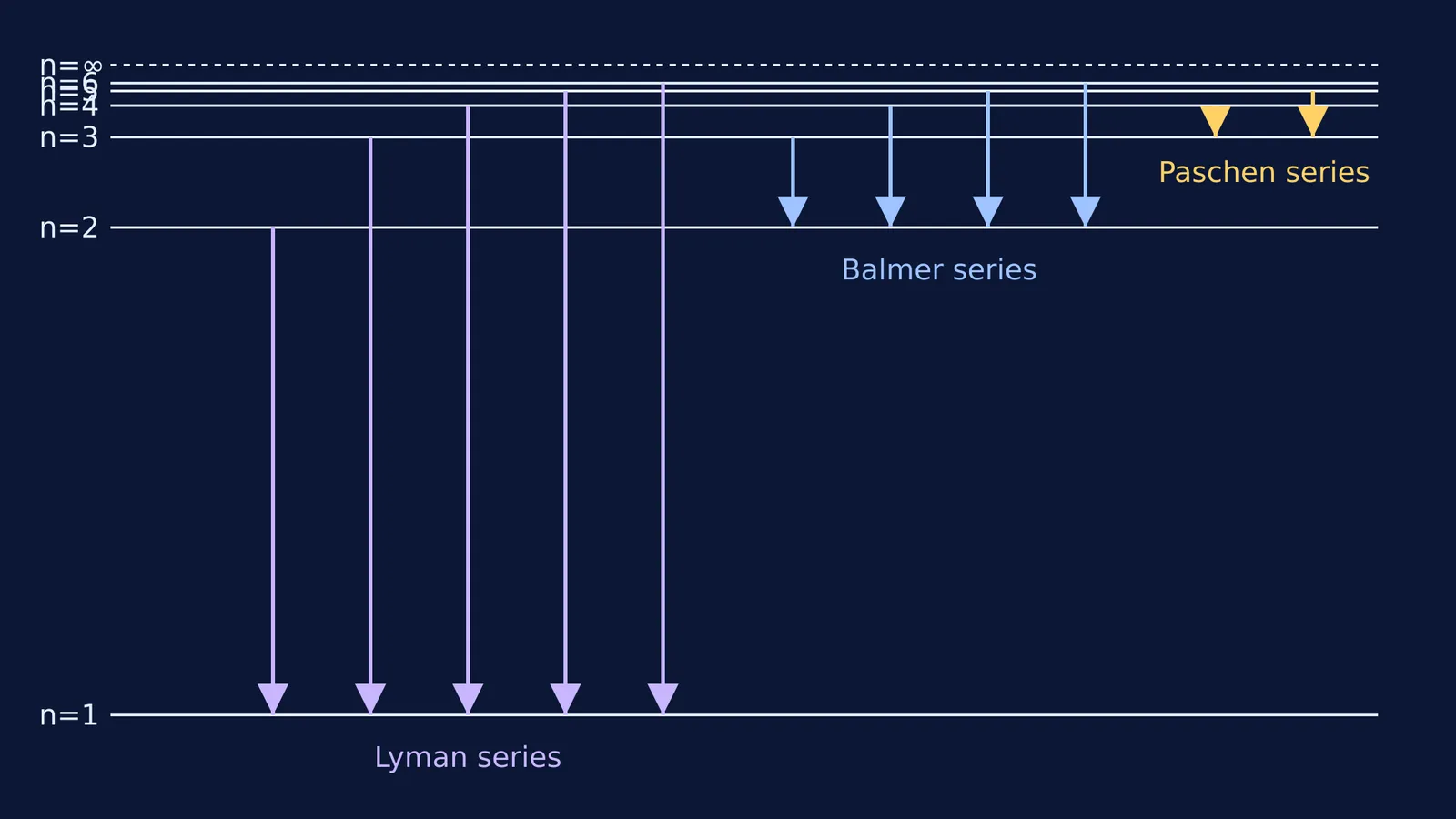
This single equation elegantly described all the known (and yet-to-be-discovered) spectral series of hydrogen:
Lyman series (ultraviolet): n₁ = 1
Balmer series (visible): n₁ = 2
Paschen series (infrared): n₁ = 3
How did the Rydberg formula pave the way for the Bohr model?
Rydberg had discovered the "Rosetta Stone" of atomic spectra, but the physical reason behind the integers n₁ and n₂ remained a mystery.
In 1913, Niels Bohr used Rydberg's formula to build his quantum model of the atom. Bohr demonstrated that n₁ and n₂ were not arbitrary numbers; they represented discrete, quantized orbits for electrons. The wavenumber was directly proportional to the energy released when an atom emits a photon as an electron drops from a higher orbit to a lower one.
When you practice atomic physics in the Fermi Problem Library, the AI tutor shows how these electron jumps translate directly into energy differences without getting lost in the arithmetic, giving you a clear next step.
How do you solve Rydberg formula problems quickly?
If you are preparing for exams like JEE or NEET, manually calculating 1/λ with R_H = 1.097 × 10⁷ m⁻¹ can consume too much time.
Here is a practical shortcut: instead of multiplying by R_H and then taking the reciprocal to find the wavelength, you can memorize that 1/R_H ≈ 91.1 nm (or 911 Å).
You can rewrite the formula to solve for λ directly:
λ (in nm) = 91.1 / (1/n₁² - 1/n₂²)
Worked Example: Find the wavelength of the first line of the Balmer series (an electron falling from n₂ = 3 to n₁ = 2).
Calculate the bracketed term: (1/2² - 1/3²) = (1/4 - 1/9) = 5/36.
Multiply by the shortcut value: λ = 91.1 × (36 / 5) = 91.1 × 7.2 ≈ 656 nm. (This closely matches the 656.3 nm red light measured in hydrogen).
Alternatively, you can skip wavelengths entirely and calculate the transition energy. Using the photon energy formula, you know that E = 1240 / λ (with λ in nm). The energy levels of hydrogen are given by E_n = -13.6 / n² eV. The difference gives you the photon energy directly in electron-volts: E = 13.6 × (1/n₁² - 1/n₂²) eV.


